

82
exploded from deep layers on Spindletop near
Beaumont, Texas. Although scientists hoped that
oil could be used to feed engines like coal or even
better since oil burnt more effectively than coal
producing more energy, oil reserves in the world
are way too small to meet the growing energy
demand of humanity. The Hamill brothers drilled
a second well that produced 1000 barrels of oil in
a day and then a third, a fourth and a fifth one so
sceptics fell silent, speculators appeared and the
oil age was started.
Just like Newcomen’s engine set loose the
industrial revolution making coal mining much
cheaper than before, drillers and geological exploration made cheap oil available. New oil fields
were soon found flooding the market with tens of
millions of barrels of oil. As a result, coal users in
large numbers changed to the cheaper fuel. Steam
locomotives used oil, then shipping companies
realised that oil runs ships faster than coal and
needs less space as well. The dominance of oil,
however, was founded on feeding the petrolfuelled engines. Greater volume of resources
intensified their utilisation and demand grew rapidly as in the case of coal but even faster. As oil
consumption grew to 1.25 million barrels a day in
1915 and to 4 million barrels by 1929 oil companies explored farther in more distant regions.
Possession of oil became power, so great that
not only companies competed against each other
but countries, peoples or interest groups made
war to own reservoirs, mining rights, markets or
distribution rights. In the second half of the twentieth century oil became a policy-forming factor
that even determined the operation of the global
society and thus the lifestyle of ordinary people.
Oil became the focus of world politics within
a very short period of time. Major powers of the
world fought for colonies rich in sugar, tea and
slaves in the nineteenth century while in the
twentieth century oil was the most important.
Certain governments with the help of international oil companies ruled over vulnerable oil
producing countries like Venezuela, Mexico and
of course the Middle East where European and
US diplomats drew maps and state borders in
order to obtain as much oil as possible. One
French diplomat stated that “who owns oil rules
the world” (O’Connor 1955).
Oil economy and the leading role of the USA
in it were always based on continuous supply. For
growing demands further fields had to be explored
and more oil had to be produced. This became
uncertain in time, continuous supply was not possible to be guaranteed. In the second half of the
twentieth century the first global oil cartel was
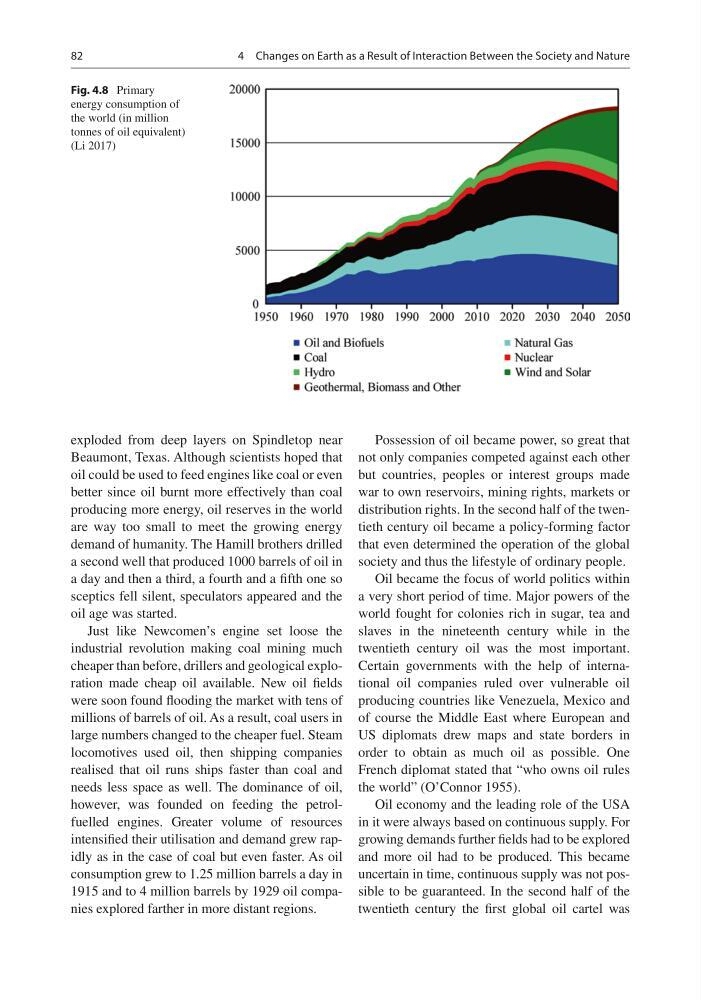
Fig. 4.8 Primary
energy consumption of
the world (in million
tonnes of oil equivalent)
(Li 2017)
4 Changes on Earth as a Result of Interaction Between the Society and Nature
exploded from deep layers on Spindletop near
Beaumont, Texas. Although scientists hoped that
oil could be used to feed engines like coal or even
better since oil burnt more effectively than coal
producing more energy, oil reserves in the world
are way too small to meet the growing energy
demand of humanity. The Hamill brothers drilled
a second well that produced 1000 barrels of oil in
a day and then a third, a fourth and a fifth one so
sceptics fell silent, speculators appeared and the
oil age was started.
Just like Newcomen’s engine set loose the
industrial revolution making coal mining much
cheaper than before, drillers and geological exploration made cheap oil available. New oil fields
were soon found flooding the market with tens of
millions of barrels of oil. As a result, coal users in
large numbers changed to the cheaper fuel. Steam
locomotives used oil, then shipping companies
realised that oil runs ships faster than coal and
needs less space as well. The dominance of oil,
however, was founded on feeding the petrolfuelled engines. Greater volume of resources
intensified their utilisation and demand grew rapidly as in the case of coal but even faster. As oil
consumption grew to 1.25 million barrels a day in
1915 and to 4 million barrels by 1929 oil companies explored farther in more distant regions.
Possession of oil became power, so great that
not only companies competed against each other
but countries, peoples or interest groups made
war to own reservoirs, mining rights, markets or
distribution rights. In the second half of the twentieth century oil became a policy-forming factor
that even determined the operation of the global
society and thus the lifestyle of ordinary people.
Oil became the focus of world politics within
a very short period of time. Major powers of the
world fought for colonies rich in sugar, tea and
slaves in the nineteenth century while in the
twentieth century oil was the most important.
Certain governments with the help of international oil companies ruled over vulnerable oil
producing countries like Venezuela, Mexico and
of course the Middle East where European and
US diplomats drew maps and state borders in
order to obtain as much oil as possible. One
French diplomat stated that “who owns oil rules
the world” (O’Connor 1955).
Oil economy and the leading role of the USA
in it were always based on continuous supply. For
growing demands further fields had to be explored
and more oil had to be produced. This became
uncertain in time, continuous supply was not possible to be guaranteed. In the second half of the
twentieth century the first global oil cartel was
Fig. 4.8 Primary
energy consumption of
the world (in million
tonnes of oil equivalent)
(Li 2017)
4 Changes on Earth as a Result of Interaction Between the Society and Nature