

72
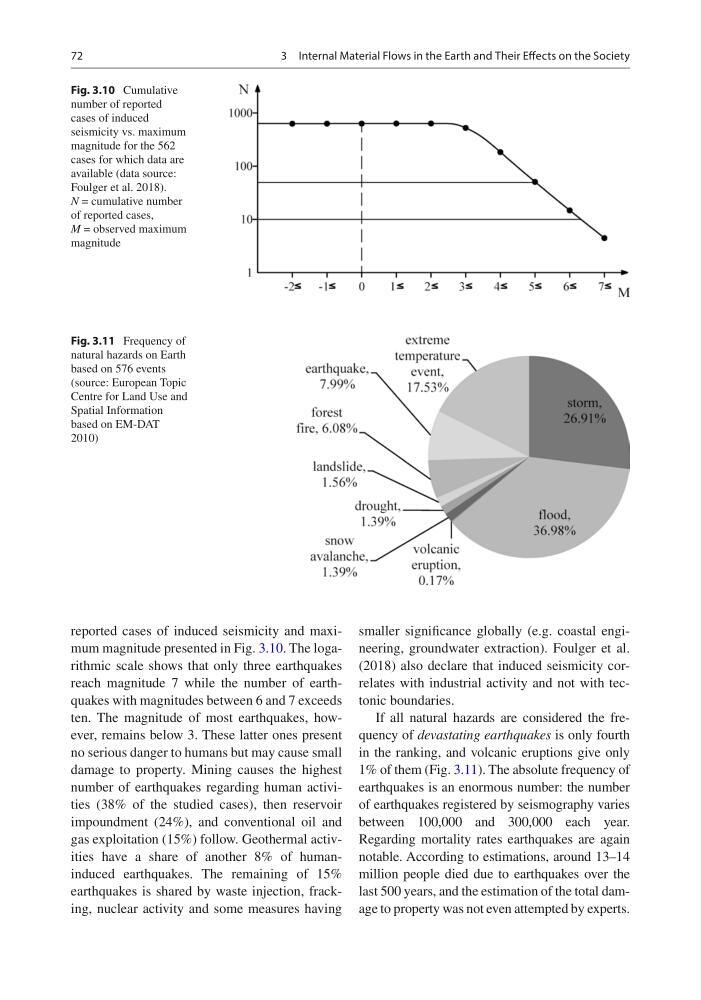
Fig. 3.11 Frequency of
natural hazards on Earth
based on 576 events
(source: European Topic
Centre for Land Use and
Spatial Information
based on EM-DAT
2010)
Fig. 3.10 Cumulative
number of reported
cases of induced
seismicity vs. maximum
magnitude for the 562
cases for which data are
available (data source:
Foulger et al. 2018).
N = cumulative number
of reported cases,
M = observed maximum
magnitude
reported cases of induced seismicity and maximum magnitude presented in Fig. 3.10. The logarithmic scale shows that only three earthquakes
reach magnitude 7 while the number of earthquakes with magnitudes between 6 and 7 exceeds
ten. The magnitude of most earthquakes, however, remains below 3. These latter ones present
no serious danger to humans but may cause small
damage to property. Mining causes the highest
number of earthquakes regarding human activities (38% of the studied cases), then reservoir
impoundment (24%), and conventional oil and
gas exploitation (15%) follow. Geothermal activities have a share of another 8% of humaninduced earthquakes. The remaining of 15%
earthquakes is shared by waste injection, fracking, nuclear activity and some measures having
smaller significance globally (e.g. coastal engineering, groundwater extraction). Foulger et al.
(2018) also declare that induced seismicity correlates with industrial activity and not with tectonic boundaries.
If all natural hazards are considered the frequency of devastating earthquakes is only fourth
in the ranking, and volcanic eruptions give only
1% of them (Fig. 3.11). The absolute frequency of
earthquakes is an enormous number: the number
of earthquakes registered by seismography varies
between 100,000 and 300,000 each year.
Regarding mortality rates earthquakes are again
notable. According to estimations, around 13–14
million people died due to earthquakes over the
last 500 years, and the estimation of the total damage to property was not even attempted by experts.
3 Internal Material Flows in the Earth and Their Effects on the Society
Fig. 3.11 Frequency of
natural hazards on Earth
based on 576 events
(source: European Topic
Centre for Land Use and
Spatial Information
based on EM-DAT
2010)
Fig. 3.10 Cumulative
number of reported
cases of induced
seismicity vs. maximum
magnitude for the 562
cases for which data are
available (data source:
Foulger et al. 2018).
N = cumulative number
of reported cases,
M = observed maximum
magnitude
reported cases of induced seismicity and maximum magnitude presented in Fig. 3.10. The logarithmic scale shows that only three earthquakes
reach magnitude 7 while the number of earthquakes with magnitudes between 6 and 7 exceeds
ten. The magnitude of most earthquakes, however, remains below 3. These latter ones present
no serious danger to humans but may cause small
damage to property. Mining causes the highest
number of earthquakes regarding human activities (38% of the studied cases), then reservoir
impoundment (24%), and conventional oil and
gas exploitation (15%) follow. Geothermal activities have a share of another 8% of humaninduced earthquakes. The remaining of 15%
earthquakes is shared by waste injection, fracking, nuclear activity and some measures having
smaller significance globally (e.g. coastal engineering, groundwater extraction). Foulger et al.
(2018) also declare that induced seismicity correlates with industrial activity and not with tectonic boundaries.
If all natural hazards are considered the frequency of devastating earthquakes is only fourth
in the ranking, and volcanic eruptions give only
1% of them (Fig. 3.11). The absolute frequency of
earthquakes is an enormous number: the number
of earthquakes registered by seismography varies
between 100,000 and 300,000 each year.
Regarding mortality rates earthquakes are again
notable. According to estimations, around 13–14
million people died due to earthquakes over the
last 500 years, and the estimation of the total damage to property was not even attempted by experts.
3 Internal Material Flows in the Earth and Their Effects on the Society