

71
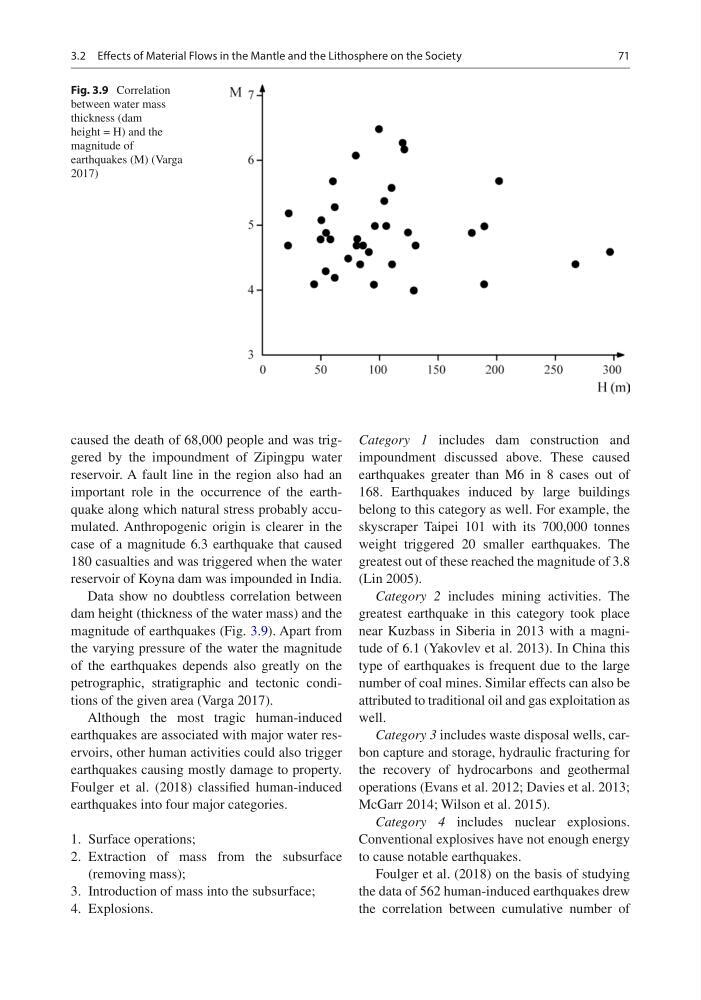
Fig. 3.9 Correlation
between water mass
thickness (dam
height = H) and the
magnitude of
earthquakes (M) (Varga
2017)
caused the death of 68,000 people and was triggered by the impoundment of Zipingpu water
reservoir. A fault line in the region also had an
important role in the occurrence of the earthquake along which natural stress probably accumulated. Anthropogenic origin is clearer in the
case of a magnitude 6.3 earthquake that caused
180 casualties and was triggered when the water
reservoir of Koyna dam was impounded in India.
Data show no doubtless correlation between
dam height (thickness of the water mass) and the
magnitude of earthquakes (Fig. 3.9). Apart from
the varying pressure of the water the magnitude
of the earthquakes depends also greatly on the
petrographic, stratigraphic and tectonic conditions of the given area (Varga 2017).
Although the most tragic human-induced
earthquakes are associated with major water reservoirs, other human activities could also trigger
earthquakes causing mostly damage to property.
Foulger et al. (2018) classified human-induced
earthquakes into four major categories.
1. Surface operations;
2. Extraction of mass from the subsurface
(removing mass);
3. Introduction of mass into the subsurface;
4. Explosions.
Category 1 includes dam construction and
impoundment discussed above. These caused
earthquakes greater than M6 in 8 cases out of
168. Earthquakes induced by large buildings
belong to this category as well. For example, the
skyscraper Taipei 101 with its 700,000 tonnes
weight triggered 20 smaller earthquakes. The
greatest out of these reached the magnitude of 3.8
(Lin 2005).
Category 2 includes mining activities. The
greatest earthquake in this category took place
near Kuzbass in Siberia in 2013 with a magnitude of 6.1 (Yakovlev et al. 2013). In China this
type of earthquakes is frequent due to the large
number of coal mines. Similar effects can also be
attributed to traditional oil and gas exploitation as
well.
Category 3 includes waste disposal wells, carbon capture and storage, hydraulic fracturing for
the recovery of hydrocarbons and geothermal
operations (Evans et al. 2012; Davies et al. 2013;
McGarr 2014; Wilson et al. 2015).
Category 4 includes nuclear explosions.
Conventional explosives have not enough energy
to cause notable earthquakes.
Foulger et al. (2018) on the basis of studying
the data of 562 human-induced earthquakes drew
the correlation between cumulative number of
3.2 Effects of Material Flows in the Mantle and the Lithosphere on the Society
Fig. 3.9 Correlation
between water mass
thickness (dam
height = H) and the
magnitude of
earthquakes (M) (Varga
2017)
caused the death of 68,000 people and was triggered by the impoundment of Zipingpu water
reservoir. A fault line in the region also had an
important role in the occurrence of the earthquake along which natural stress probably accumulated. Anthropogenic origin is clearer in the
case of a magnitude 6.3 earthquake that caused
180 casualties and was triggered when the water
reservoir of Koyna dam was impounded in India.
Data show no doubtless correlation between
dam height (thickness of the water mass) and the
magnitude of earthquakes (Fig. 3.9). Apart from
the varying pressure of the water the magnitude
of the earthquakes depends also greatly on the
petrographic, stratigraphic and tectonic conditions of the given area (Varga 2017).
Although the most tragic human-induced
earthquakes are associated with major water reservoirs, other human activities could also trigger
earthquakes causing mostly damage to property.
Foulger et al. (2018) classified human-induced
earthquakes into four major categories.
1. Surface operations;
2. Extraction of mass from the subsurface
(removing mass);
3. Introduction of mass into the subsurface;
4. Explosions.
Category 1 includes dam construction and
impoundment discussed above. These caused
earthquakes greater than M6 in 8 cases out of
168. Earthquakes induced by large buildings
belong to this category as well. For example, the
skyscraper Taipei 101 with its 700,000 tonnes
weight triggered 20 smaller earthquakes. The
greatest out of these reached the magnitude of 3.8
(Lin 2005).
Category 2 includes mining activities. The
greatest earthquake in this category took place
near Kuzbass in Siberia in 2013 with a magnitude of 6.1 (Yakovlev et al. 2013). In China this
type of earthquakes is frequent due to the large
number of coal mines. Similar effects can also be
attributed to traditional oil and gas exploitation as
well.
Category 3 includes waste disposal wells, carbon capture and storage, hydraulic fracturing for
the recovery of hydrocarbons and geothermal
operations (Evans et al. 2012; Davies et al. 2013;
McGarr 2014; Wilson et al. 2015).
Category 4 includes nuclear explosions.
Conventional explosives have not enough energy
to cause notable earthquakes.
Foulger et al. (2018) on the basis of studying
the data of 562 human-induced earthquakes drew
the correlation between cumulative number of
3.2 Effects of Material Flows in the Mantle and the Lithosphere on the Society