

69
volcanoes become activated following major
earthquakes (Kundu et al. 2012).
Earthquakes with smaller energy are typical
for divergent plate boundaries, like along the
Mid-Atlantic Ridge in the Atlantic Ocean
(Fig. 3.8).
Earthquakes may appear within lithospheric
plates (intraplate earthquakes) with generally
medium or small energy quakes with shallow
focal depths (Stein et al. 2015). Several kinds of
reasons could trigger within plate quakes like
hot-spots under the plate, mass movements, etc.
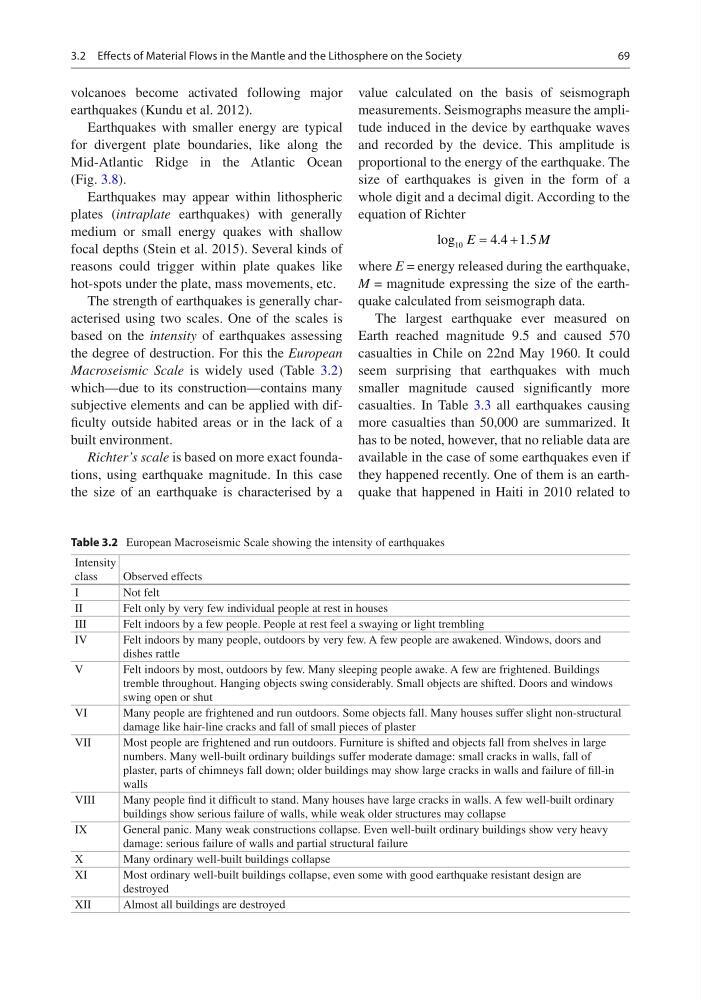
The strength of earthquakes is generally characterised using two scales. One of the scales is
based on the intensity of earthquakes assessing
the degree of destruction. For this the European
Macroseismic Scale is widely used (Table 3.2)
which—due to its construction—contains many
subjective elements and can be applied with difficulty outside habited areas or in the lack of a
built environment.
Richter’s scale is based on more exact foundations, using earthquake magnitude. In this case
the size of an earthquake is characterised by a
value calculated on the basis of seismograph
measurements. Seismographs measure the amplitude induced in the device by earthquake waves
and recorded by the device. This amplitude is
proportional to the energy of the earthquake. The
size of earthquakes is given in the form of a
whole digit and a decimal digit. According to the
equation of Richter
log
.
.
10
4 4 1 5
E
M
=
+
where E = energy released during the earthquake,
M = magnitude expressing the size of the earthquake calculated from seismograph data.
The largest earthquake ever measured on
Earth reached magnitude 9.5 and caused 570
casualties in Chile on 22nd May 1960. It could
seem surprising that earthquakes with much
smaller magnitude caused significantly more
casualties. In Table 3.3 all earthquakes causing
more casualties than 50,000 are summarized. It
has to be noted, however, that no reliable data are
available in the case of some earthquakes even if
they happened recently. One of them is an earthquake that happened in Haiti in 2010 related to
Table 3.2 European Macroseismic Scale showing the intensity of earthquakes
Intensity
class
Observed effects
I
Not felt
II
Felt only by very few individual people at rest in houses
III
Felt indoors by a few people. People at rest feel a swaying or light trembling
IV
Felt indoors by many people, outdoors by very few. A few people are awakened. Windows, doors and
dishes rattle
V
Felt indoors by most, outdoors by few. Many sleeping people awake. A few are frightened. Buildings
tremble throughout. Hanging objects swing considerably. Small objects are shifted. Doors and windows
swing open or shut
VI
Many people are frightened and run outdoors. Some objects fall. Many houses suffer slight non-structural
damage like hair-line cracks and fall of small pieces of plaster
VII
Most people are frightened and run outdoors. Furniture is shifted and objects fall from shelves in large
numbers. Many well-built ordinary buildings suffer moderate damage: small cracks in walls, fall of
plaster, parts of chimneys fall down; older buildings may show large cracks in walls and failure of fill-in
walls
VIII
Many people find it difficult to stand. Many houses have large cracks in walls. A few well-built ordinary
buildings show serious failure of walls, while weak older structures may collapse
IX
General panic. Many weak constructions collapse. Even well-built ordinary buildings show very heavy
damage: serious failure of walls and partial structural failure
X
Many ordinary well-built buildings collapse
XI
Most ordinary well-built buildings collapse, even some with good earthquake resistant design are
destroyed
XII
Almost all buildings are destroyed
3.2 Effects of Material Flows in the Mantle and the Lithosphere on the Society
volcanoes become activated following major
earthquakes (Kundu et al. 2012).
Earthquakes with smaller energy are typical
for divergent plate boundaries, like along the
Mid-Atlantic Ridge in the Atlantic Ocean
(Fig. 3.8).
Earthquakes may appear within lithospheric
plates (intraplate earthquakes) with generally
medium or small energy quakes with shallow
focal depths (Stein et al. 2015). Several kinds of
reasons could trigger within plate quakes like
hot-spots under the plate, mass movements, etc.
The strength of earthquakes is generally characterised using two scales. One of the scales is
based on the intensity of earthquakes assessing
the degree of destruction. For this the European
Macroseismic Scale is widely used (Table 3.2)
which—due to its construction—contains many
subjective elements and can be applied with difficulty outside habited areas or in the lack of a
built environment.
Richter’s scale is based on more exact foundations, using earthquake magnitude. In this case
the size of an earthquake is characterised by a
value calculated on the basis of seismograph
measurements. Seismographs measure the amplitude induced in the device by earthquake waves
and recorded by the device. This amplitude is
proportional to the energy of the earthquake. The
size of earthquakes is given in the form of a
whole digit and a decimal digit. According to the
equation of Richter
log
.
.
10
4 4 1 5
E
M
=
+
where E = energy released during the earthquake,
M = magnitude expressing the size of the earthquake calculated from seismograph data.
The largest earthquake ever measured on
Earth reached magnitude 9.5 and caused 570
casualties in Chile on 22nd May 1960. It could
seem surprising that earthquakes with much
smaller magnitude caused significantly more
casualties. In Table 3.3 all earthquakes causing
more casualties than 50,000 are summarized. It
has to be noted, however, that no reliable data are
available in the case of some earthquakes even if
they happened recently. One of them is an earthquake that happened in Haiti in 2010 related to
Table 3.2 European Macroseismic Scale showing the intensity of earthquakes
Intensity
class
Observed effects
I
Not felt
II
Felt only by very few individual people at rest in houses
III
Felt indoors by a few people. People at rest feel a swaying or light trembling
IV
Felt indoors by many people, outdoors by very few. A few people are awakened. Windows, doors and
dishes rattle
V
Felt indoors by most, outdoors by few. Many sleeping people awake. A few are frightened. Buildings
tremble throughout. Hanging objects swing considerably. Small objects are shifted. Doors and windows
swing open or shut
VI
Many people are frightened and run outdoors. Some objects fall. Many houses suffer slight non-structural
damage like hair-line cracks and fall of small pieces of plaster
VII
Most people are frightened and run outdoors. Furniture is shifted and objects fall from shelves in large
numbers. Many well-built ordinary buildings suffer moderate damage: small cracks in walls, fall of
plaster, parts of chimneys fall down; older buildings may show large cracks in walls and failure of fill-in
walls
VIII
Many people find it difficult to stand. Many houses have large cracks in walls. A few well-built ordinary
buildings show serious failure of walls, while weak older structures may collapse
IX
General panic. Many weak constructions collapse. Even well-built ordinary buildings show very heavy
damage: serious failure of walls and partial structural failure
X
Many ordinary well-built buildings collapse
XI
Most ordinary well-built buildings collapse, even some with good earthquake resistant design are
destroyed
XII
Almost all buildings are destroyed
3.2 Effects of Material Flows in the Mantle and the Lithosphere on the Society