

68
the deep ocean bonds a vast amount of methane.
This special compound, however, is very sensitive to changes in temperature and pressure. If
heat, either from major deep sea volcanic eruptions or via the warming of the climate, gets
down to the deep zone of oceans (conveyor belt)
enormous amount of methane could be released.
Methane has a greenhouse potential 24–26 times
that of carbon dioxide and according to estimations, the carbon content of the methane hydrate
lying on the ocean floor can be between 1500 and
3000 Gt which is a multiple of the amount of
natural gas estimated in the earth crust (Flannery
2005).
If only 10% of the mentioned methane hydrate
released methane, the global warming of the climate would be accelerated dramatically posing
serious danger to the society. (Consequences of
the warming of the climate are discussed in Sect.
4.5.)
3.2.2 Effects of Earthquakes
on the Society
Apart from volcanic eruptions a number of other
material flows are active in the deep but solid layers of the earth crust and the lithospheric plates.
Typically, these movements are periodical: initially tension or compression stress is generated
in the rocks then suddenly movements take place
inducing vibration in the crust. The point where
an earthquake rupture starts is called the hypocentre the depth of which could be up to several
hundred kilometres below the surface. Depending
on the depth of the hypocentre (focal point)
earthquakes can be classified as shallow(70 km>), medium- (70–300 km), or deep-seated
(300–700 km). The point on the surface above
the hypocentre is called epicentre.
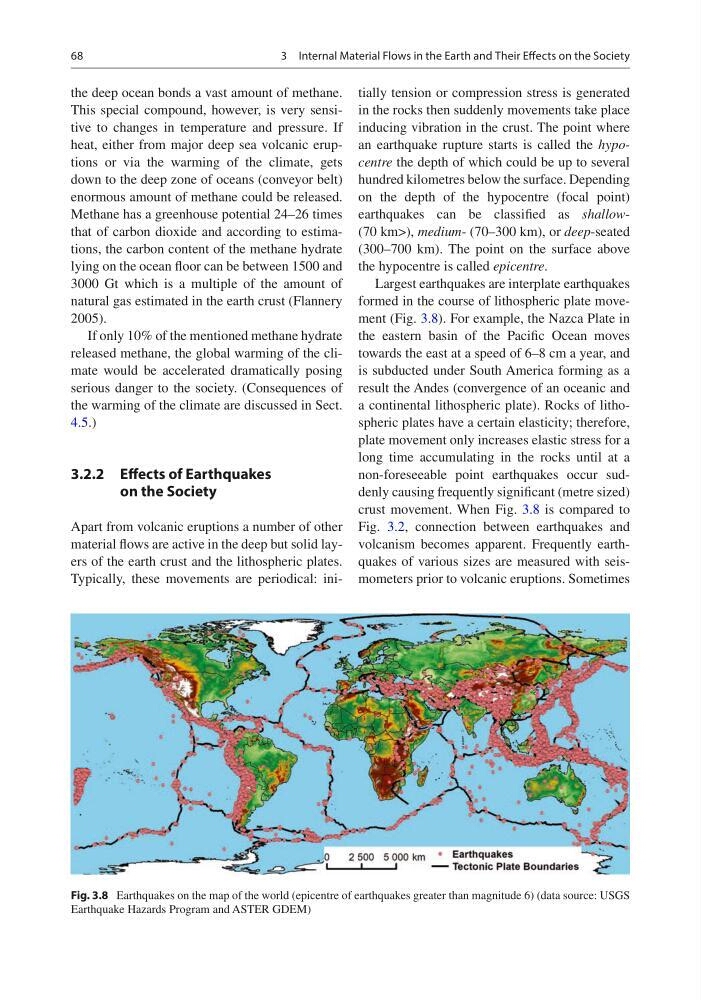
Largest earthquakes are interplate earthquakes
formed in the course of lithospheric plate movement (Fig. 3.8). For example, the Nazca Plate in
the eastern basin of the Pacific Ocean moves
towards the east at a speed of 6–8 cm a year, and
is subducted under South America forming as a
result the Andes (convergence of an oceanic and
a continental lithospheric plate). Rocks of lithospheric plates have a certain elasticity; therefore,
plate movement only increases elastic stress for a
long time accumulating in the rocks until at a
non-foreseeable point earthquakes occur suddenly causing frequently significant (metre sized)
crust movement. When Fig. 3.8 is compared to
Fig. 3.2, connection between earthquakes and
volcanism becomes apparent. Frequently earthquakes of various sizes are measured with seismometers prior to volcanic eruptions. Sometimes
Fig. 3.8 Earthquakes on the map of the world (epicentre of earthquakes greater than magnitude 6) (data source: USGS
Earthquake Hazards Program and ASTER GDEM)
3 Internal Material Flows in the Earth and Their Effects on the Society
the deep ocean bonds a vast amount of methane.
This special compound, however, is very sensitive to changes in temperature and pressure. If
heat, either from major deep sea volcanic eruptions or via the warming of the climate, gets
down to the deep zone of oceans (conveyor belt)
enormous amount of methane could be released.
Methane has a greenhouse potential 24–26 times
that of carbon dioxide and according to estimations, the carbon content of the methane hydrate
lying on the ocean floor can be between 1500 and
3000 Gt which is a multiple of the amount of
natural gas estimated in the earth crust (Flannery
2005).
If only 10% of the mentioned methane hydrate
released methane, the global warming of the climate would be accelerated dramatically posing
serious danger to the society. (Consequences of
the warming of the climate are discussed in Sect.
4.5.)
3.2.2 Effects of Earthquakes
on the Society
Apart from volcanic eruptions a number of other
material flows are active in the deep but solid layers of the earth crust and the lithospheric plates.
Typically, these movements are periodical: initially tension or compression stress is generated
in the rocks then suddenly movements take place
inducing vibration in the crust. The point where
an earthquake rupture starts is called the hypocentre the depth of which could be up to several
hundred kilometres below the surface. Depending
on the depth of the hypocentre (focal point)
earthquakes can be classified as shallow(70 km>), medium- (70–300 km), or deep-seated
(300–700 km). The point on the surface above
the hypocentre is called epicentre.
Largest earthquakes are interplate earthquakes
formed in the course of lithospheric plate movement (Fig. 3.8). For example, the Nazca Plate in
the eastern basin of the Pacific Ocean moves
towards the east at a speed of 6–8 cm a year, and
is subducted under South America forming as a
result the Andes (convergence of an oceanic and
a continental lithospheric plate). Rocks of lithospheric plates have a certain elasticity; therefore,
plate movement only increases elastic stress for a
long time accumulating in the rocks until at a
non-foreseeable point earthquakes occur suddenly causing frequently significant (metre sized)
crust movement. When Fig. 3.8 is compared to
Fig. 3.2, connection between earthquakes and
volcanism becomes apparent. Frequently earthquakes of various sizes are measured with seismometers prior to volcanic eruptions. Sometimes
Fig. 3.8 Earthquakes on the map of the world (epicentre of earthquakes greater than magnitude 6) (data source: USGS
Earthquake Hazards Program and ASTER GDEM)
3 Internal Material Flows in the Earth and Their Effects on the Society