

62
thousand years. Although it has not erupted
since then small lava flows under the sea indicate that it cannot be regarded inactive. Due to
such cases most scientists agree that volcanoes
are active if they erupted at least once in the
past ten thousand years or if they are expected
to erupt based on volcanological investigations.
Many scientists believe that volcanoes could
become reactivated after more than 10,000 years
in certain cases.
The size of volcanic eruptions is determined
on the basis of relatively complex formulae
which are outside the scope of this book. It is
worth nothing, however, that the size of an eruption is determined by three factors.
1. Magnitude (M) can be calculated on the basis
of the mass of material erupted.
2. Intensity (I): calculated on the basis of the
mass of material erupted per second (kg/s).
3. Explosivity: VEI (Volcanic Explosivity Index)
value calculated on the basis of several parameters (e.g. the height of the eruption cloud,
duration of eruption, volume of eruption products) (Newhall and Self 1982).
The destruction made by volcanic eruptions is
determined mostly by VEI. For example, magnitude could be high in the case of long-lasting fissure volcanic lava flows as well, but such eruptions
are less dangerous than explosive volcanism.
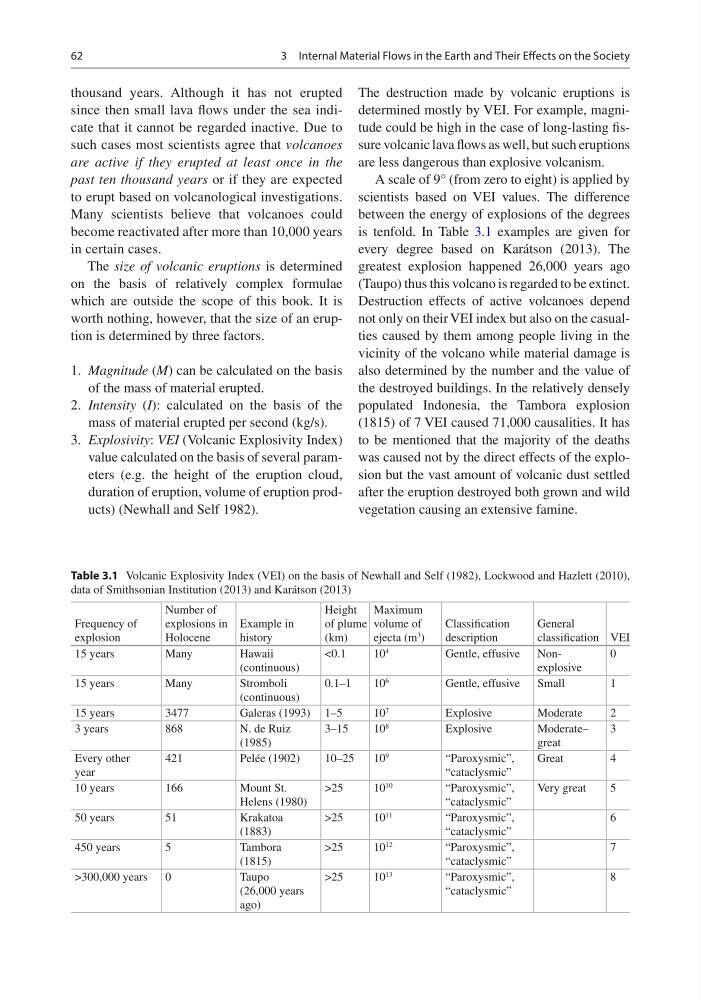
A scale of 9° (from zero to eight) is applied by
scientists based on VEI values. The difference
between the energy of explosions of the degrees
is tenfold. In Table 3.1 examples are given for
every degree based on Karátson (2013). The
greatest explosion happened 26,000 years ago
(Taupo) thus this volcano is regarded to be extinct.
Destruction effects of active volcanoes depend
not only on their VEI index but also on the casualties caused by them among people living in the
vicinity of the volcano while material damage is
also determined by the number and the value of
the destroyed buildings. In the relatively densely
populated Indonesia, the Tambora explosion
(1815) of 7 VEI caused 71,000 causalities. It has
to be mentioned that the majority of the deaths
was caused not by the direct effects of the explosion but the vast amount of volcanic dust settled
after the eruption destroyed both grown and wild
vegetation causing an extensive famine.
Table 3.1 Volcanic Explosivity Index (VEI) on the basis of Newhall and Self (1982), Lockwood and Hazlett (2010),
data of Smithsonian Institution (2013) and Karátson (2013)
Frequency of
explosion
Number of
explosions in
Holocene
Example in
history
Height
of plume
(km)
Maximum
volume of
ejecta (m
3 )
Classification
description
General
classification VEI
15 years
Many
Hawaii
(continuous)
<0.1
10
4
Gentle, effusive Nonexplosive
0
15 years
Many
Stromboli
(continuous)
0.1–1
10
6
Gentle, effusive Small
1
15 years
3477
Galeras (1993) 1–5
10
7
Explosive
Moderate
2
3 years
868
N. de Ruiz
(1985)
3–15
10
8
Explosive
Moderate–
great
3
Every other
year
421
Pelée (1902)
10–25
10
9
“Paroxysmic”,
“cataclysmic”
Great
4
10 years
166
Mount St.
Helens (1980)
>25
10
10
“Paroxysmic”,
“cataclysmic”
Very great
5
50 years
51
Krakatoa
(1883)
>25
10
11
“Paroxysmic”,
“cataclysmic”
6
450 years
5
Tambora
(1815)
>25
10
12
“Paroxysmic”,
“cataclysmic”
7
>300,000 years 0
Taupo
(26,000 years
ago)
>25
10
13
“Paroxysmic”,
“cataclysmic”
8
3 Internal Material Flows in the Earth and Their Effects on the Society
thousand years. Although it has not erupted
since then small lava flows under the sea indicate that it cannot be regarded inactive. Due to
such cases most scientists agree that volcanoes
are active if they erupted at least once in the
past ten thousand years or if they are expected
to erupt based on volcanological investigations.
Many scientists believe that volcanoes could
become reactivated after more than 10,000 years
in certain cases.
The size of volcanic eruptions is determined
on the basis of relatively complex formulae
which are outside the scope of this book. It is
worth nothing, however, that the size of an eruption is determined by three factors.
1. Magnitude (M) can be calculated on the basis
of the mass of material erupted.
2. Intensity (I): calculated on the basis of the
mass of material erupted per second (kg/s).
3. Explosivity: VEI (Volcanic Explosivity Index)
value calculated on the basis of several parameters (e.g. the height of the eruption cloud,
duration of eruption, volume of eruption products) (Newhall and Self 1982).
The destruction made by volcanic eruptions is
determined mostly by VEI. For example, magnitude could be high in the case of long-lasting fissure volcanic lava flows as well, but such eruptions
are less dangerous than explosive volcanism.
A scale of 9° (from zero to eight) is applied by
scientists based on VEI values. The difference
between the energy of explosions of the degrees
is tenfold. In Table 3.1 examples are given for
every degree based on Karátson (2013). The
greatest explosion happened 26,000 years ago
(Taupo) thus this volcano is regarded to be extinct.
Destruction effects of active volcanoes depend
not only on their VEI index but also on the casualties caused by them among people living in the
vicinity of the volcano while material damage is
also determined by the number and the value of
the destroyed buildings. In the relatively densely
populated Indonesia, the Tambora explosion
(1815) of 7 VEI caused 71,000 causalities. It has
to be mentioned that the majority of the deaths
was caused not by the direct effects of the explosion but the vast amount of volcanic dust settled
after the eruption destroyed both grown and wild
vegetation causing an extensive famine.
Table 3.1 Volcanic Explosivity Index (VEI) on the basis of Newhall and Self (1982), Lockwood and Hazlett (2010),
data of Smithsonian Institution (2013) and Karátson (2013)
Frequency of
explosion
Number of
explosions in
Holocene
Example in
history
Height
of plume
(km)
Maximum
volume of
ejecta (m
3 )
Classification
description
General
classification VEI
15 years
Many
Hawaii
(continuous)
<0.1
10
4
Gentle, effusive Nonexplosive
0
15 years
Many
Stromboli
(continuous)
0.1–1
10
6
Gentle, effusive Small
1
15 years
3477
Galeras (1993) 1–5
10
7
Explosive
Moderate
2
3 years
868
N. de Ruiz
(1985)
3–15
10
8
Explosive
Moderate–
great
3
Every other
year
421
Pelée (1902)
10–25
10
9
“Paroxysmic”,
“cataclysmic”
Great
4
10 years
166
Mount St.
Helens (1980)
>25
10
10
“Paroxysmic”,
“cataclysmic”
Very great
5
50 years
51
Krakatoa
(1883)
>25
10
11
“Paroxysmic”,
“cataclysmic”
6
450 years
5
Tambora
(1815)
>25
10
12
“Paroxysmic”,
“cataclysmic”
7
>300,000 years 0
Taupo
(26,000 years
ago)
>25
10
13
“Paroxysmic”,
“cataclysmic”
8
3 Internal Material Flows in the Earth and Their Effects on the Society