

61
effects on the life of the human society (volcanism has effects on the biosphere as well); therefore, the authors evaluate these effects from
sustainable development point of view. Beneficial
and destructive effects of volcanism together
with destruction caused by earthquakes and the
possibilities of prevention are to be discussed.
3.2.1 Volcanism and the Society
Volcanism was decisive many times in the development of the biosphere—way before the existence of the human society—over the geological
past. The operation of volcanoes has always
been characterised by both destruction and construction. The formation of large basalt plateaus
(Siberia, Deccan Plateau), however, contributed
to changing the global climate and the extinction
of many species. This process, however, provided new possibilities for the surviving species.
Fertile soils formed on the new basalt plateaus
providing appropriate habitats for new plants
and new ecosystems were developed on this
basis.
The tendency of volcanic activities decreases
towards the present. This means not, however,
that volcanism would have insignificant effects
on the life of the society. The fact itself that
around 10% of the population of Earth lives in
areas threatened directly by volcanic eruptions
indicates the degree of threat. Certain large eruptions could threaten the life of those living nearby
and their regional consequences can be rather
severe; however, their global effects are mostly
moderate as the examples given below illustrate.
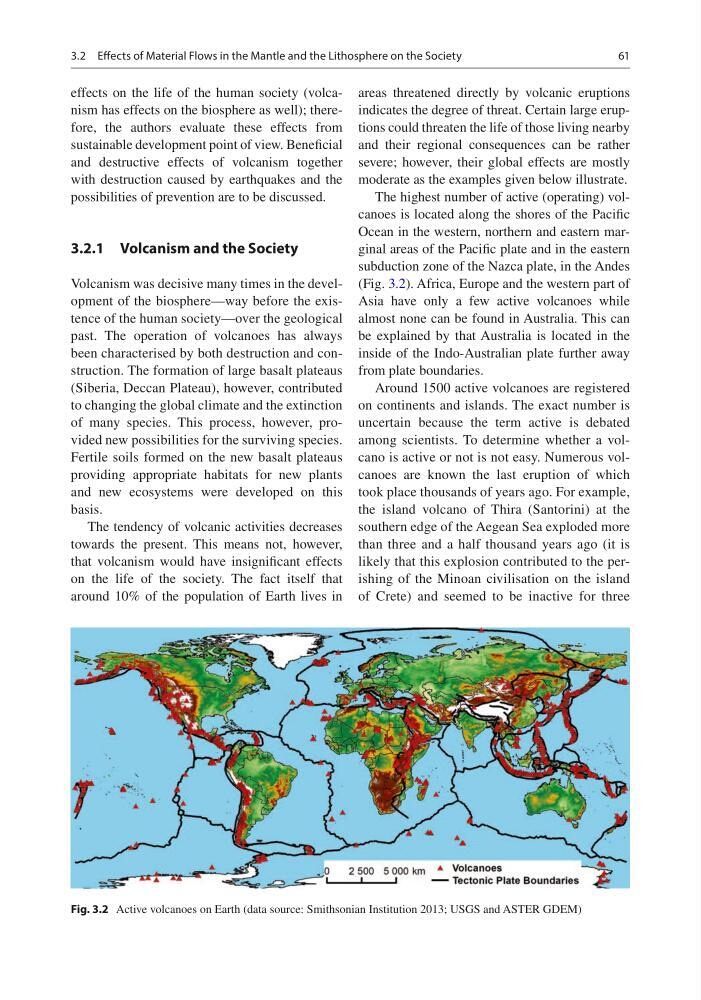
The highest number of active (operating) volcanoes is located along the shores of the Pacific
Ocean in the western, northern and eastern marginal areas of the Pacific plate and in the eastern
subduction zone of the Nazca plate, in the Andes
(Fig. 3.2). Africa, Europe and the western part of
Asia have only a few active volcanoes while
almost none can be found in Australia. This can
be explained by that Australia is located in the
inside of the Indo-Australian plate further away
from plate boundaries.
Around 1500 active volcanoes are registered
on continents and islands. The exact number is
uncertain because the term active is debated
among scientists. To determine whether a volcano is active or not is not easy. Numerous volcanoes are known the last eruption of which
took place thousands of years ago. For example,
the island volcano of Thira (Santorini) at the
southern edge of the Aegean Sea exploded more
than three and a half thousand years ago (it is
likely that this explosion contributed to the perishing of the Minoan civilisation on the island
of Crete) and seemed to be inactive for three
Fig. 3.2 Active volcanoes on Earth (data source: Smithsonian Institution 2013; USGS and ASTER GDEM)
3.2 Effects of Material Flows in the Mantle and the Lithosphere on the Society
effects on the life of the human society (volcanism has effects on the biosphere as well); therefore, the authors evaluate these effects from
sustainable development point of view. Beneficial
and destructive effects of volcanism together
with destruction caused by earthquakes and the
possibilities of prevention are to be discussed.
3.2.1 Volcanism and the Society
Volcanism was decisive many times in the development of the biosphere—way before the existence of the human society—over the geological
past. The operation of volcanoes has always
been characterised by both destruction and construction. The formation of large basalt plateaus
(Siberia, Deccan Plateau), however, contributed
to changing the global climate and the extinction
of many species. This process, however, provided new possibilities for the surviving species.
Fertile soils formed on the new basalt plateaus
providing appropriate habitats for new plants
and new ecosystems were developed on this
basis.
The tendency of volcanic activities decreases
towards the present. This means not, however,
that volcanism would have insignificant effects
on the life of the society. The fact itself that
around 10% of the population of Earth lives in
areas threatened directly by volcanic eruptions
indicates the degree of threat. Certain large eruptions could threaten the life of those living nearby
and their regional consequences can be rather
severe; however, their global effects are mostly
moderate as the examples given below illustrate.
The highest number of active (operating) volcanoes is located along the shores of the Pacific
Ocean in the western, northern and eastern marginal areas of the Pacific plate and in the eastern
subduction zone of the Nazca plate, in the Andes
(Fig. 3.2). Africa, Europe and the western part of
Asia have only a few active volcanoes while
almost none can be found in Australia. This can
be explained by that Australia is located in the
inside of the Indo-Australian plate further away
from plate boundaries.
Around 1500 active volcanoes are registered
on continents and islands. The exact number is
uncertain because the term active is debated
among scientists. To determine whether a volcano is active or not is not easy. Numerous volcanoes are known the last eruption of which
took place thousands of years ago. For example,
the island volcano of Thira (Santorini) at the
southern edge of the Aegean Sea exploded more
than three and a half thousand years ago (it is
likely that this explosion contributed to the perishing of the Minoan civilisation on the island
of Crete) and seemed to be inactive for three
Fig. 3.2 Active volcanoes on Earth (data source: Smithsonian Institution 2013; USGS and ASTER GDEM)
3.2 Effects of Material Flows in the Mantle and the Lithosphere on the Society