

49
The social world model of Ervin László is also
worth mentioning (László 2008a, b). In his opinion the society is a complex system developing
via bifurcations. A seemingly prolonged change
could take a new direction abruptly and the system could become chaotic. (We have to note that
the tendency to bifurcation in certain stages of
their development seems to be a typical characteristic of certain types of chaotic systems. Their
operation cannot be described using deterministic equations, however, this does not mean that
chaos would prevail continuously in the system
but the growth of tension in the society may lead
to it.) According to László, development via
bifurcation in the society can be divided into four
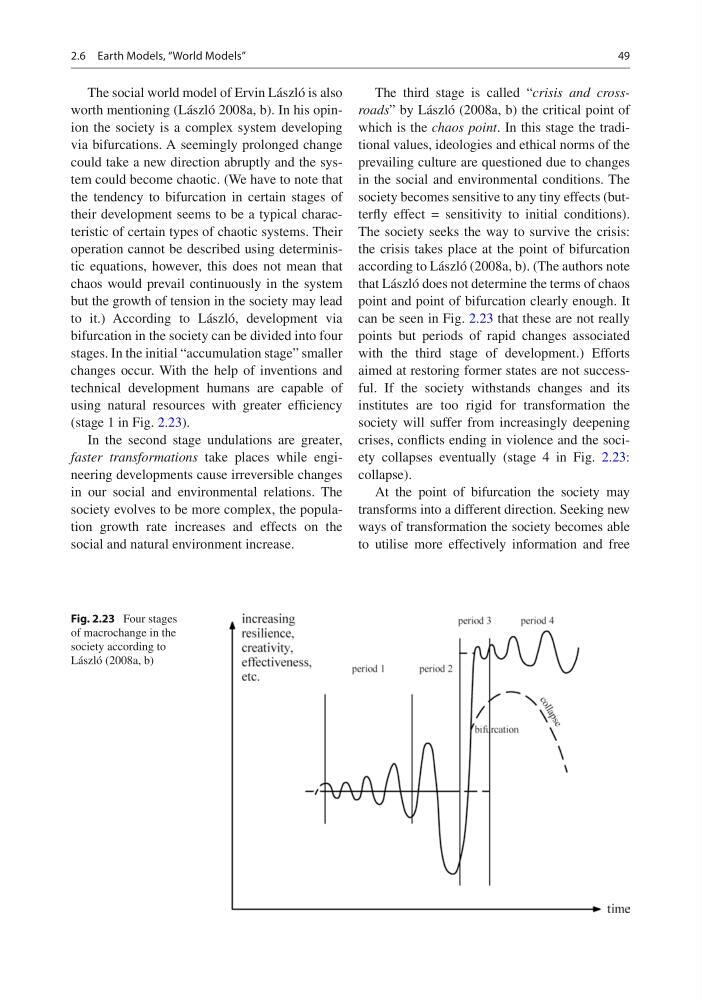
stages. In the initial “accumulation stage” smaller
changes occur. With the help of inventions and
technical development humans are capable of
using natural resources with greater efficiency
(stage 1 in Fig. 2.23).
In the second stage undulations are greater,
faster transformations take places while engineering developments cause irreversible changes
in our social and environmental relations. The
society evolves to be more complex, the population growth rate increases and effects on the
social and natural environment increase.
The third stage is called “crisis and crossroads” by László (2008a, b) the critical point of
which is the chaos point. In this stage the traditional values, ideologies and ethical norms of the
prevailing culture are questioned due to changes
in the social and environmental conditions. The
society becomes sensitive to any tiny effects (butterfly effect = sensitivity to initial conditions).
The society seeks the way to survive the crisis:
the crisis takes place at the point of bifurcation
according to László (2008a, b). (The authors note
that László does not determine the terms of chaos
point and point of bifurcation clearly enough. It
can be seen in Fig. 2.23 that these are not really
points but periods of rapid changes associated
with the third stage of development.) Efforts
aimed at restoring former states are not successful. If the society withstands changes and its
institutes are too rigid for transformation the
society will suffer from increasingly deepening
crises, conflicts ending in violence and the society collapses eventually (stage 4 in Fig. 2.23:
collapse).
At the point of bifurcation the society may
transforms into a different direction. Seeking new
ways of transformation the society becomes able
to utilise more effectively information and free
Fig. 2.23 Four stages
of macrochange in the
society according to
László (2008a, b)
2.6 Earth Models, “World Models”
The social world model of Ervin László is also
worth mentioning (László 2008a, b). In his opinion the society is a complex system developing
via bifurcations. A seemingly prolonged change
could take a new direction abruptly and the system could become chaotic. (We have to note that
the tendency to bifurcation in certain stages of
their development seems to be a typical characteristic of certain types of chaotic systems. Their
operation cannot be described using deterministic equations, however, this does not mean that
chaos would prevail continuously in the system
but the growth of tension in the society may lead
to it.) According to László, development via
bifurcation in the society can be divided into four
stages. In the initial “accumulation stage” smaller
changes occur. With the help of inventions and
technical development humans are capable of
using natural resources with greater efficiency
(stage 1 in Fig. 2.23).
In the second stage undulations are greater,
faster transformations take places while engineering developments cause irreversible changes
in our social and environmental relations. The
society evolves to be more complex, the population growth rate increases and effects on the
social and natural environment increase.
The third stage is called “crisis and crossroads” by László (2008a, b) the critical point of
which is the chaos point. In this stage the traditional values, ideologies and ethical norms of the
prevailing culture are questioned due to changes
in the social and environmental conditions. The
society becomes sensitive to any tiny effects (butterfly effect = sensitivity to initial conditions).
The society seeks the way to survive the crisis:
the crisis takes place at the point of bifurcation
according to László (2008a, b). (The authors note
that László does not determine the terms of chaos
point and point of bifurcation clearly enough. It
can be seen in Fig. 2.23 that these are not really
points but periods of rapid changes associated
with the third stage of development.) Efforts
aimed at restoring former states are not successful. If the society withstands changes and its
institutes are too rigid for transformation the
society will suffer from increasingly deepening
crises, conflicts ending in violence and the society collapses eventually (stage 4 in Fig. 2.23:
collapse).
At the point of bifurcation the society may
transforms into a different direction. Seeking new
ways of transformation the society becomes able
to utilise more effectively information and free
Fig. 2.23 Four stages
of macrochange in the
society according to
László (2008a, b)
2.6 Earth Models, “World Models”