

23
The question seems justified that why society
belongs to environmental systems. Considering
the life of an individual, the social environment is
just as important as the natural environment even
though the two types of environment are different. The natural environment provides biological
conditions of existence for humans (air, water,
etc.) while the social environment provides the
conditions of social existence: work, communication, culture, social relations, etc. The boundary
is not sharp. Today the majority of biological
conditions of existence can be obtained within
the society: food (agricultural production), water
(established waterworks), appropriate environmental temperature (built residential environment), etc.
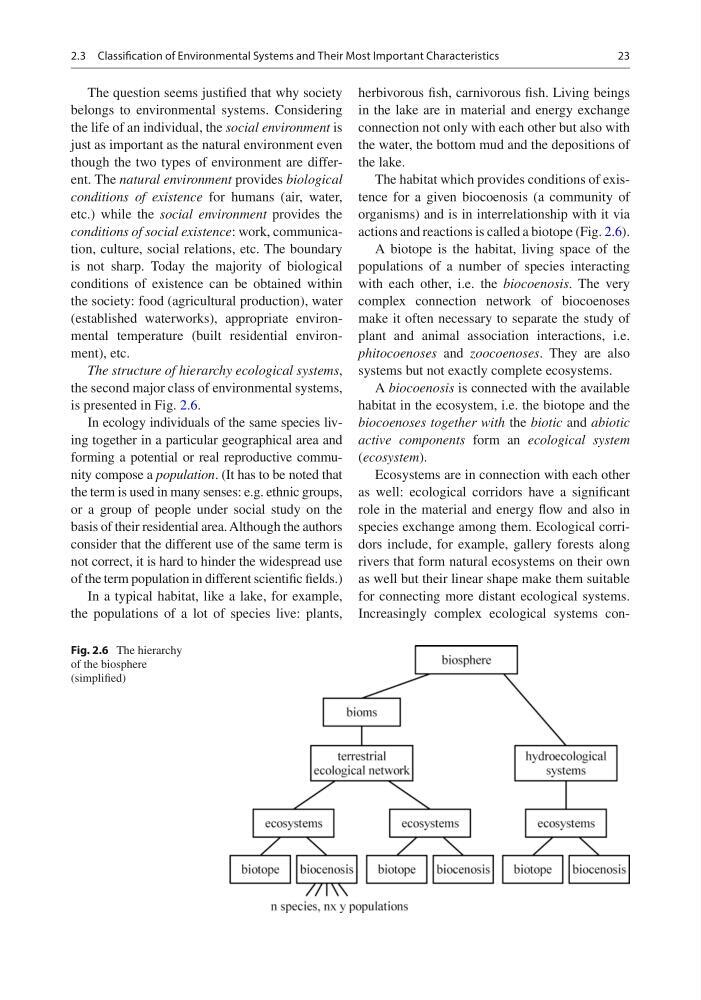
The structure of hierarchy ecological systems,
the second major class of environmental systems,
is presented in Fig. 2.6.
In ecology individuals of the same species living together in a particular geographical area and
forming a potential or real reproductive community compose a population. (It has to be noted that
the term is used in many senses: e.g. ethnic groups,
or a group of people under social study on the
basis of their residential area. Although the authors
consider that the different use of the same term is
not correct, it is hard to hinder the widespread use
of the term population in different scientific fields.)
In a typical habitat, like a lake, for example,
the populations of a lot of species live: plants,
herbivorous fish, carnivorous fish. Living beings
in the lake are in material and energy exchange
connection not only with each other but also with
the water, the bottom mud and the depositions of
the lake.
The habitat which provides conditions of existence for a given biocoenosis (a community of
organisms) and is in interrelationship with it via
actions and reactions is called a biotope (Fig. 2.6).
A biotope is the habitat, living space of the
populations of a number of species interacting
with each other, i.e. the biocoenosis. The very
complex connection network of biocoenoses
make it often necessary to separate the study of
plant and animal association interactions, i.e.
phitocoenoses and zoocoenoses. They are also
systems but not exactly complete ecosystems.
A biocoenosis is connected with the available
habitat in the ecosystem, i.e. the biotope and the
biocoenoses together with the biotic and abiotic
active components form an ecological system
(ecosystem).
Ecosystems are in connection with each other
as well: ecological corridors have a significant
role in the material and energy flow and also in
species exchange among them. Ecological corridors include, for example, gallery forests along
rivers that form natural ecosystems on their own
as well but their linear shape make them suitable
for connecting more distant ecological systems.
Increasingly complex ecological systems conFig. 2.6 The hierarchy
of the biosphere
(simplified)
2.3 Classification of Environmental Systems and Their Most Important Characteristics
The question seems justified that why society
belongs to environmental systems. Considering
the life of an individual, the social environment is
just as important as the natural environment even
though the two types of environment are different. The natural environment provides biological
conditions of existence for humans (air, water,
etc.) while the social environment provides the
conditions of social existence: work, communication, culture, social relations, etc. The boundary
is not sharp. Today the majority of biological
conditions of existence can be obtained within
the society: food (agricultural production), water
(established waterworks), appropriate environmental temperature (built residential environment), etc.
The structure of hierarchy ecological systems,
the second major class of environmental systems,
is presented in Fig. 2.6.
In ecology individuals of the same species living together in a particular geographical area and
forming a potential or real reproductive community compose a population. (It has to be noted that
the term is used in many senses: e.g. ethnic groups,
or a group of people under social study on the
basis of their residential area. Although the authors
consider that the different use of the same term is
not correct, it is hard to hinder the widespread use
of the term population in different scientific fields.)
In a typical habitat, like a lake, for example,
the populations of a lot of species live: plants,
herbivorous fish, carnivorous fish. Living beings
in the lake are in material and energy exchange
connection not only with each other but also with
the water, the bottom mud and the depositions of
the lake.
The habitat which provides conditions of existence for a given biocoenosis (a community of
organisms) and is in interrelationship with it via
actions and reactions is called a biotope (Fig. 2.6).
A biotope is the habitat, living space of the
populations of a number of species interacting
with each other, i.e. the biocoenosis. The very
complex connection network of biocoenoses
make it often necessary to separate the study of
plant and animal association interactions, i.e.
phitocoenoses and zoocoenoses. They are also
systems but not exactly complete ecosystems.
A biocoenosis is connected with the available
habitat in the ecosystem, i.e. the biotope and the
biocoenoses together with the biotic and abiotic
active components form an ecological system
(ecosystem).
Ecosystems are in connection with each other
as well: ecological corridors have a significant
role in the material and energy flow and also in
species exchange among them. Ecological corridors include, for example, gallery forests along
rivers that form natural ecosystems on their own
as well but their linear shape make them suitable
for connecting more distant ecological systems.
Increasingly complex ecological systems conFig. 2.6 The hierarchy
of the biosphere
(simplified)
2.3 Classification of Environmental Systems and Their Most Important Characteristics