

22
and also the heat capacity and heat transport of
seas and oceans are important just as the mesoclimatic effects of lakes and water reservoirs in the
case of freshwater.
When water systems are studied the physical
and chemical properties (flows, amount of inand outflowing water, acid or basic character,
composition of dissolved material, etc.) of the
rivers, lakes, surface and subsurface waters of a
given catchment area are measured. At the same
time, the elements of a water system (rivers,
lakes) are habitats of aquatic ecosystems and thus
are classified as ecological systems. In this case,
both the approach and methods of the study are
different: research will focus on the interactions
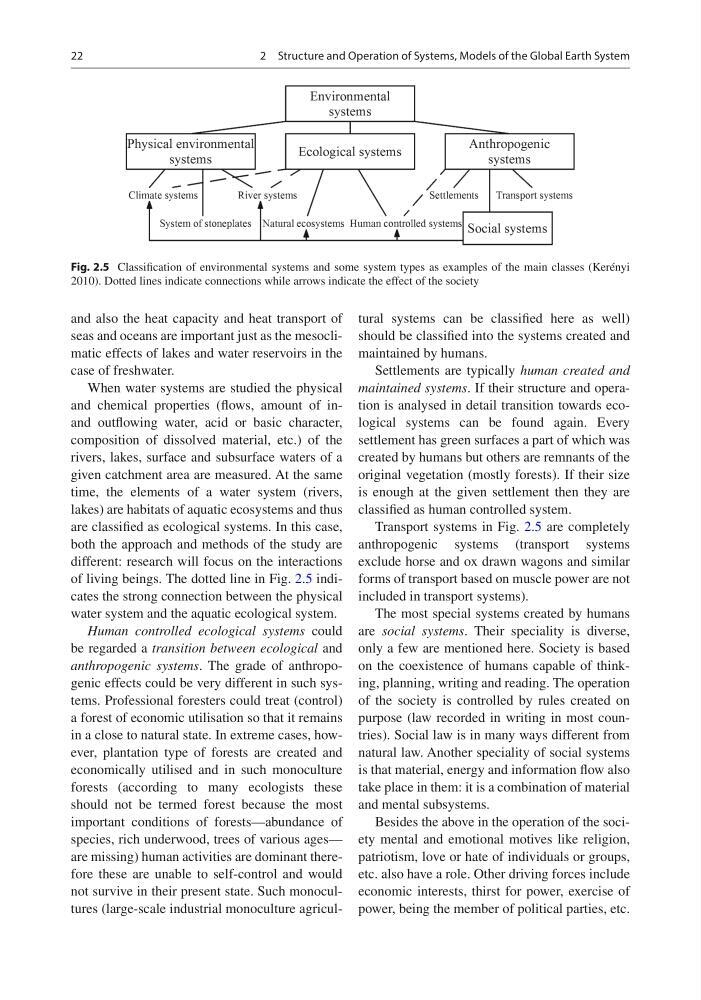
of living beings. The dotted line in Fig. 2.5 indicates the strong connection between the physical
water system and the aquatic ecological system.
Human controlled ecological systems could
be regarded a transition between ecological and
anthropogenic systems. The grade of anthropogenic effects could be very different in such systems. Professional foresters could treat (control)
a forest of economic utilisation so that it remains
in a close to natural state. In extreme cases, however, plantation type of forests are created and
economically utilised and in such monoculture
forests (according to many ecologists these
should not be termed forest because the most
important conditions of forests—abundance of
species, rich underwood, trees of various ages—
are missing) human activities are dominant therefore these are unable to self-control and would
not survive in their present state. Such monocultures (large-scale industrial monoculture agricultural systems can be classified here as well)
should be classified into the systems created and
maintained by humans.
Settlements are typically human created and
maintained systems. If their structure and operation is analysed in detail transition towards ecological systems can be found again. Every
settlement has green surfaces a part of which was
created by humans but others are remnants of the
original vegetation (mostly forests). If their size
is enough at the given settlement then they are
classified as human controlled system.
Transport systems in Fig. 2.5 are completely
anthropogenic systems (transport systems
exclude horse and ox drawn wagons and similar
forms of transport based on muscle power are not
included in transport systems).
The most special systems created by humans
are social systems. Their speciality is diverse,
only a few are mentioned here. Society is based
on the coexistence of humans capable of thinking, planning, writing and reading. The operation
of the society is controlled by rules created on
purpose (law recorded in writing in most countries). Social law is in many ways different from
natural law. Another speciality of social systems
is that material, energy and information flow also
take place in them: it is a combination of material
and mental subsystems.
Besides the above in the operation of the society mental and emotional motives like religion,
patriotism, love or hate of individuals or groups,
etc. also have a role. Other driving forces include
economic interests, thirst for power, exercise of
power, being the member of political parties, etc.
Fig. 2.5 Classification of environmental systems and some system types as examples of the main classes (Kerényi
2010). Dotted lines indicate connections while arrows indicate the effect of the society
2 Structure and Operation of Systems, Models of the Global Earth System
and also the heat capacity and heat transport of
seas and oceans are important just as the mesoclimatic effects of lakes and water reservoirs in the
case of freshwater.
When water systems are studied the physical
and chemical properties (flows, amount of inand outflowing water, acid or basic character,
composition of dissolved material, etc.) of the
rivers, lakes, surface and subsurface waters of a
given catchment area are measured. At the same
time, the elements of a water system (rivers,
lakes) are habitats of aquatic ecosystems and thus
are classified as ecological systems. In this case,
both the approach and methods of the study are
different: research will focus on the interactions
of living beings. The dotted line in Fig. 2.5 indicates the strong connection between the physical
water system and the aquatic ecological system.
Human controlled ecological systems could
be regarded a transition between ecological and
anthropogenic systems. The grade of anthropogenic effects could be very different in such systems. Professional foresters could treat (control)
a forest of economic utilisation so that it remains
in a close to natural state. In extreme cases, however, plantation type of forests are created and
economically utilised and in such monoculture
forests (according to many ecologists these
should not be termed forest because the most
important conditions of forests—abundance of
species, rich underwood, trees of various ages—
are missing) human activities are dominant therefore these are unable to self-control and would
not survive in their present state. Such monocultures (large-scale industrial monoculture agricultural systems can be classified here as well)
should be classified into the systems created and
maintained by humans.
Settlements are typically human created and
maintained systems. If their structure and operation is analysed in detail transition towards ecological systems can be found again. Every
settlement has green surfaces a part of which was
created by humans but others are remnants of the
original vegetation (mostly forests). If their size
is enough at the given settlement then they are
classified as human controlled system.
Transport systems in Fig. 2.5 are completely
anthropogenic systems (transport systems
exclude horse and ox drawn wagons and similar
forms of transport based on muscle power are not
included in transport systems).
The most special systems created by humans
are social systems. Their speciality is diverse,
only a few are mentioned here. Society is based
on the coexistence of humans capable of thinking, planning, writing and reading. The operation
of the society is controlled by rules created on
purpose (law recorded in writing in most countries). Social law is in many ways different from
natural law. Another speciality of social systems
is that material, energy and information flow also
take place in them: it is a combination of material
and mental subsystems.
Besides the above in the operation of the society mental and emotional motives like religion,
patriotism, love or hate of individuals or groups,
etc. also have a role. Other driving forces include
economic interests, thirst for power, exercise of
power, being the member of political parties, etc.
Fig. 2.5 Classification of environmental systems and some system types as examples of the main classes (Kerényi
2010). Dotted lines indicate connections while arrows indicate the effect of the society
2 Structure and Operation of Systems, Models of the Global Earth System