

230
everyone could get along is envisaged.
Furthermore, this world would be without fear
and violence, and everyone gets quality education. Following this idealistic view, a realistic
image is given about current conditions thus the
contrast between the typical conditions of the
current world and the imagined future one is very
sharp. Particular goals in the 17 points are closer
to the realistic image and clearly point towards
the global implementation of sustainable development. Let’s analyse briefly the reality of
achieving the above targets.
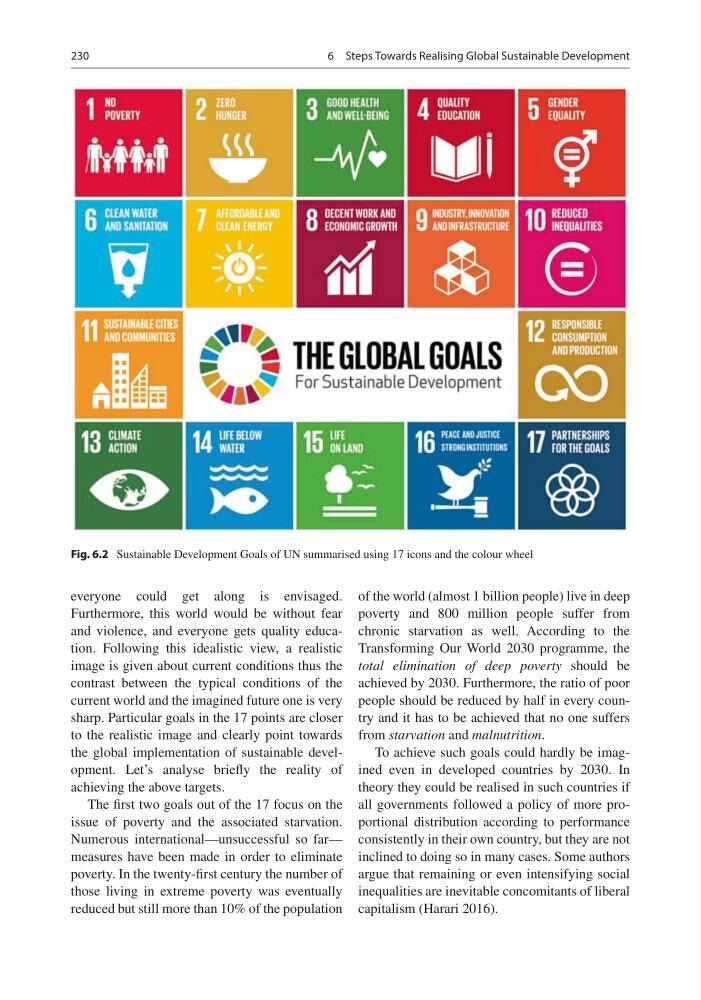
The first two goals out of the 17 focus on the
issue of poverty and the associated starvation.
Numerous international—unsuccessful so far—
measures have been made in order to eliminate
poverty. In the twenty-first century the number of
those living in extreme poverty was eventually
reduced but still more than 10% of the population
of the world (almost 1 billion people) live in deep
poverty and 800 million people suffer from
chronic starvation as well. According to the
Transforming Our World 2030 programme, the
total elimination of deep poverty should be
achieved by 2030. Furthermore, the ratio of poor
people should be reduced by half in every country and it has to be achieved that no one suffers
from starvation and malnutrition.
To achieve such goals could hardly be imagined even in developed countries by 2030. In
theory they could be realised in such countries if
all governments followed a policy of more proportional distribution according to performance
consistently in their own country, but they are not
inclined to doing so in many cases. Some authors
argue that remaining or even intensifying social
inequalities are inevitable concomitants of liberal
capitalism (Harari 2016).
Fig. 6.2 Sustainable Development Goals of UN summarised using 17 icons and the colour wheel
6 Steps Towards Realising Global Sustainable Development
everyone could get along is envisaged.
Furthermore, this world would be without fear
and violence, and everyone gets quality education. Following this idealistic view, a realistic
image is given about current conditions thus the
contrast between the typical conditions of the
current world and the imagined future one is very
sharp. Particular goals in the 17 points are closer
to the realistic image and clearly point towards
the global implementation of sustainable development. Let’s analyse briefly the reality of
achieving the above targets.
The first two goals out of the 17 focus on the
issue of poverty and the associated starvation.
Numerous international—unsuccessful so far—
measures have been made in order to eliminate
poverty. In the twenty-first century the number of
those living in extreme poverty was eventually
reduced but still more than 10% of the population
of the world (almost 1 billion people) live in deep
poverty and 800 million people suffer from
chronic starvation as well. According to the
Transforming Our World 2030 programme, the
total elimination of deep poverty should be
achieved by 2030. Furthermore, the ratio of poor
people should be reduced by half in every country and it has to be achieved that no one suffers
from starvation and malnutrition.
To achieve such goals could hardly be imagined even in developed countries by 2030. In
theory they could be realised in such countries if
all governments followed a policy of more proportional distribution according to performance
consistently in their own country, but they are not
inclined to doing so in many cases. Some authors
argue that remaining or even intensifying social
inequalities are inevitable concomitants of liberal
capitalism (Harari 2016).
Fig. 6.2 Sustainable Development Goals of UN summarised using 17 icons and the colour wheel
6 Steps Towards Realising Global Sustainable Development