

216
wells) on fire the combustion products of which
polluted the air for weeks. Haavisto (2005) calls
attention to a survey made by UNEP experts
revealing the fact that oil and numerous dangerous chemicals were released into the environment,
including the Danube River from the ruins of
industrial establishments in Kosovo, Serbia and
Montenegro in 1999 during the Yugoslav Wars.
In Afghanistan prolonged war destructed the
built environment and agricultural infrastructure
so that even rebuilding the country and the restoration of normal life are difficult, especially
because the civil war has not been ended completely yet.
In summary, it can be stated that wars broke
out primarily for social and economic reasons,
and in certain regions in recent years also for conflicts induced by deteriorating environmental
conditions that could well be the reasons for
major wars in the future. Enormous masses of
refugees escaping from war cause major concern
in recipient countries already today. These
together seriously hinder the realisation of sustainable development. Countries involved in wars
suffer from social problems long after the war as
presented in Table 5.2.
Finally, according to certain views, connectivity in the global society will impede all major
armed conflicts in the future (Khanna 2016).
Others came to the same conclusion with different reasoning. In the opinion of Harari (2016), for
example, fighting for the most important “raw
material” (knowledge) in today’s knowledgebased economy is pointless because knowledge
cannot be acquired by war. Wars fade away and
are limited only to that part of the world where
traditional, material-based economy still
prevails.
The authors of the present book consider the
above views too optimistic. No one knows what
tension will be caused by intensifying environmental problems in the twenty-first century. The
grade to which transforming social conditions
could either increase or decrease these tensions is
not known either. Not the least, who will be in
what power and how they are going to use it are
the questions that answers to which will decide
the future of the global society. One thing is sure,
history has already proved that the thoughts, feelings and antipathies of people can be manipulated, and even the decisions of those in power
could be irrational.
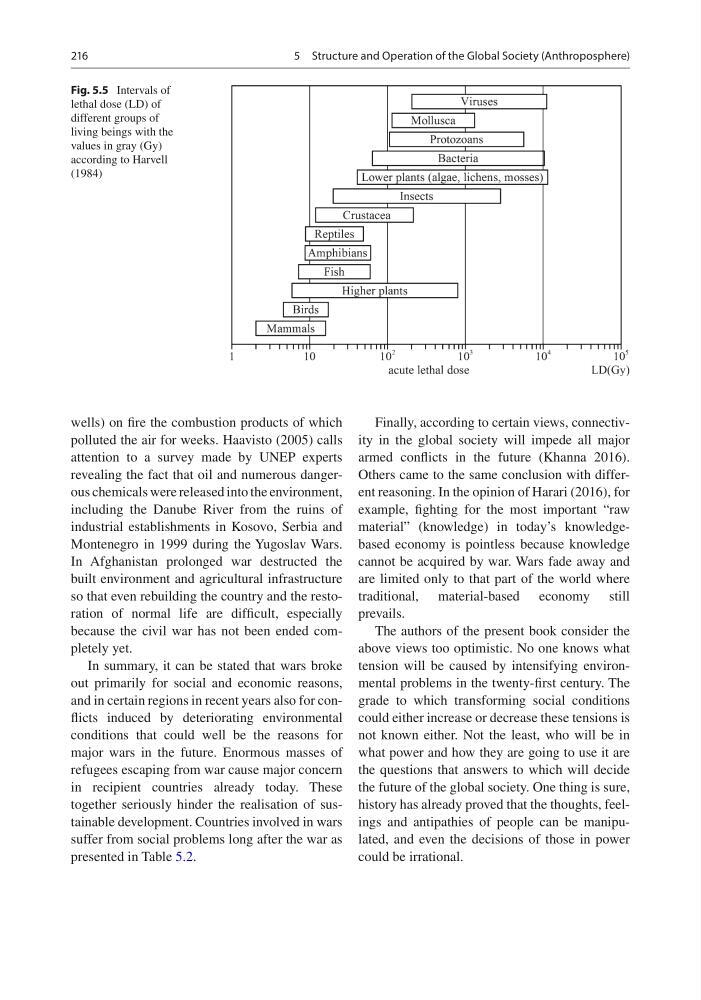
Fig. 5.5 Intervals of
lethal dose (LD) of
different groups of
living beings with the
values in gray (Gy)
according to Harvell
(1984)
5 Structure and Operation of the Global Society (Anthroposphere)
wells) on fire the combustion products of which
polluted the air for weeks. Haavisto (2005) calls
attention to a survey made by UNEP experts
revealing the fact that oil and numerous dangerous chemicals were released into the environment,
including the Danube River from the ruins of
industrial establishments in Kosovo, Serbia and
Montenegro in 1999 during the Yugoslav Wars.
In Afghanistan prolonged war destructed the
built environment and agricultural infrastructure
so that even rebuilding the country and the restoration of normal life are difficult, especially
because the civil war has not been ended completely yet.
In summary, it can be stated that wars broke
out primarily for social and economic reasons,
and in certain regions in recent years also for conflicts induced by deteriorating environmental
conditions that could well be the reasons for
major wars in the future. Enormous masses of
refugees escaping from war cause major concern
in recipient countries already today. These
together seriously hinder the realisation of sustainable development. Countries involved in wars
suffer from social problems long after the war as
presented in Table 5.2.
Finally, according to certain views, connectivity in the global society will impede all major
armed conflicts in the future (Khanna 2016).
Others came to the same conclusion with different reasoning. In the opinion of Harari (2016), for
example, fighting for the most important “raw
material” (knowledge) in today’s knowledgebased economy is pointless because knowledge
cannot be acquired by war. Wars fade away and
are limited only to that part of the world where
traditional, material-based economy still
prevails.
The authors of the present book consider the
above views too optimistic. No one knows what
tension will be caused by intensifying environmental problems in the twenty-first century. The
grade to which transforming social conditions
could either increase or decrease these tensions is
not known either. Not the least, who will be in
what power and how they are going to use it are
the questions that answers to which will decide
the future of the global society. One thing is sure,
history has already proved that the thoughts, feelings and antipathies of people can be manipulated, and even the decisions of those in power
could be irrational.
Fig. 5.5 Intervals of
lethal dose (LD) of
different groups of
living beings with the
values in gray (Gy)
according to Harvell
(1984)
5 Structure and Operation of the Global Society (Anthroposphere)