

181
experienced in the case of certain fish groups.
For example, the index for scrombidae (tuna,
mackerel, bonito) decreased by 74% between
1970 and 2010. The index for fish in seagrass
habitats shows a decline of over 70% in the
same interval.
Apart from the above the Red List of IUCN
also shows increasing numbers for endangered
marine species. The Living Blue Planet Report
depicts a rather dark picture on the situation of
marine life. Regarding this, however, the editors
of the report note that only a very small fraction
of marine species is known and even monitoring
data are few regarding known species as well.
Living Planet Report 2018 gives recommendations and aims for the future as follows.
• Measures up to now aimed at preserving biodiversity are still important: managing nature
protection areas, applying the different methods of species preservation (ex situ protection,
establishment of gene banks, etc.)
• Curves demanded in the future for three recommended biodiversity indicators have to be
achieved.
– Decreasing populational trend has to be
stopped by 2020, trend of increase has to
be achieved by 2030, and this relates to all
species including endangered ones as well
(Fig. 4.76).
– The nature protectional status of species
have to be dealt with (Fig. 4.77). Species at
the edge of global extinction deserve special attention. Endangered species are generally protected but species not yet
protected today will need nature protectional status in the near future. From 2030
the latter species will require great
attention.
– Monitoring biom (biocoenosises determined climatically and geographical, and
similar from ecological aspect) transformations also demand increasing care
(Fig. 4.78).
The authors of the present book consider the
aims correct. Doubts are declared regarding the
methods of achieving these aims referred to only
in general by the authors of Living Planet Report
(WWF 2018).
Finally the relationship of species diversity
and gene stock and gene erosion have to be
discussed.
Species decline brings decrease in gene
resources. Apart from this, however, another degradation process is also taking place as a result of
anthropogenic effects on the biosphere, called
gene erosion. In this process the number of existing versions of given genes decreases and as a
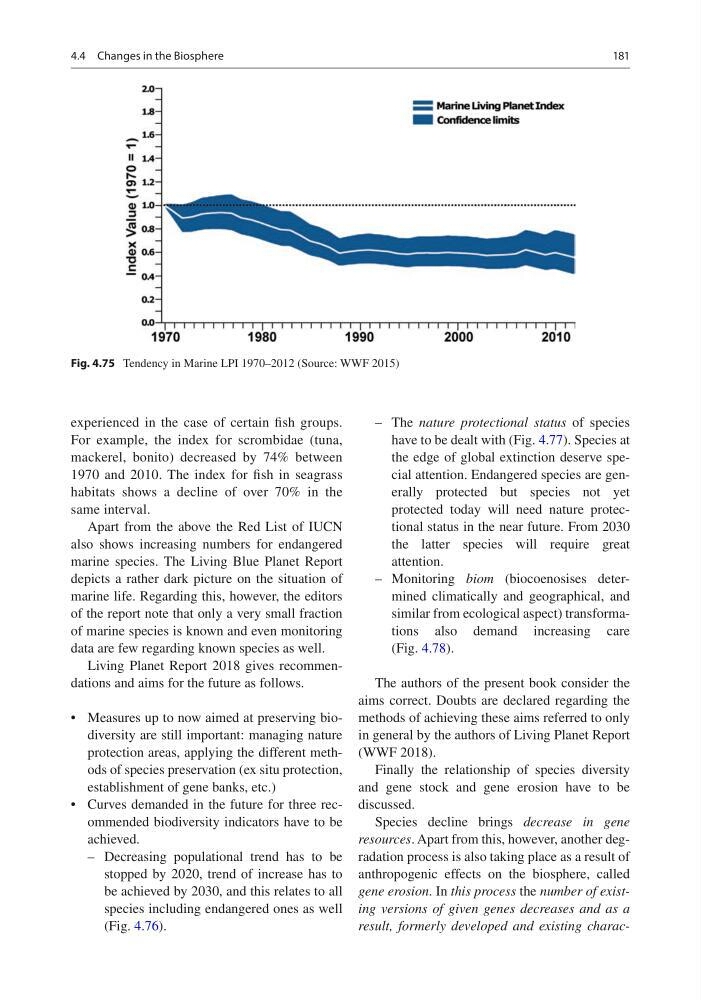
result, formerly developed and existing characFig. 4.75 Tendency in Marine LPI 1970–2012 (Source: WWF 2015)
4.4 Changes in the Biosphere
experienced in the case of certain fish groups.
For example, the index for scrombidae (tuna,
mackerel, bonito) decreased by 74% between
1970 and 2010. The index for fish in seagrass
habitats shows a decline of over 70% in the
same interval.
Apart from the above the Red List of IUCN
also shows increasing numbers for endangered
marine species. The Living Blue Planet Report
depicts a rather dark picture on the situation of
marine life. Regarding this, however, the editors
of the report note that only a very small fraction
of marine species is known and even monitoring
data are few regarding known species as well.
Living Planet Report 2018 gives recommendations and aims for the future as follows.
• Measures up to now aimed at preserving biodiversity are still important: managing nature
protection areas, applying the different methods of species preservation (ex situ protection,
establishment of gene banks, etc.)
• Curves demanded in the future for three recommended biodiversity indicators have to be
achieved.
– Decreasing populational trend has to be
stopped by 2020, trend of increase has to
be achieved by 2030, and this relates to all
species including endangered ones as well
(Fig. 4.76).
– The nature protectional status of species
have to be dealt with (Fig. 4.77). Species at
the edge of global extinction deserve special attention. Endangered species are generally protected but species not yet
protected today will need nature protectional status in the near future. From 2030
the latter species will require great
attention.
– Monitoring biom (biocoenosises determined climatically and geographical, and
similar from ecological aspect) transformations also demand increasing care
(Fig. 4.78).
The authors of the present book consider the
aims correct. Doubts are declared regarding the
methods of achieving these aims referred to only
in general by the authors of Living Planet Report
(WWF 2018).
Finally the relationship of species diversity
and gene stock and gene erosion have to be
discussed.
Species decline brings decrease in gene
resources. Apart from this, however, another degradation process is also taking place as a result of
anthropogenic effects on the biosphere, called
gene erosion. In this process the number of existing versions of given genes decreases and as a
result, formerly developed and existing characFig. 4.75 Tendency in Marine LPI 1970–2012 (Source: WWF 2015)
4.4 Changes in the Biosphere