

159
eutrophication in surface waters into which it
would be washed via erosion and potassium has
not presented an environmental issue so far.
4.3.4 Fresh Water Scarcity, Polluted
Potable Water and Their
Consequences on the Society
The operation of the global society cannot be
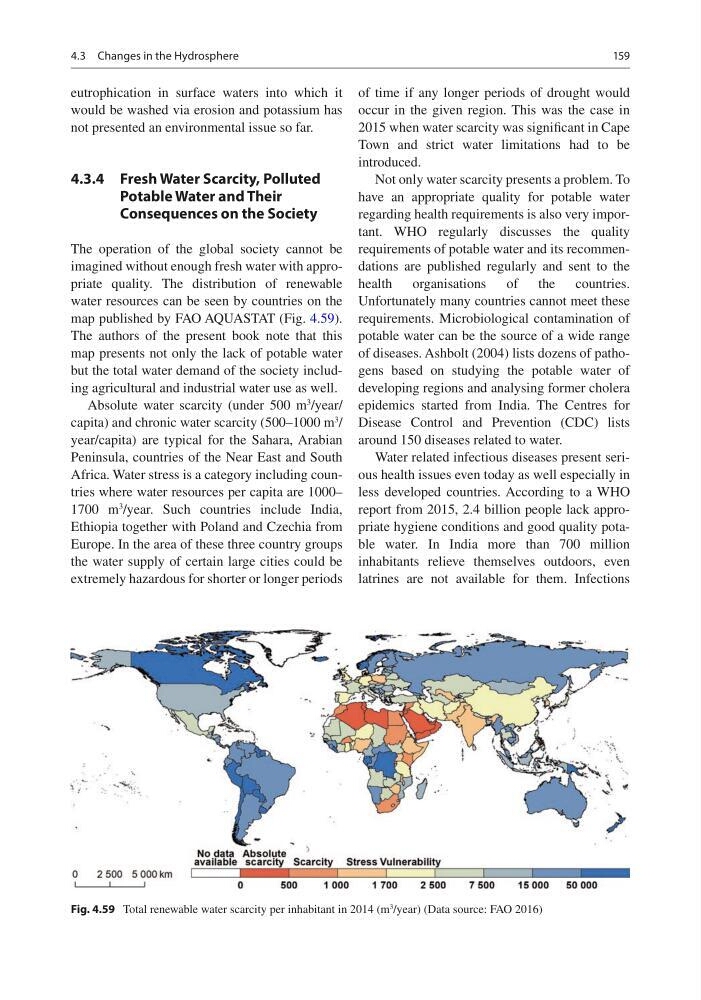
imagined without enough fresh water with appropriate quality. The distribution of renewable
water resources can be seen by countries on the
map published by FAO AQUASTAT (Fig. 4.59).
The authors of the present book note that this
map presents not only the lack of potable water
but the total water demand of the society including agricultural and industrial water use as well.
Absolute water scarcity (under 500 m
3
/year/
capita) and chronic water scarcity (500–1000 m
3
/
year/capita) are typical for the Sahara, Arabian
Peninsula, countries of the Near East and South
Africa. Water stress is a category including countries where water resources per capita are 1000–
1700 m
3
/year. Such countries include India,
Ethiopia together with Poland and Czechia from
Europe. In the area of these three country groups
the water supply of certain large cities could be
extremely hazardous for shorter or longer periods
of time if any longer periods of drought would
occur in the given region. This was the case in
2015 when water scarcity was significant in Cape
Town and strict water limitations had to be
introduced.
Not only water scarcity presents a problem. To
have an appropriate quality for potable water
regarding health requirements is also very important. WHO regularly discusses the quality
requirements of potable water and its recommendations are published regularly and sent to the
health organisations of the countries.
Unfortunately many countries cannot meet these
requirements. Microbiological contamination of
potable water can be the source of a wide range
of diseases. Ashbolt (2004) lists dozens of pathogens based on studying the potable water of
developing regions and analysing former cholera
epidemics started from India. The Centres for
Disease Control and Prevention (CDC) lists
around 150 diseases related to water.
Water related infectious diseases present serious health issues even today as well especially in
less developed countries. According to a WHO
report from 2015, 2.4 billion people lack appropriate hygiene conditions and good quality potable water. In India more than 700 million
inhabitants relieve themselves outdoors, even
latrines are not available for them. Infections
Fig. 4.59 Total renewable water scarcity per inhabitant in 2014 (m
3
/year) (Data source: FAO 2016)
4.3 Changes in the Hydrosphere
eutrophication in surface waters into which it
would be washed via erosion and potassium has
not presented an environmental issue so far.
4.3.4 Fresh Water Scarcity, Polluted
Potable Water and Their
Consequences on the Society
The operation of the global society cannot be
imagined without enough fresh water with appropriate quality. The distribution of renewable
water resources can be seen by countries on the
map published by FAO AQUASTAT (Fig. 4.59).
The authors of the present book note that this
map presents not only the lack of potable water
but the total water demand of the society including agricultural and industrial water use as well.
Absolute water scarcity (under 500 m
3
/year/
capita) and chronic water scarcity (500–1000 m
3
/
year/capita) are typical for the Sahara, Arabian
Peninsula, countries of the Near East and South
Africa. Water stress is a category including countries where water resources per capita are 1000–
1700 m
3
/year. Such countries include India,
Ethiopia together with Poland and Czechia from
Europe. In the area of these three country groups
the water supply of certain large cities could be
extremely hazardous for shorter or longer periods
of time if any longer periods of drought would
occur in the given region. This was the case in
2015 when water scarcity was significant in Cape
Town and strict water limitations had to be
introduced.
Not only water scarcity presents a problem. To
have an appropriate quality for potable water
regarding health requirements is also very important. WHO regularly discusses the quality
requirements of potable water and its recommendations are published regularly and sent to the
health organisations of the countries.
Unfortunately many countries cannot meet these
requirements. Microbiological contamination of
potable water can be the source of a wide range
of diseases. Ashbolt (2004) lists dozens of pathogens based on studying the potable water of
developing regions and analysing former cholera
epidemics started from India. The Centres for
Disease Control and Prevention (CDC) lists
around 150 diseases related to water.
Water related infectious diseases present serious health issues even today as well especially in
less developed countries. According to a WHO
report from 2015, 2.4 billion people lack appropriate hygiene conditions and good quality potable water. In India more than 700 million
inhabitants relieve themselves outdoors, even
latrines are not available for them. Infections
Fig. 4.59 Total renewable water scarcity per inhabitant in 2014 (m
3
/year) (Data source: FAO 2016)
4.3 Changes in the Hydrosphere