

158
Drain water is water flowing in the drain pipes.
Drain pipes are perforated plastic pipes installed
into too wet soils in order to drain excess water.
The difference between the nitrogen loss of
arable lands and that of grass covered soils is
huge. Grass covering continuously the surface
uses the majority of the nitrogen while from the
partly or totally non-vegetated arable lands much
nitrogen is removed by filtrating water. When
plants grow on arable lands the amount of
removed nitrogen starts to decrease.
Increasing nitrate content in groundwater is
only a risk in areas where drinking water is
obtained from groundwater (small settlements,
farms). Drinking water with nitrate content
higher than 20 mg/L is not recommended for
infants while above 50 mg/L the disease methemoglobinemia could develop and this could grow
very serious. The disease results in nitrite forming out of nitrate in the human body deteriorating
the oxygen transport capability of the blood and
may cause death by suffocation in extreme cases.
Infants older than 3 months are more resistant but
prolonged consumption of water with high nitrate
content is not recommended for them either. If
the wells in an area yield high nitrate containing
groundwater then bottled water is given to infants
and their tea is also made of bottled water since
nitrate cannot be removed by boiling the water.
Generally in lowlands with fertile soil where
groundwater is found near the surface and much
nitrogen fertiliser is used the water has already
been contaminated with nitrate. Such areas
include, for example, lowlands in the Netherlands,
Germany and Poland, the Po Plain, Great
Hungarian Plain, plains of the Mississippi and
Missouri in the USA, the North China Plain and
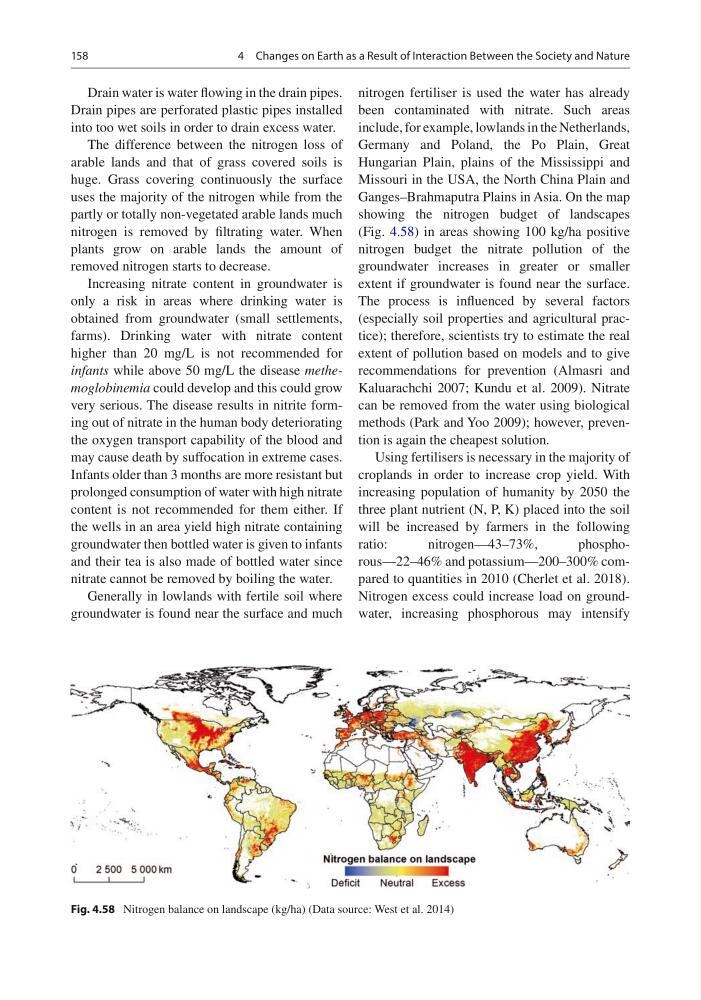
Ganges–Brahmaputra Plains in Asia. On the map
showing the nitrogen budget of landscapes
(Fig. 4.58) in areas showing 100 kg/ha positive
nitrogen budget the nitrate pollution of the
groundwater increases in greater or smaller
extent if groundwater is found near the surface.
The process is influenced by several factors
(especially soil properties and agricultural practice); therefore, scientists try to estimate the real
extent of pollution based on models and to give
recommendations for prevention (Almasri and
Kaluarachchi 2007; Kundu et al. 2009). Nitrate
can be removed from the water using biological
methods (Park and Yoo 2009); however, prevention is again the cheapest solution.
Using fertilisers is necessary in the majority of
croplands in order to increase crop yield. With
increasing population of humanity by 2050 the
three plant nutrient (N, P, K) placed into the soil
will be increased by farmers in the following
ratio:
nitrogen—43–73%,
phosphorous—22–46% and potassium—200–300% compared to quantities in 2010 (Cherlet et al. 2018).
Nitrogen excess could increase load on groundwater, increasing phosphorous may intensify
Fig. 4.58 Nitrogen balance on landscape (kg/ha) (Data source: West et al. 2014)
4 Changes on Earth as a Result of Interaction Between the Society and Nature
Drain water is water flowing in the drain pipes.
Drain pipes are perforated plastic pipes installed
into too wet soils in order to drain excess water.
The difference between the nitrogen loss of
arable lands and that of grass covered soils is
huge. Grass covering continuously the surface
uses the majority of the nitrogen while from the
partly or totally non-vegetated arable lands much
nitrogen is removed by filtrating water. When
plants grow on arable lands the amount of
removed nitrogen starts to decrease.
Increasing nitrate content in groundwater is
only a risk in areas where drinking water is
obtained from groundwater (small settlements,
farms). Drinking water with nitrate content
higher than 20 mg/L is not recommended for
infants while above 50 mg/L the disease methemoglobinemia could develop and this could grow
very serious. The disease results in nitrite forming out of nitrate in the human body deteriorating
the oxygen transport capability of the blood and
may cause death by suffocation in extreme cases.
Infants older than 3 months are more resistant but
prolonged consumption of water with high nitrate
content is not recommended for them either. If
the wells in an area yield high nitrate containing
groundwater then bottled water is given to infants
and their tea is also made of bottled water since
nitrate cannot be removed by boiling the water.
Generally in lowlands with fertile soil where
groundwater is found near the surface and much
nitrogen fertiliser is used the water has already
been contaminated with nitrate. Such areas
include, for example, lowlands in the Netherlands,
Germany and Poland, the Po Plain, Great
Hungarian Plain, plains of the Mississippi and
Missouri in the USA, the North China Plain and
Ganges–Brahmaputra Plains in Asia. On the map
showing the nitrogen budget of landscapes
(Fig. 4.58) in areas showing 100 kg/ha positive
nitrogen budget the nitrate pollution of the
groundwater increases in greater or smaller
extent if groundwater is found near the surface.
The process is influenced by several factors
(especially soil properties and agricultural practice); therefore, scientists try to estimate the real
extent of pollution based on models and to give
recommendations for prevention (Almasri and
Kaluarachchi 2007; Kundu et al. 2009). Nitrate
can be removed from the water using biological
methods (Park and Yoo 2009); however, prevention is again the cheapest solution.
Using fertilisers is necessary in the majority of
croplands in order to increase crop yield. With
increasing population of humanity by 2050 the
three plant nutrient (N, P, K) placed into the soil
will be increased by farmers in the following
ratio:
nitrogen—43–73%,
phosphorous—22–46% and potassium—200–300% compared to quantities in 2010 (Cherlet et al. 2018).
Nitrogen excess could increase load on groundwater, increasing phosphorous may intensify
Fig. 4.58 Nitrogen balance on landscape (kg/ha) (Data source: West et al. 2014)
4 Changes on Earth as a Result of Interaction Between the Society and Nature