

156
the results of water analyses from 45,000 wells
by 2014 and the results showed for Bennett and
Zubak-Skees (2014) that Texas, Minnesota,
Wisconsin and the SW USA are those areas
where the arsenic content of groundwater
exceeded the limit of 10 g/L recommended by
WHO in numerous wells.
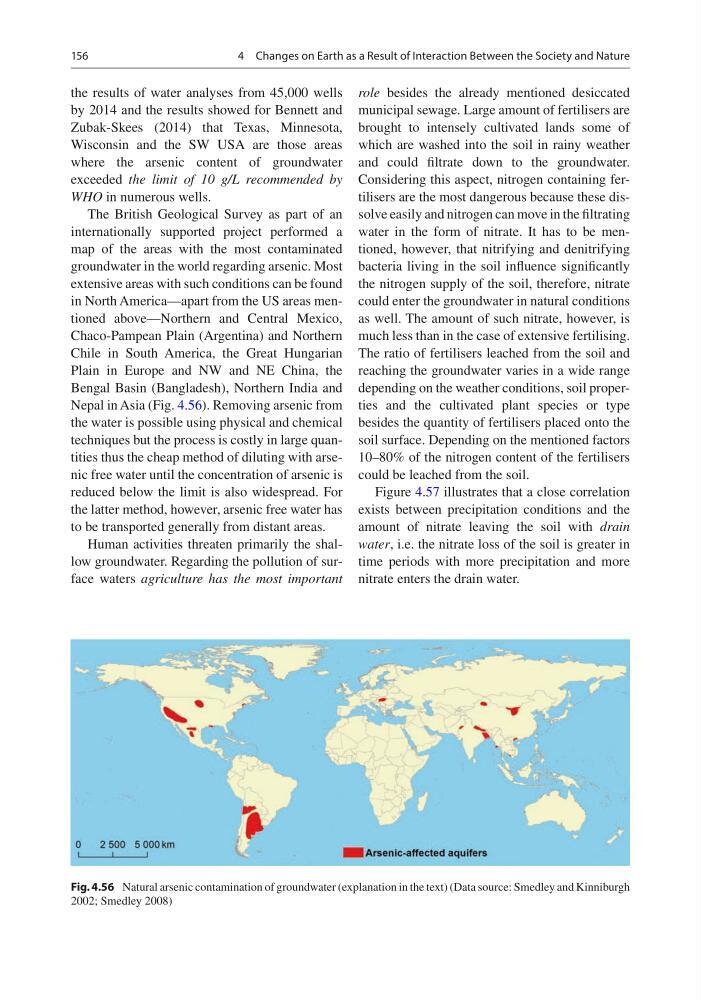
The British Geological Survey as part of an
internationally supported project performed a
map of the areas with the most contaminated
groundwater in the world regarding arsenic. Most
extensive areas with such conditions can be found
in North America—apart from the US areas mentioned above—Northern and Central Mexico,
Chaco-Pampean Plain (Argentina) and Northern
Chile in South America, the Great Hungarian
Plain in Europe and NW and NE China, the
Bengal Basin (Bangladesh), Northern India and
Nepal in Asia (Fig. 4.56). Removing arsenic from
the water is possible using physical and chemical
techniques but the process is costly in large quantities thus the cheap method of diluting with arsenic free water until the concentration of arsenic is
reduced below the limit is also widespread. For
the latter method, however, arsenic free water has
to be transported generally from distant areas.
Human activities threaten primarily the shallow groundwater. Regarding the pollution of surface waters agriculture has the most important
role besides the already mentioned desiccated
municipal sewage. Large amount of fertilisers are
brought to intensely cultivated lands some of
which are washed into the soil in rainy weather
and could filtrate down to the groundwater.
Considering this aspect, nitrogen containing fertilisers are the most dangerous because these dissolve easily and nitrogen can move in the filtrating
water in the form of nitrate. It has to be mentioned, however, that nitrifying and denitrifying
bacteria living in the soil influence significantly
the nitrogen supply of the soil, therefore, nitrate
could enter the groundwater in natural conditions
as well. The amount of such nitrate, however, is
much less than in the case of extensive fertilising.
The ratio of fertilisers leached from the soil and
reaching the groundwater varies in a wide range
depending on the weather conditions, soil properties and the cultivated plant species or type
besides the quantity of fertilisers placed onto the
soil surface. Depending on the mentioned factors
10–80% of the nitrogen content of the fertilisers
could be leached from the soil.
Figure 4.57 illustrates that a close correlation
exists between precipitation conditions and the
amount of nitrate leaving the soil with drain
water, i.e. the nitrate loss of the soil is greater in
time periods with more precipitation and more
nitrate enters the drain water.
Fig. 4.56 Natural arsenic contamination of groundwater (explanation in the text) (Data source: Smedley and Kinniburgh
2002; Smedley 2008)
4 Changes on Earth as a Result of Interaction Between the Society and Nature
the results of water analyses from 45,000 wells
by 2014 and the results showed for Bennett and
Zubak-Skees (2014) that Texas, Minnesota,
Wisconsin and the SW USA are those areas
where the arsenic content of groundwater
exceeded the limit of 10 g/L recommended by
WHO in numerous wells.
The British Geological Survey as part of an
internationally supported project performed a
map of the areas with the most contaminated
groundwater in the world regarding arsenic. Most
extensive areas with such conditions can be found
in North America—apart from the US areas mentioned above—Northern and Central Mexico,
Chaco-Pampean Plain (Argentina) and Northern
Chile in South America, the Great Hungarian
Plain in Europe and NW and NE China, the
Bengal Basin (Bangladesh), Northern India and
Nepal in Asia (Fig. 4.56). Removing arsenic from
the water is possible using physical and chemical
techniques but the process is costly in large quantities thus the cheap method of diluting with arsenic free water until the concentration of arsenic is
reduced below the limit is also widespread. For
the latter method, however, arsenic free water has
to be transported generally from distant areas.
Human activities threaten primarily the shallow groundwater. Regarding the pollution of surface waters agriculture has the most important
role besides the already mentioned desiccated
municipal sewage. Large amount of fertilisers are
brought to intensely cultivated lands some of
which are washed into the soil in rainy weather
and could filtrate down to the groundwater.
Considering this aspect, nitrogen containing fertilisers are the most dangerous because these dissolve easily and nitrogen can move in the filtrating
water in the form of nitrate. It has to be mentioned, however, that nitrifying and denitrifying
bacteria living in the soil influence significantly
the nitrogen supply of the soil, therefore, nitrate
could enter the groundwater in natural conditions
as well. The amount of such nitrate, however, is
much less than in the case of extensive fertilising.
The ratio of fertilisers leached from the soil and
reaching the groundwater varies in a wide range
depending on the weather conditions, soil properties and the cultivated plant species or type
besides the quantity of fertilisers placed onto the
soil surface. Depending on the mentioned factors
10–80% of the nitrogen content of the fertilisers
could be leached from the soil.
Figure 4.57 illustrates that a close correlation
exists between precipitation conditions and the
amount of nitrate leaving the soil with drain
water, i.e. the nitrate loss of the soil is greater in
time periods with more precipitation and more
nitrate enters the drain water.
Fig. 4.56 Natural arsenic contamination of groundwater (explanation in the text) (Data source: Smedley and Kinniburgh
2002; Smedley 2008)
4 Changes on Earth as a Result of Interaction Between the Society and Nature