

141
decay to the effect of sunlight releasing methane and ethylene. As a result these plastics
contribute to the warming of the climate the
degree of which, however, is not known yet.
Removing micrograined plastics from the
ocean is practically impossible as these are present everywhere in water layers near the surface
only their concentration varies. Efforts were
made to clean in parts the northern plastic island
in the Pacific Ocean in the framework of the
Ocean Clean-up Project in 2018. The invention
of the Dutch Bojan Slat was not able to hold the
fished plastic particles and was also damaged;
therefore, the experiment had to be abandoned.
The primary task is, therefore, to impede further
growth of plastic pollution.
Today it is possible to produce biodegradable
plastics as well. Such biopolymers are produced
from corn, potato, sugar beet and vegetable oil
base material (Niaounakis 2013). Unfortunately
their production is more expensive than that of
petroleum-based plastics and they have smaller
mechanical resistivity, therefore they cannot be
used for replacing certain conventional plastics.
Considering their life-cycle petroleum-based
degradable plastics are less environmental
friendly than biopolymers. They are used for
making soil covering foils, bottles and shopping
bags. Certain methods to make plastics degradable are tested in “green chemistry” (using various additives or plant-based material) but studies
so far suggest that either their degradation produces pollutants in the water or they degrade only
slightly more than petroleum-based plastics
(Wurpel et al. 2011).
Legal and economic regulations are also
required to further reduce the contamination of the
hydrosphere with plastics, mostly the combination
of the two is effective. International agreements
prohibit the release of waste into oceans since the
1970s. The effectiveness of more recent international agreements seems to be very low. National
law could be more effective if they are strict enough.
An extreme example is Kenya where plastic packaging material was completely banned from production via distribution to individual use. Those
violating the rules could face up to 4 years in jail.
Many countries approach the reduction of the
use of plastics from consumption. According to
the 2018 report of UNEP 60 countries took some
kind of measures in order to reduce plastic pollution. In Chile, for example, the use of plastic bags
was banned all together while in many countries
the use of disposable plastic bags was banned, in
New Zealand, India, Eritrea and Galápagos
Islands among others.
Economic regulations could have an effect on
producers, traders and consumers as well. The
essence of the regulation is economic support for
reuse and recycling and taxation on disposable
plastic bags and other non-degradable plastics.
Such regulations have been introduced in several
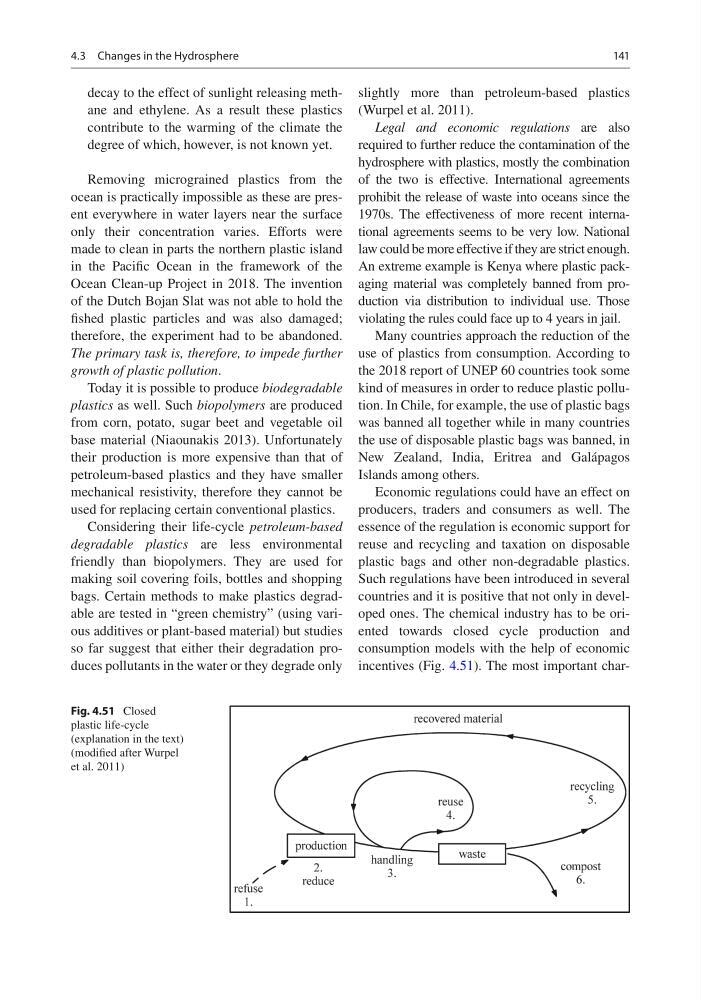
countries and it is positive that not only in developed ones. The chemical industry has to be oriented towards closed cycle production and
consumption models with the help of economic
incentives (Fig. 4.51). The most important charFig. 4.51 Closed
plastic life-cycle
(explanation in the text)
(modified after Wurpel
et al. 2011)
4.3 Changes in the Hydrosphere
decay to the effect of sunlight releasing methane and ethylene. As a result these plastics
contribute to the warming of the climate the
degree of which, however, is not known yet.
Removing micrograined plastics from the
ocean is practically impossible as these are present everywhere in water layers near the surface
only their concentration varies. Efforts were
made to clean in parts the northern plastic island
in the Pacific Ocean in the framework of the
Ocean Clean-up Project in 2018. The invention
of the Dutch Bojan Slat was not able to hold the
fished plastic particles and was also damaged;
therefore, the experiment had to be abandoned.
The primary task is, therefore, to impede further
growth of plastic pollution.
Today it is possible to produce biodegradable
plastics as well. Such biopolymers are produced
from corn, potato, sugar beet and vegetable oil
base material (Niaounakis 2013). Unfortunately
their production is more expensive than that of
petroleum-based plastics and they have smaller
mechanical resistivity, therefore they cannot be
used for replacing certain conventional plastics.
Considering their life-cycle petroleum-based
degradable plastics are less environmental
friendly than biopolymers. They are used for
making soil covering foils, bottles and shopping
bags. Certain methods to make plastics degradable are tested in “green chemistry” (using various additives or plant-based material) but studies
so far suggest that either their degradation produces pollutants in the water or they degrade only
slightly more than petroleum-based plastics
(Wurpel et al. 2011).
Legal and economic regulations are also
required to further reduce the contamination of the
hydrosphere with plastics, mostly the combination
of the two is effective. International agreements
prohibit the release of waste into oceans since the
1970s. The effectiveness of more recent international agreements seems to be very low. National
law could be more effective if they are strict enough.
An extreme example is Kenya where plastic packaging material was completely banned from production via distribution to individual use. Those
violating the rules could face up to 4 years in jail.
Many countries approach the reduction of the
use of plastics from consumption. According to
the 2018 report of UNEP 60 countries took some
kind of measures in order to reduce plastic pollution. In Chile, for example, the use of plastic bags
was banned all together while in many countries
the use of disposable plastic bags was banned, in
New Zealand, India, Eritrea and Galápagos
Islands among others.
Economic regulations could have an effect on
producers, traders and consumers as well. The
essence of the regulation is economic support for
reuse and recycling and taxation on disposable
plastic bags and other non-degradable plastics.
Such regulations have been introduced in several
countries and it is positive that not only in developed ones. The chemical industry has to be oriented towards closed cycle production and
consumption models with the help of economic
incentives (Fig. 4.51). The most important charFig. 4.51 Closed
plastic life-cycle
(explanation in the text)
(modified after Wurpel
et al. 2011)
4.3 Changes in the Hydrosphere