

129
ries. Since such production systems apply the
fundamental law of ecology in farming, it is
essential to utilise the soil-plant-animal relationship in production. In this process the farmer
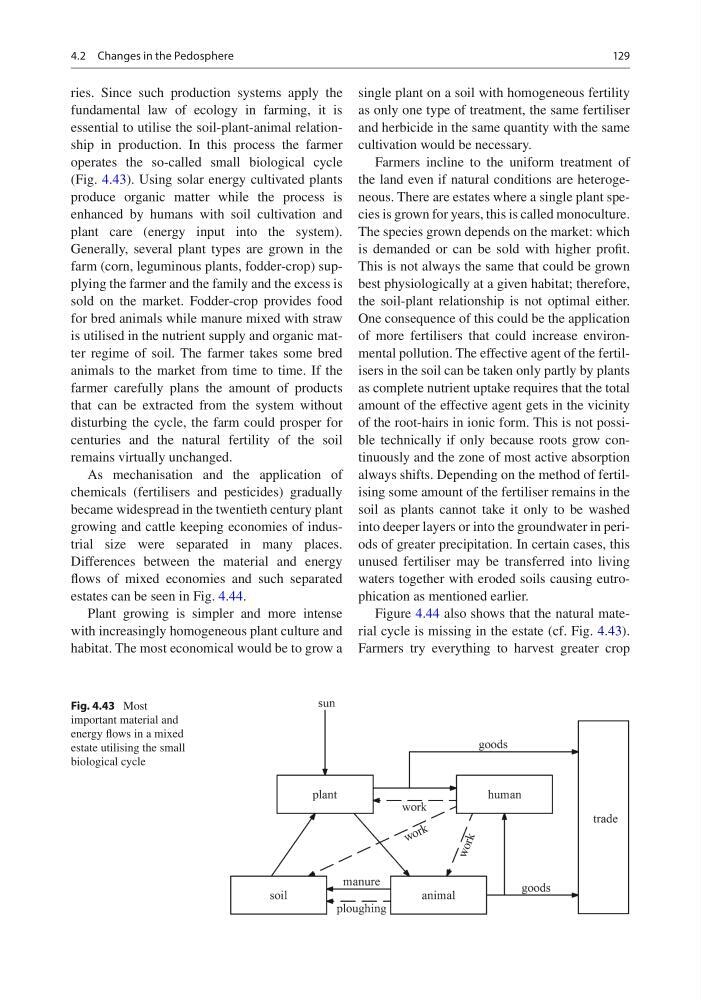
operates the so-called small biological cycle
(Fig. 4.43). Using solar energy cultivated plants
produce organic matter while the process is
enhanced by humans with soil cultivation and
plant care (energy input into the system).
Generally, several plant types are grown in the
farm (corn, leguminous plants, fodder-crop) supplying the farmer and the family and the excess is
sold on the market. Fodder-crop provides food
for bred animals while manure mixed with straw
is utilised in the nutrient supply and organic matter regime of soil. The farmer takes some bred
animals to the market from time to time. If the
farmer carefully plans the amount of products
that can be extracted from the system without
disturbing the cycle, the farm could prosper for
centuries and the natural fertility of the soil
remains virtually unchanged.
As mechanisation and the application of
chemicals (fertilisers and pesticides) gradually
became widespread in the twentieth century plant
growing and cattle keeping economies of industrial size were separated in many places.
Differences between the material and energy
flows of mixed economies and such separated
estates can be seen in Fig. 4.44.
Plant growing is simpler and more intense
with increasingly homogeneous plant culture and
habitat. The most economical would be to grow a
single plant on a soil with homogeneous fertility
as only one type of treatment, the same fertiliser
and herbicide in the same quantity with the same
cultivation would be necessary.
Farmers incline to the uniform treatment of
the land even if natural conditions are heterogeneous. There are estates where a single plant species is grown for years, this is called monoculture.
The species grown depends on the market: which
is demanded or can be sold with higher profit.
This is not always the same that could be grown
best physiologically at a given habitat; therefore,
the soil-plant relationship is not optimal either.
One consequence of this could be the application
of more fertilisers that could increase environmental pollution. The effective agent of the fertilisers in the soil can be taken only partly by plants
as complete nutrient uptake requires that the total
amount of the effective agent gets in the vicinity
of the root-hairs in ionic form. This is not possible technically if only because roots grow continuously and the zone of most active absorption
always shifts. Depending on the method of fertilising some amount of the fertiliser remains in the
soil as plants cannot take it only to be washed
into deeper layers or into the groundwater in periods of greater precipitation. In certain cases, this
unused fertiliser may be transferred into living
waters together with eroded soils causing eutrophication as mentioned earlier.
Figure 4.44 also shows that the natural material cycle is missing in the estate (cf. Fig. 4.43).
Farmers try everything to harvest greater crop
Fig. 4.43 Most
important material and
energy flows in a mixed
estate utilising the small
biological cycle
4.2 Changes in the Pedosphere
ries. Since such production systems apply the
fundamental law of ecology in farming, it is
essential to utilise the soil-plant-animal relationship in production. In this process the farmer
operates the so-called small biological cycle
(Fig. 4.43). Using solar energy cultivated plants
produce organic matter while the process is
enhanced by humans with soil cultivation and
plant care (energy input into the system).
Generally, several plant types are grown in the
farm (corn, leguminous plants, fodder-crop) supplying the farmer and the family and the excess is
sold on the market. Fodder-crop provides food
for bred animals while manure mixed with straw
is utilised in the nutrient supply and organic matter regime of soil. The farmer takes some bred
animals to the market from time to time. If the
farmer carefully plans the amount of products
that can be extracted from the system without
disturbing the cycle, the farm could prosper for
centuries and the natural fertility of the soil
remains virtually unchanged.
As mechanisation and the application of
chemicals (fertilisers and pesticides) gradually
became widespread in the twentieth century plant
growing and cattle keeping economies of industrial size were separated in many places.
Differences between the material and energy
flows of mixed economies and such separated
estates can be seen in Fig. 4.44.
Plant growing is simpler and more intense
with increasingly homogeneous plant culture and
habitat. The most economical would be to grow a
single plant on a soil with homogeneous fertility
as only one type of treatment, the same fertiliser
and herbicide in the same quantity with the same
cultivation would be necessary.
Farmers incline to the uniform treatment of
the land even if natural conditions are heterogeneous. There are estates where a single plant species is grown for years, this is called monoculture.
The species grown depends on the market: which
is demanded or can be sold with higher profit.
This is not always the same that could be grown
best physiologically at a given habitat; therefore,
the soil-plant relationship is not optimal either.
One consequence of this could be the application
of more fertilisers that could increase environmental pollution. The effective agent of the fertilisers in the soil can be taken only partly by plants
as complete nutrient uptake requires that the total
amount of the effective agent gets in the vicinity
of the root-hairs in ionic form. This is not possible technically if only because roots grow continuously and the zone of most active absorption
always shifts. Depending on the method of fertilising some amount of the fertiliser remains in the
soil as plants cannot take it only to be washed
into deeper layers or into the groundwater in periods of greater precipitation. In certain cases, this
unused fertiliser may be transferred into living
waters together with eroded soils causing eutrophication as mentioned earlier.
Figure 4.44 also shows that the natural material cycle is missing in the estate (cf. Fig. 4.43).
Farmers try everything to harvest greater crop
Fig. 4.43 Most
important material and
energy flows in a mixed
estate utilising the small
biological cycle
4.2 Changes in the Pedosphere