

127
authors note that they hope that humans will
never use this extent of areas for agricultural purposes since it would destroy a significant portion
of the biosphere via destroying natural vegetation
even threatening significantly the human race as
humans attached to the biosphere with numerous
threads.)
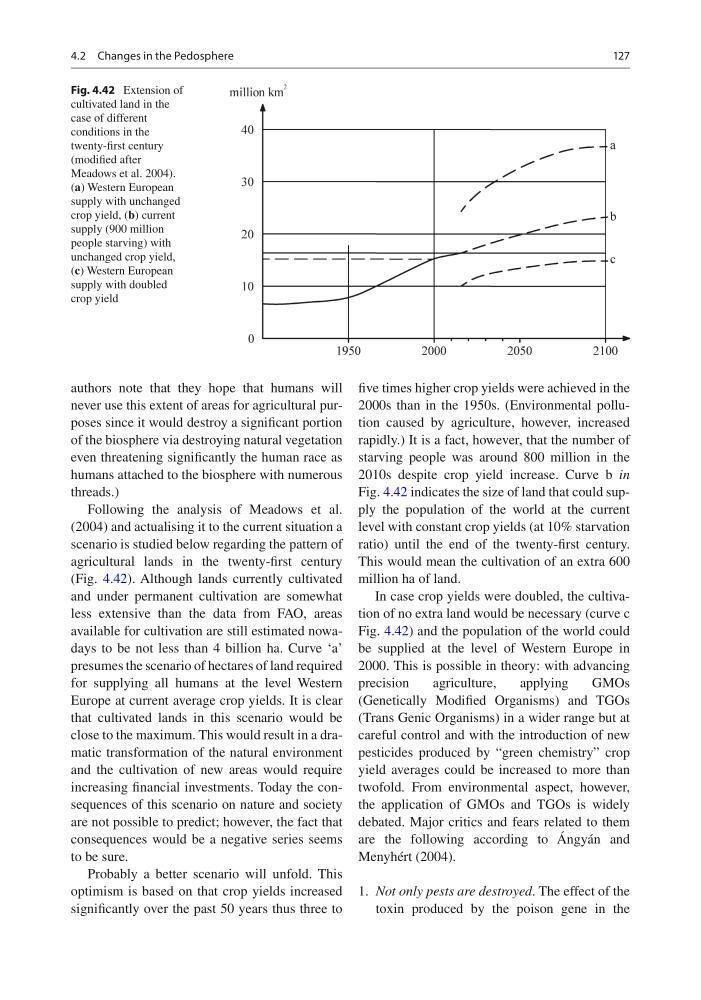
Following the analysis of Meadows et al.
(2004) and actualising it to the current situation a
scenario is studied below regarding the pattern of
agricultural lands in the twenty-first century
(Fig. 4.42). Although lands currently cultivated
and under permanent cultivation are somewhat
less extensive than the data from FAO, areas
available for cultivation are still estimated nowadays to be not less than 4 billion ha. Curve ‘a’
presumes the scenario of hectares of land required
for supplying all humans at the level Western
Europe at current average crop yields. It is clear
that cultivated lands in this scenario would be
close to the maximum. This would result in a dramatic transformation of the natural environment
and the cultivation of new areas would require
increasing financial investments. Today the consequences of this scenario on nature and society
are not possible to predict; however, the fact that
consequences would be a negative series seems
to be sure.
Probably a better scenario will unfold. This
optimism is based on that crop yields increased
significantly over the past 50 years thus three to
five times higher crop yields were achieved in the
2000s than in the 1950s. (Environmental pollution caused by agriculture, however, increased
rapidly.) It is a fact, however, that the number of
starving people was around 800 million in the
2010s despite crop yield increase. Curve b in
Fig. 4.42 indicates the size of land that could supply the population of the world at the current
level with constant crop yields (at 10% starvation
ratio) until the end of the twenty-first century.
This would mean the cultivation of an extra 600
million ha of land.
In case crop yields were doubled, the cultivation of no extra land would be necessary (curve c
Fig. 4.42) and the population of the world could
be supplied at the level of Western Europe in
2000. This is possible in theory: with advancing
precision
agriculture,
applying
GMOs
(Genetically Modified Organisms) and TGOs
(Trans Genic Organisms) in a wider range but at
careful control and with the introduction of new
pesticides produced by “green chemistry” crop
yield averages could be increased to more than
twofold. From environmental aspect, however,
the application of GMOs and TGOs is widely
debated. Major critics and fears related to them
are the following according to Ángyán and
Menyhért (2004).
1. Not only pests are destroyed. The effect of the
toxin produced by the poison gene in the
Fig. 4.42 Extension of
cultivated land in the
case of different
conditions in the
twenty-first century
(modified after
Meadows et al. 2004).
(a) Western European
supply with unchanged
crop yield, (b) current
supply (900 million
people starving) with
unchanged crop yield,
(c) Western European
supply with doubled
crop yield
4.2 Changes in the Pedosphere
authors note that they hope that humans will
never use this extent of areas for agricultural purposes since it would destroy a significant portion
of the biosphere via destroying natural vegetation
even threatening significantly the human race as
humans attached to the biosphere with numerous
threads.)
Following the analysis of Meadows et al.
(2004) and actualising it to the current situation a
scenario is studied below regarding the pattern of
agricultural lands in the twenty-first century
(Fig. 4.42). Although lands currently cultivated
and under permanent cultivation are somewhat
less extensive than the data from FAO, areas
available for cultivation are still estimated nowadays to be not less than 4 billion ha. Curve ‘a’
presumes the scenario of hectares of land required
for supplying all humans at the level Western
Europe at current average crop yields. It is clear
that cultivated lands in this scenario would be
close to the maximum. This would result in a dramatic transformation of the natural environment
and the cultivation of new areas would require
increasing financial investments. Today the consequences of this scenario on nature and society
are not possible to predict; however, the fact that
consequences would be a negative series seems
to be sure.
Probably a better scenario will unfold. This
optimism is based on that crop yields increased
significantly over the past 50 years thus three to
five times higher crop yields were achieved in the
2000s than in the 1950s. (Environmental pollution caused by agriculture, however, increased
rapidly.) It is a fact, however, that the number of
starving people was around 800 million in the
2010s despite crop yield increase. Curve b in
Fig. 4.42 indicates the size of land that could supply the population of the world at the current
level with constant crop yields (at 10% starvation
ratio) until the end of the twenty-first century.
This would mean the cultivation of an extra 600
million ha of land.
In case crop yields were doubled, the cultivation of no extra land would be necessary (curve c
Fig. 4.42) and the population of the world could
be supplied at the level of Western Europe in
2000. This is possible in theory: with advancing
precision
agriculture,
applying
GMOs
(Genetically Modified Organisms) and TGOs
(Trans Genic Organisms) in a wider range but at
careful control and with the introduction of new
pesticides produced by “green chemistry” crop
yield averages could be increased to more than
twofold. From environmental aspect, however,
the application of GMOs and TGOs is widely
debated. Major critics and fears related to them
are the following according to Ángyán and
Menyhért (2004).
1. Not only pests are destroyed. The effect of the
toxin produced by the poison gene in the
Fig. 4.42 Extension of
cultivated land in the
case of different
conditions in the
twenty-first century
(modified after
Meadows et al. 2004).
(a) Western European
supply with unchanged
crop yield, (b) current
supply (900 million
people starving) with
unchanged crop yield,
(c) Western European
supply with doubled
crop yield
4.2 Changes in the Pedosphere