

126
ing nutrient in waters, limiting the growth of
plants and indirectly animals as well. As a result
of using fertilisers the phosphorus content of
soils increased and large amount of phosphorus
got into rivers due to soil erosion. According to
Filippelli (2008), natural phosphorus load doubled in rivers (forest clearings also contributed to
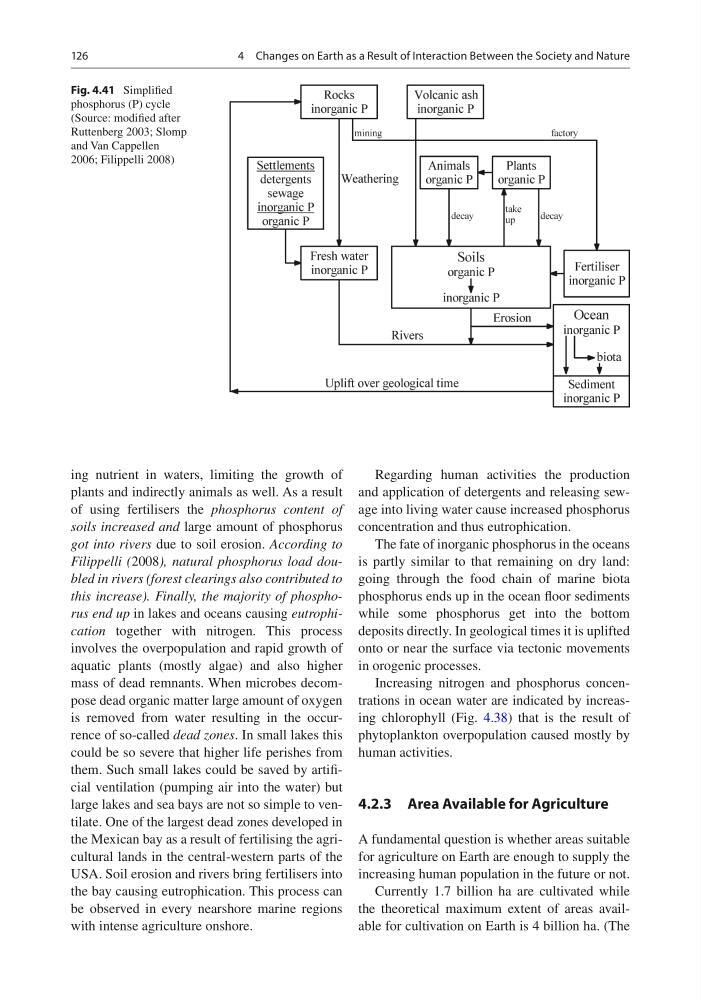
this increase). Finally, the majority of phosphorus end up in lakes and oceans causing eutrophication together with nitrogen. This process
involves the overpopulation and rapid growth of
aquatic plants (mostly algae) and also higher
mass of dead remnants. When microbes decompose dead organic matter large amount of oxygen
is removed from water resulting in the occurrence of so-called dead zones. In small lakes this
could be so severe that higher life perishes from
them. Such small lakes could be saved by artificial ventilation (pumping air into the water) but
large lakes and sea bays are not so simple to ventilate. One of the largest dead zones developed in
the Mexican bay as a result of fertilising the agricultural lands in the central-western parts of the
USA. Soil erosion and rivers bring fertilisers into
the bay causing eutrophication. This process can
be observed in every nearshore marine regions
with intense agriculture onshore.
Regarding human activities the production
and application of detergents and releasing sewage into living water cause increased phosphorus
concentration and thus eutrophication.
The fate of inorganic phosphorus in the oceans
is partly similar to that remaining on dry land:
going through the food chain of marine biota
phosphorus ends up in the ocean floor sediments
while some phosphorus get into the bottom
deposits directly. In geological times it is uplifted
onto or near the surface via tectonic movements
in orogenic processes.
Increasing nitrogen and phosphorus concentrations in ocean water are indicated by increasing chlorophyll (Fig. 4.38) that is the result of
phytoplankton overpopulation caused mostly by
human activities.
4.2.3 Area Available for Agriculture
A fundamental question is whether areas suitable
for agriculture on Earth are enough to supply the
increasing human population in the future or not.
Currently 1.7 billion ha are cultivated while
the theoretical maximum extent of areas available for cultivation on Earth is 4 billion ha. (The
Fig. 4.41 Simplified
phosphorus (P) cycle
(Source: modified after
Ruttenberg 2003; Slomp
and Van Cappellen
2006; Filippelli 2008)
4 Changes on Earth as a Result of Interaction Between the Society and Nature
ing nutrient in waters, limiting the growth of
plants and indirectly animals as well. As a result
of using fertilisers the phosphorus content of
soils increased and large amount of phosphorus
got into rivers due to soil erosion. According to
Filippelli (2008), natural phosphorus load doubled in rivers (forest clearings also contributed to
this increase). Finally, the majority of phosphorus end up in lakes and oceans causing eutrophication together with nitrogen. This process
involves the overpopulation and rapid growth of
aquatic plants (mostly algae) and also higher
mass of dead remnants. When microbes decompose dead organic matter large amount of oxygen
is removed from water resulting in the occurrence of so-called dead zones. In small lakes this
could be so severe that higher life perishes from
them. Such small lakes could be saved by artificial ventilation (pumping air into the water) but
large lakes and sea bays are not so simple to ventilate. One of the largest dead zones developed in
the Mexican bay as a result of fertilising the agricultural lands in the central-western parts of the
USA. Soil erosion and rivers bring fertilisers into
the bay causing eutrophication. This process can
be observed in every nearshore marine regions
with intense agriculture onshore.
Regarding human activities the production
and application of detergents and releasing sewage into living water cause increased phosphorus
concentration and thus eutrophication.
The fate of inorganic phosphorus in the oceans
is partly similar to that remaining on dry land:
going through the food chain of marine biota
phosphorus ends up in the ocean floor sediments
while some phosphorus get into the bottom
deposits directly. In geological times it is uplifted
onto or near the surface via tectonic movements
in orogenic processes.
Increasing nitrogen and phosphorus concentrations in ocean water are indicated by increasing chlorophyll (Fig. 4.38) that is the result of
phytoplankton overpopulation caused mostly by
human activities.
4.2.3 Area Available for Agriculture
A fundamental question is whether areas suitable
for agriculture on Earth are enough to supply the
increasing human population in the future or not.
Currently 1.7 billion ha are cultivated while
the theoretical maximum extent of areas available for cultivation on Earth is 4 billion ha. (The
Fig. 4.41 Simplified
phosphorus (P) cycle
(Source: modified after
Ruttenberg 2003; Slomp
and Van Cappellen
2006; Filippelli 2008)
4 Changes on Earth as a Result of Interaction Between the Society and Nature