

123
Figure 4.38 also shows that extended areas of
dry land are degraded due to natural conditions.
Soils are frozen over most of the year in polar or
boreal areas and climatic conditions also hinder
plant cultivation. Vertisols are soils with great
clay content the physical properties of which
make agricultural utilisation impossible.
4.2.2 Effects of Using Fertilisers
on Nitrogen and Phosphorus
Cycles
Nitrogen is an essential element for life just like
carbon. Nitrogen is an important constituent of
nucleic acids, amino acids and proteins; therefore, it is essential for living beings to input nitrogen. It is also an important constituent of humus
molecules that have a decisive role in the fertility
of soils. Nitrogen is also the gas in greatest quantity in the atmosphere: its total mass (rounded) is
3.9 × 10
15
tonnes.
Around 99.99% of this vast amount is molecular nitrogen and only 0.01% is reactive nitrogen
(Nr) that is involved in the global cycle mostly in
the form of compounds. Environmental chemical
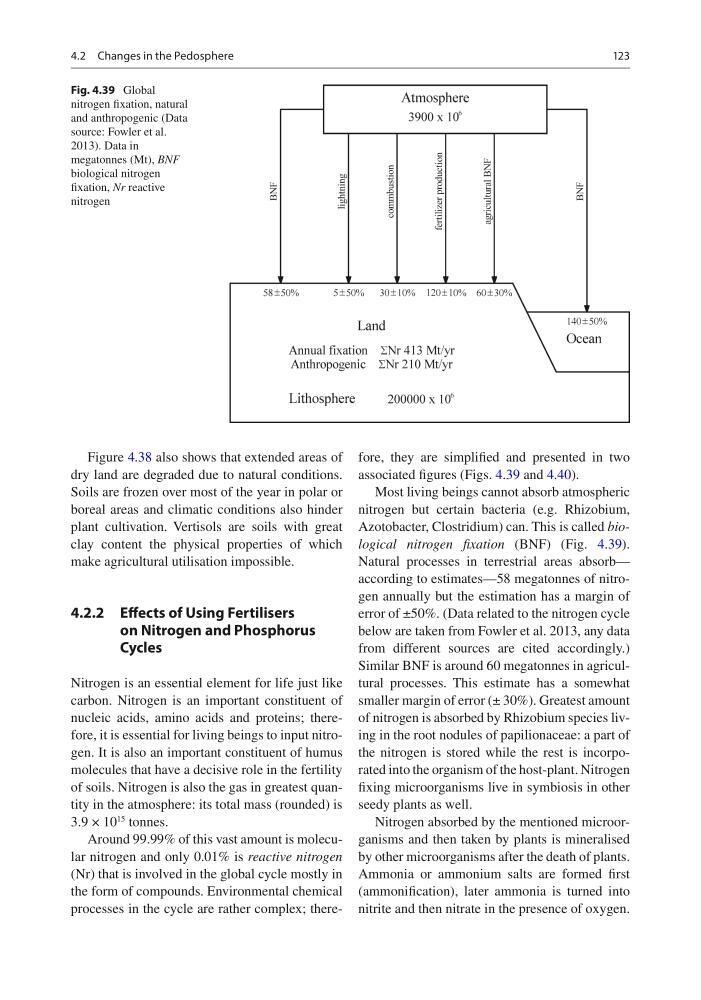
processes in the cycle are rather complex; therefore, they are simplified and presented in two
associated figures (Figs. 4.39 and 4.40).
Most living beings cannot absorb atmospheric
nitrogen but certain bacteria (e.g. Rhizobium,
Azotobacter, Clostridium) can. This is called biological nitrogen fixation (BNF) (Fig. 4.39).
Natural processes in terrestrial areas absorb—
according to estimates—58 megatonnes of nitrogen annually but the estimation has a margin of
error of ±50%. (Data related to the nitrogen cycle
below are taken from Fowler et al. 2013, any data
from different sources are cited accordingly.)
Similar BNF is around 60 megatonnes in agricultural processes. This estimate has a somewhat
smaller margin of error (± 30%). Greatest amount
of nitrogen is absorbed by Rhizobium species living in the root nodules of papilionaceae: a part of
the nitrogen is stored while the rest is incorporated into the organism of the host-plant. Nitrogen
fixing microorganisms live in symbiosis in other
seedy plants as well.
Nitrogen absorbed by the mentioned microorganisms and then taken by plants is mineralised
by other microorganisms after the death of plants.
Ammonia or ammonium salts are formed first
(ammonification), later ammonia is turned into
nitrite and then nitrate in the presence of oxygen.
Fig. 4.39 Global
nitrogen fixation, natural
and anthropogenic (Data
source: Fowler et al.
2013). Data in
megatonnes (Mt), BNF
biological nitrogen
fixation, Nr reactive
nitrogen
4.2 Changes in the Pedosphere
Figure 4.38 also shows that extended areas of
dry land are degraded due to natural conditions.
Soils are frozen over most of the year in polar or
boreal areas and climatic conditions also hinder
plant cultivation. Vertisols are soils with great
clay content the physical properties of which
make agricultural utilisation impossible.
4.2.2 Effects of Using Fertilisers
on Nitrogen and Phosphorus
Cycles
Nitrogen is an essential element for life just like
carbon. Nitrogen is an important constituent of
nucleic acids, amino acids and proteins; therefore, it is essential for living beings to input nitrogen. It is also an important constituent of humus
molecules that have a decisive role in the fertility
of soils. Nitrogen is also the gas in greatest quantity in the atmosphere: its total mass (rounded) is
3.9 × 10
15
tonnes.
Around 99.99% of this vast amount is molecular nitrogen and only 0.01% is reactive nitrogen
(Nr) that is involved in the global cycle mostly in
the form of compounds. Environmental chemical
processes in the cycle are rather complex; therefore, they are simplified and presented in two
associated figures (Figs. 4.39 and 4.40).
Most living beings cannot absorb atmospheric
nitrogen but certain bacteria (e.g. Rhizobium,
Azotobacter, Clostridium) can. This is called biological nitrogen fixation (BNF) (Fig. 4.39).
Natural processes in terrestrial areas absorb—
according to estimates—58 megatonnes of nitrogen annually but the estimation has a margin of
error of ±50%. (Data related to the nitrogen cycle
below are taken from Fowler et al. 2013, any data
from different sources are cited accordingly.)
Similar BNF is around 60 megatonnes in agricultural processes. This estimate has a somewhat
smaller margin of error (± 30%). Greatest amount
of nitrogen is absorbed by Rhizobium species living in the root nodules of papilionaceae: a part of
the nitrogen is stored while the rest is incorporated into the organism of the host-plant. Nitrogen
fixing microorganisms live in symbiosis in other
seedy plants as well.
Nitrogen absorbed by the mentioned microorganisms and then taken by plants is mineralised
by other microorganisms after the death of plants.
Ammonia or ammonium salts are formed first
(ammonification), later ammonia is turned into
nitrite and then nitrate in the presence of oxygen.
Fig. 4.39 Global
nitrogen fixation, natural
and anthropogenic (Data
source: Fowler et al.
2013). Data in
megatonnes (Mt), BNF
biological nitrogen
fixation, Nr reactive
nitrogen
4.2 Changes in the Pedosphere