

106
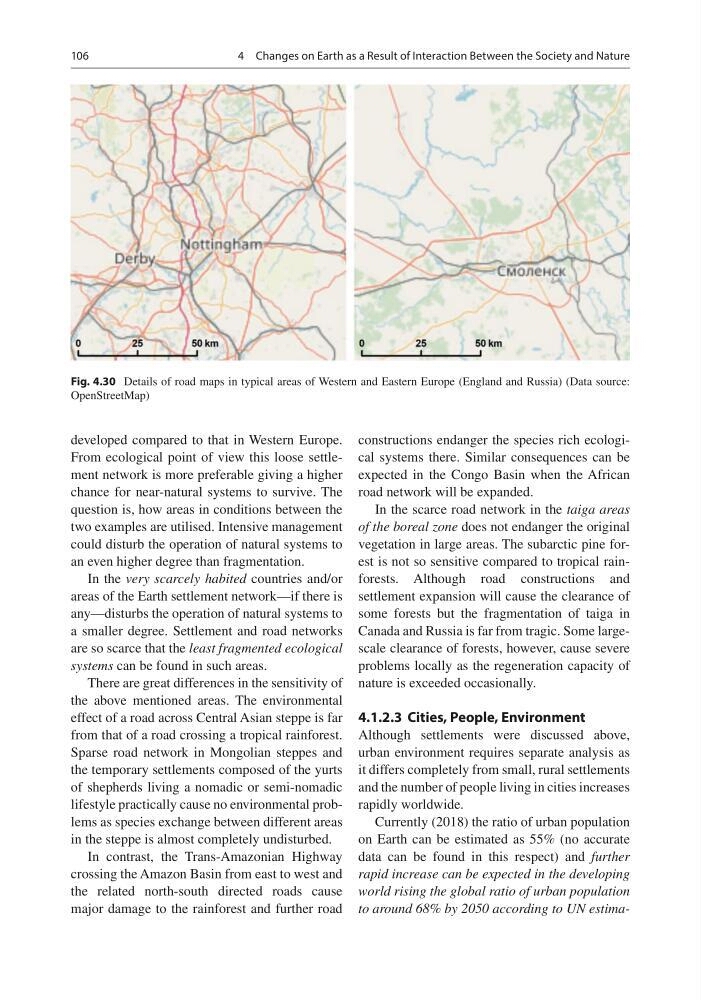
developed compared to that in Western Europe.
From ecological point of view this loose settlement network is more preferable giving a higher
chance for near-natural systems to survive. The
question is, how areas in conditions between the
two examples are utilised. Intensive management
could disturb the operation of natural systems to
an even higher degree than fragmentation.
In the very scarcely habited countries and/or
areas of the Earth settlement network—if there is
any—disturbs the operation of natural systems to
a smaller degree. Settlement and road networks
are so scarce that the least fragmented ecological
systems can be found in such areas.
There are great differences in the sensitivity of
the above mentioned areas. The environmental
effect of a road across Central Asian steppe is far
from that of a road crossing a tropical rainforest.
Sparse road network in Mongolian steppes and
the temporary settlements composed of the yurts
of shepherds living a nomadic or semi-nomadic
lifestyle practically cause no environmental problems as species exchange between different areas
in the steppe is almost completely undisturbed.
In contrast, the Trans-Amazonian Highway
crossing the Amazon Basin from east to west and
the related north-south directed roads cause
major damage to the rainforest and further road
constructions endanger the species rich ecological systems there. Similar consequences can be
expected in the Congo Basin when the African
road network will be expanded.
In the scarce road network in the taiga areas
of the boreal zone does not endanger the original
vegetation in large areas. The subarctic pine forest is not so sensitive compared to tropical rainforests. Although road constructions and
settlement expansion will cause the clearance of
some forests but the fragmentation of taiga in
Canada and Russia is far from tragic. Some largescale clearance of forests, however, cause severe
problems locally as the regeneration capacity of
nature is exceeded occasionally.
4.1.2.3 Cities, People, Environment
Although settlements were discussed above,
urban environment requires separate analysis as
it differs completely from small, rural settlements
and the number of people living in cities increases
rapidly worldwide.
Currently (2018) the ratio of urban population
on Earth can be estimated as 55% (no accurate
data can be found in this respect) and further
rapid increase can be expected in the developing
world rising the global ratio of urban population
to around 68% by 2050 according to UN estimaFig. 4.30 Details of road maps in typical areas of Western and Eastern Europe (England and Russia) (Data source:
OpenStreetMap)
4 Changes on Earth as a Result of Interaction Between the Society and Nature
developed compared to that in Western Europe.
From ecological point of view this loose settlement network is more preferable giving a higher
chance for near-natural systems to survive. The
question is, how areas in conditions between the
two examples are utilised. Intensive management
could disturb the operation of natural systems to
an even higher degree than fragmentation.
In the very scarcely habited countries and/or
areas of the Earth settlement network—if there is
any—disturbs the operation of natural systems to
a smaller degree. Settlement and road networks
are so scarce that the least fragmented ecological
systems can be found in such areas.
There are great differences in the sensitivity of
the above mentioned areas. The environmental
effect of a road across Central Asian steppe is far
from that of a road crossing a tropical rainforest.
Sparse road network in Mongolian steppes and
the temporary settlements composed of the yurts
of shepherds living a nomadic or semi-nomadic
lifestyle practically cause no environmental problems as species exchange between different areas
in the steppe is almost completely undisturbed.
In contrast, the Trans-Amazonian Highway
crossing the Amazon Basin from east to west and
the related north-south directed roads cause
major damage to the rainforest and further road
constructions endanger the species rich ecological systems there. Similar consequences can be
expected in the Congo Basin when the African
road network will be expanded.
In the scarce road network in the taiga areas
of the boreal zone does not endanger the original
vegetation in large areas. The subarctic pine forest is not so sensitive compared to tropical rainforests. Although road constructions and
settlement expansion will cause the clearance of
some forests but the fragmentation of taiga in
Canada and Russia is far from tragic. Some largescale clearance of forests, however, cause severe
problems locally as the regeneration capacity of
nature is exceeded occasionally.
4.1.2.3 Cities, People, Environment
Although settlements were discussed above,
urban environment requires separate analysis as
it differs completely from small, rural settlements
and the number of people living in cities increases
rapidly worldwide.
Currently (2018) the ratio of urban population
on Earth can be estimated as 55% (no accurate
data can be found in this respect) and further
rapid increase can be expected in the developing
world rising the global ratio of urban population
to around 68% by 2050 according to UN estimaFig. 4.30 Details of road maps in typical areas of Western and Eastern Europe (England and Russia) (Data source:
OpenStreetMap)
4 Changes on Earth as a Result of Interaction Between the Society and Nature