

92
than doubling its 2016 production (USGS 2018).
There is no data available separately for ruthenium mining; however, the USGS calculated an
increase of 45% for the annual average price of
the metal from 2016 to 2017. This increase can
be explained again by growing industrial demand
for ruthenium (USGS 2018).
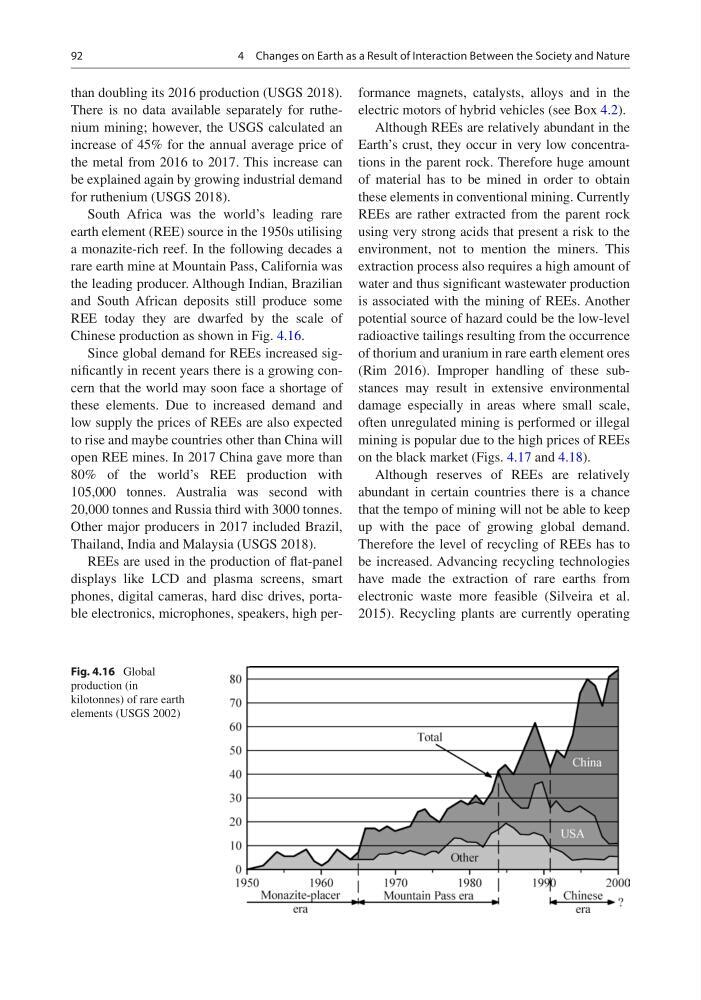
South Africa was the world’s leading rare
earth element (REE) source in the 1950s utilising
a monazite-rich reef. In the following decades a
rare earth mine at Mountain Pass, California was
the leading producer. Although Indian, Brazilian
and South African deposits still produce some
REE today they are dwarfed by the scale of
Chinese production as shown in Fig. 4.16.
Since global demand for REEs increased significantly in recent years there is a growing concern that the world may soon face a shortage of
these elements. Due to increased demand and
low supply the prices of REEs are also expected
to rise and maybe countries other than China will
open REE mines. In 2017 China gave more than
80% of the world’s REE production with
105,000 tonnes. Australia was second with
20,000 tonnes and Russia third with 3000 tonnes.
Other major producers in 2017 included Brazil,
Thailand, India and Malaysia (USGS 2018).
REEs are used in the production of flat-panel
displays like LCD and plasma screens, smart
phones, digital cameras, hard disc drives, portable electronics, microphones, speakers, high performance magnets, catalysts, alloys and in the
electric motors of hybrid vehicles (see Box 4.2).
Although REEs are relatively abundant in the
Earth’s crust, they occur in very low concentrations in the parent rock. Therefore huge amount
of material has to be mined in order to obtain
these elements in conventional mining. Currently
REEs are rather extracted from the parent rock
using very strong acids that present a risk to the
environment, not to mention the miners. This
extraction process also requires a high amount of
water and thus significant wastewater production
is associated with the mining of REEs. Another
potential source of hazard could be the low-level
radioactive tailings resulting from the occurrence
of thorium and uranium in rare earth element ores
(Rim 2016). Improper handling of these substances may result in extensive environmental
damage especially in areas where small scale,
often unregulated mining is performed or illegal
mining is popular due to the high prices of REEs
on the black market (Figs. 4.17 and 4.18).
Although reserves of REEs are relatively
abundant in certain countries there is a chance
that the tempo of mining will not be able to keep
up with the pace of growing global demand.
Therefore the level of recycling of REEs has to
be increased. Advancing recycling technologies
have made the extraction of rare earths from
electronic waste more feasible (Silveira et al.
2015). Recycling plants are currently operating
Fig. 4.16 Global
production (in
kilotonnes) of rare earth
elements (USGS 2002)
4 Changes on Earth as a Result of Interaction Between the Society and Nature
than doubling its 2016 production (USGS 2018).
There is no data available separately for ruthenium mining; however, the USGS calculated an
increase of 45% for the annual average price of
the metal from 2016 to 2017. This increase can
be explained again by growing industrial demand
for ruthenium (USGS 2018).
South Africa was the world’s leading rare
earth element (REE) source in the 1950s utilising
a monazite-rich reef. In the following decades a
rare earth mine at Mountain Pass, California was
the leading producer. Although Indian, Brazilian
and South African deposits still produce some
REE today they are dwarfed by the scale of
Chinese production as shown in Fig. 4.16.
Since global demand for REEs increased significantly in recent years there is a growing concern that the world may soon face a shortage of
these elements. Due to increased demand and
low supply the prices of REEs are also expected
to rise and maybe countries other than China will
open REE mines. In 2017 China gave more than
80% of the world’s REE production with
105,000 tonnes. Australia was second with
20,000 tonnes and Russia third with 3000 tonnes.
Other major producers in 2017 included Brazil,
Thailand, India and Malaysia (USGS 2018).
REEs are used in the production of flat-panel
displays like LCD and plasma screens, smart
phones, digital cameras, hard disc drives, portable electronics, microphones, speakers, high performance magnets, catalysts, alloys and in the
electric motors of hybrid vehicles (see Box 4.2).
Although REEs are relatively abundant in the
Earth’s crust, they occur in very low concentrations in the parent rock. Therefore huge amount
of material has to be mined in order to obtain
these elements in conventional mining. Currently
REEs are rather extracted from the parent rock
using very strong acids that present a risk to the
environment, not to mention the miners. This
extraction process also requires a high amount of
water and thus significant wastewater production
is associated with the mining of REEs. Another
potential source of hazard could be the low-level
radioactive tailings resulting from the occurrence
of thorium and uranium in rare earth element ores
(Rim 2016). Improper handling of these substances may result in extensive environmental
damage especially in areas where small scale,
often unregulated mining is performed or illegal
mining is popular due to the high prices of REEs
on the black market (Figs. 4.17 and 4.18).
Although reserves of REEs are relatively
abundant in certain countries there is a chance
that the tempo of mining will not be able to keep
up with the pace of growing global demand.
Therefore the level of recycling of REEs has to
be increased. Advancing recycling technologies
have made the extraction of rare earths from
electronic waste more feasible (Silveira et al.
2015). Recycling plants are currently operating
Fig. 4.16 Global
production (in
kilotonnes) of rare earth
elements (USGS 2002)
4 Changes on Earth as a Result of Interaction Between the Society and Nature