

Fresh Meats and Poultry
81
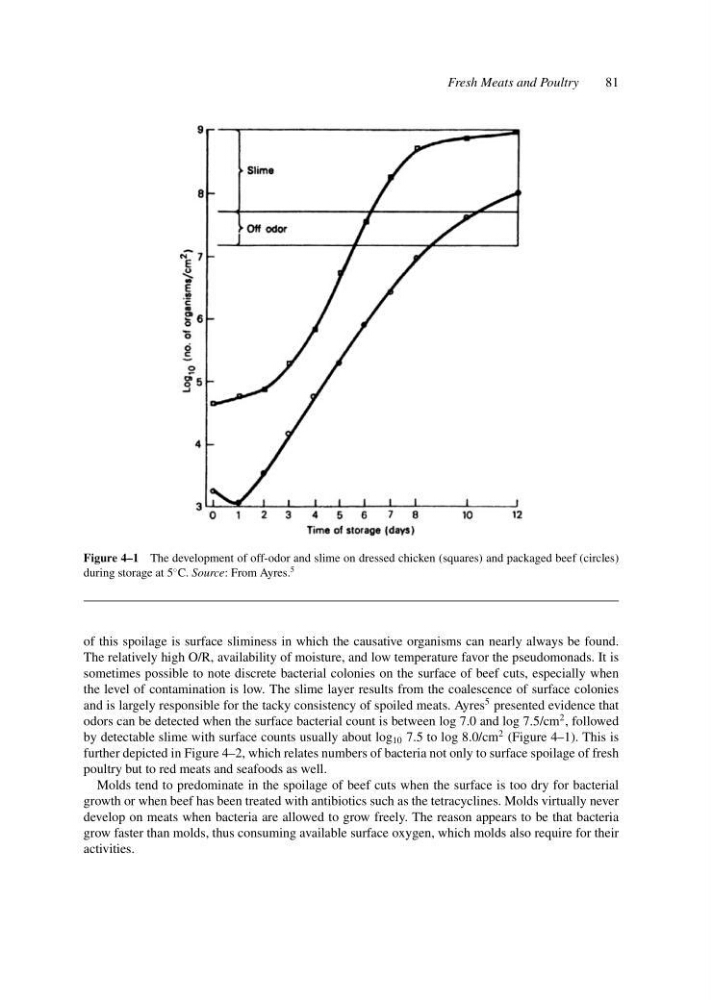
Figure 4–1 The development of off-odor and slime on dressed chicken (squares) and packaged beef (circles)
during storage at 5
◦ C. Source: From Ayres.
5
of this spoilage is surface sliminess in which the causative organisms can nearly always be found.
The relatively high O/R, availability of moisture, and low temperature favor the pseudomonads. It is
sometimes possible to note discrete bacterial colonies on the surface of beef cuts, especially when
the level of contamination is low. The slime layer results from the coalescence of surface colonies
and is largely responsible for the tacky consistency of spoiled meats. Ayres
5 presented evidence that
odors can be detected when the surface bacterial count is between log 7.0 and log 7.5/cm
2 , followed
by detectable slime with surface counts usually about log 10 7.5 to log 8.0/cm
2 (Figure 4–1). This is
further depicted in Figure 4–2, which relates numbers of bacteria not only to surface spoilage of fresh
poultry but to red meats and seafoods as well.
Molds tend to predominate in the spoilage of beef cuts when the surface is too dry for bacterial
growth or when beef has been treated with antibiotics such as the tetracyclines. Molds virtually never
develop on meats when bacteria are allowed to grow freely. The reason appears to be that bacteria
grow faster than molds, thus consuming available surface oxygen, which molds also require for their
activities.
81
Figure 4–1 The development of off-odor and slime on dressed chicken (squares) and packaged beef (circles)
during storage at 5
◦ C. Source: From Ayres.
5
of this spoilage is surface sliminess in which the causative organisms can nearly always be found.
The relatively high O/R, availability of moisture, and low temperature favor the pseudomonads. It is
sometimes possible to note discrete bacterial colonies on the surface of beef cuts, especially when
the level of contamination is low. The slime layer results from the coalescence of surface colonies
and is largely responsible for the tacky consistency of spoiled meats. Ayres
5 presented evidence that
odors can be detected when the surface bacterial count is between log 7.0 and log 7.5/cm
2 , followed
by detectable slime with surface counts usually about log 10 7.5 to log 8.0/cm
2 (Figure 4–1). This is
further depicted in Figure 4–2, which relates numbers of bacteria not only to surface spoilage of fresh
poultry but to red meats and seafoods as well.
Molds tend to predominate in the spoilage of beef cuts when the surface is too dry for bacterial
growth or when beef has been treated with antibiotics such as the tetracyclines. Molds virtually never
develop on meats when bacteria are allowed to grow freely. The reason appears to be that bacteria
grow faster than molds, thus consuming available surface oxygen, which molds also require for their
activities.