

Mycotoxins
713
Relative Toxicity and Mode of Action
For the expression of mutagenicity, mammalian metabolizing systems are essential for aflatoxins,
especially AFB 1 . Also essential is their binding with nucleic acids, especially DNA. Although nuclear
DNA is normally affected, AFB 1 has been shown to bind covalently to liver mitochondrial DNA, preferentially to nuclear DNA.
62 Cellular macromolecules other than nucleic acids are possible sites for
aflatoxins. The site of the aflatoxin molecule responsible for mutagenicity is the C 2 –C 3 double bond
in the dihydrofurofuran moiety. Its reduction to the 2,3-dihydro (AFB 2 ) form reduces mutagenicity by
200- to 500-fold.
84 Following binding to DNA, point mutations are the predominant genetic lesions
induced by aflatoxins, although frameshift mutations are known to occur. The mutagenesis of AFB 1
has been shown to be potentiated twofold by butylated hydroxyanisole (BHA) and butylated hydroxytoluene (BHT) and much less by propyl gallate employing the Ames assay, but whether potentiation
occurs in animal systems is unclear.
77
The LD 50 of AFB 1 for rats by the oral route is 1.2 mg/kg, and 1.5–2.0 mg/kg for AFG 1 .
12 The relative
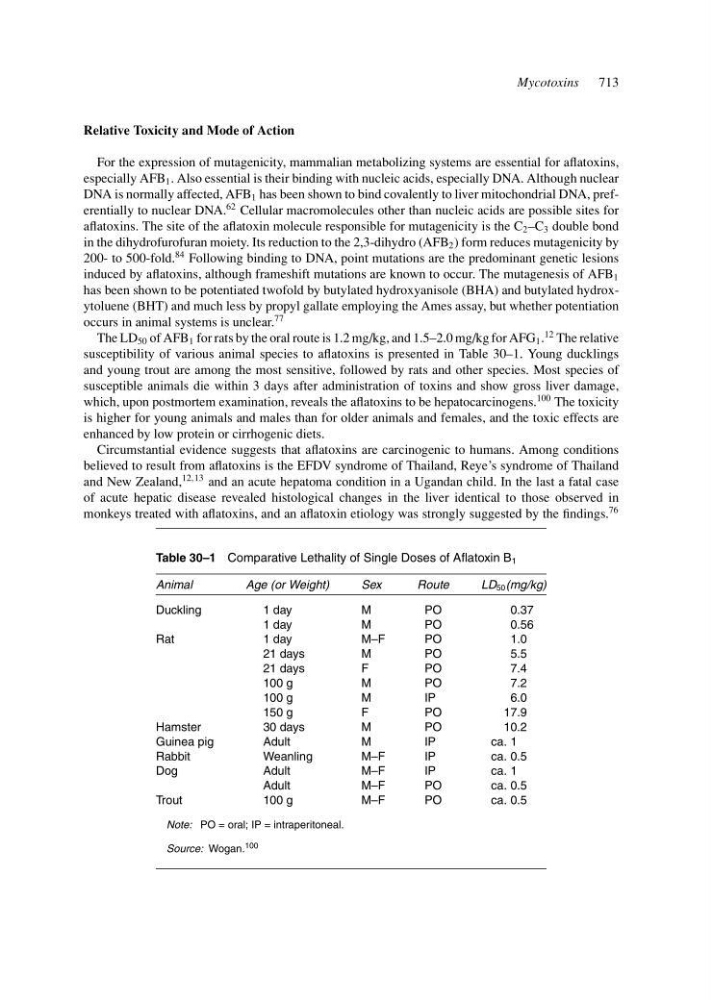
susceptibility of various animal species to aflatoxins is presented in Table 30–1. Young ducklings
and young trout are among the most sensitive, followed by rats and other species. Most species of
susceptible animals die within 3 days after administration of toxins and show gross liver damage,
which, upon postmortem examination, reveals the aflatoxins to be hepatocarcinogens.
100 The toxicity
is higher for young animals and males than for older animals and females, and the toxic effects are
enhanced by low protein or cirrhogenic diets.
Circumstantial evidence suggests that aflatoxins are carcinogenic to humans. Among conditions
believed to result from aflatoxins is the EFDV syndrome of Thailand, Reye’s syndrome of Thailand
and New Zealand,
12,13 and an acute hepatoma condition in a Ugandan child. In the last a fatal case
of acute hepatic disease revealed histological changes in the liver identical to those observed in
monkeys treated with aflatoxins, and an aflatoxin etiology was strongly suggested by the findings.
76
Table 30–1 Comparative Lethality of Single Doses of Aflatoxin B 1
Animal
Age (or Weight)
Sex
Route
LD 50 (mg/kg)
Duckling
1 day
M
PO
0.37
1 day
M
PO
0.56
Rat
1 day
M–F
PO
1.0
21 days
M
PO
5.5
21 days
F
PO
7.4
100 g
M
PO
7.2
100 g
M
IP
6.0
150 g
F
PO
17.9
Hamster
30 days
M
PO
10.2
Guinea pig
Adult
M
IP
ca. 1
Rabbit
Weanling
M–F
IP
ca. 0.5
Dog
Adult
M–F
IP
ca. 1
Adult
M–F
PO
ca. 0.5
Trout
100 g
M–F
PO
ca. 0.5
Note: PO = oral; IP = intraperitoneal.
Source: Wogan. 100