

Foodborne Animal Parasites 689
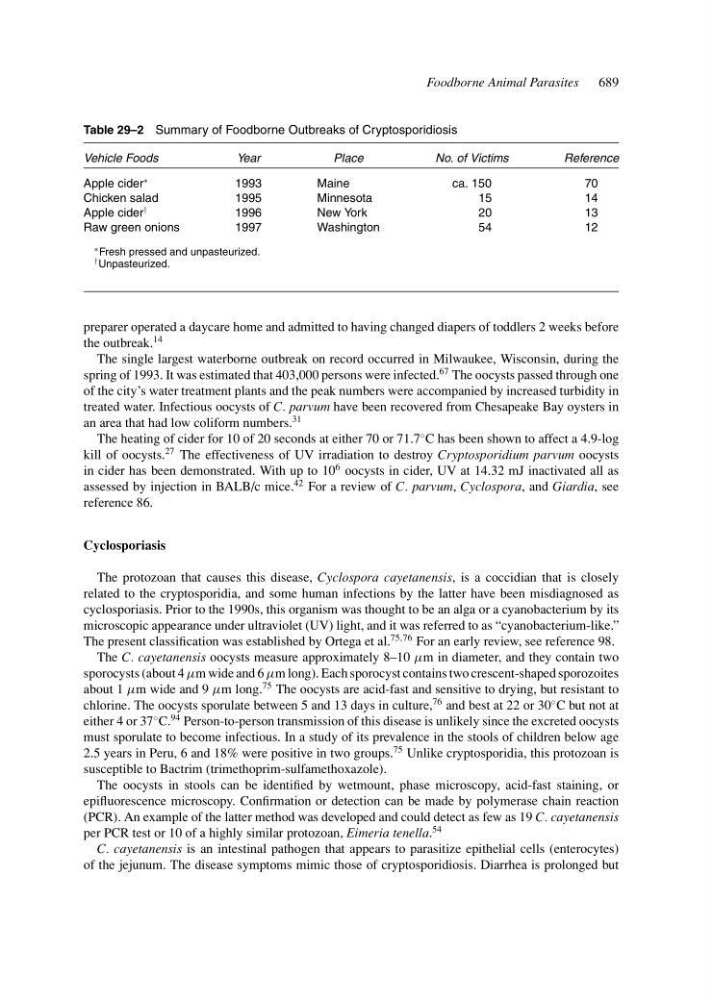
Table 29–2 Summary of Foodborne Outbreaks of Cryptosporidiosis
Vehicle Foods
Year
Place
No. of Victims
Reference
Apple cider
∗
1993
Maine
ca. 150
70
Chicken salad
1995
Minnesota
15
14
Apple cider
†
1996
New York
20
13
Raw green onions
1997
Washington
54
12
∗ Fresh pressed and unpasteurized.
† Unpasteurized.
preparer operated a daycare home and admitted to having changed diapers of toddlers 2 weeks before
the outbreak.
14
The single largest waterborne outbreak on record occurred in Milwaukee, Wisconsin, during the
spring of 1993. It was estimated that 403,000 persons were infected.
67 The oocysts passed through one
of the city’s water treatment plants and the peak numbers were accompanied by increased turbidity in
treated water. Infectious oocysts of C. parvum have been recovered from Chesapeake Bay oysters in
an area that had low coliform numbers.
31
The heating of cider for 10 of 20 seconds at either 70 or 71.7
◦ C has been shown to affect a 4.9-log
kill of oocysts.
27 The effectiveness of UV irradiation to destroy Cryptosporidium parvum oocysts
in cider has been demonstrated. With up to 10
6 oocysts in cider, UV at 14.32 mJ inactivated all as
assessed by injection in BALB/c mice.
42 For a review of C. parvum, Cyclospora, and Giardia, see
reference 86.
Cyclosporiasis
The protozoan that causes this disease, Cyclospora cayetanensis, is a coccidian that is closely
related to the cryptosporidia, and some human infections by the latter have been misdiagnosed as
cyclosporiasis. Prior to the 1990s, this organism was thought to be an alga or a cyanobacterium by its
microscopic appearance under ultraviolet (UV) light, and it was referred to as “cyanobacterium-like.”
The present classification was established by Ortega et al.
75,76 For an early review, see reference 98.
The C. cayetanensis oocysts measure approximately 8–10 µm in diameter, and they contain two
sporocysts (about 4 µm wide and 6 µm long). Each sporocyst contains two crescent-shaped sporozoites
about 1 µm wide and 9 µm long.
75 The oocysts are acid-fast and sensitive to drying, but resistant to
chlorine. The oocysts sporulate between 5 and 13 days in culture,
76 and best at 22 or 30
◦ C but not at
either 4 or 37
◦ C.
94 Person-to-person transmission of this disease is unlikely since the excreted oocysts
must sporulate to become infectious. In a study of its prevalence in the stools of children below age
2.5 years in Peru, 6 and 18% were positive in two groups.
75 Unlike cryptosporidia, this protozoan is
susceptible to Bactrim (trimethoprim-sulfamethoxazole).
The oocysts in stools can be identified by wetmount, phase microscopy, acid-fast staining, or
epifluorescence microscopy. Confirmation or detection can be made by polymerase chain reaction
(PCR). An example of the latter method was developed and could detect as few as 19 C. cayetanensis
per PCR test or 10 of a highly similar protozoan, Eimeria tenella.
54
C. cayetanensis is an intestinal pathogen that appears to parasitize epithelial cells (enterocytes)
of the jejunum. The disease symptoms mimic those of cryptosporidiosis. Diarrhea is prolonged but