

672 Modern Food Microbiology
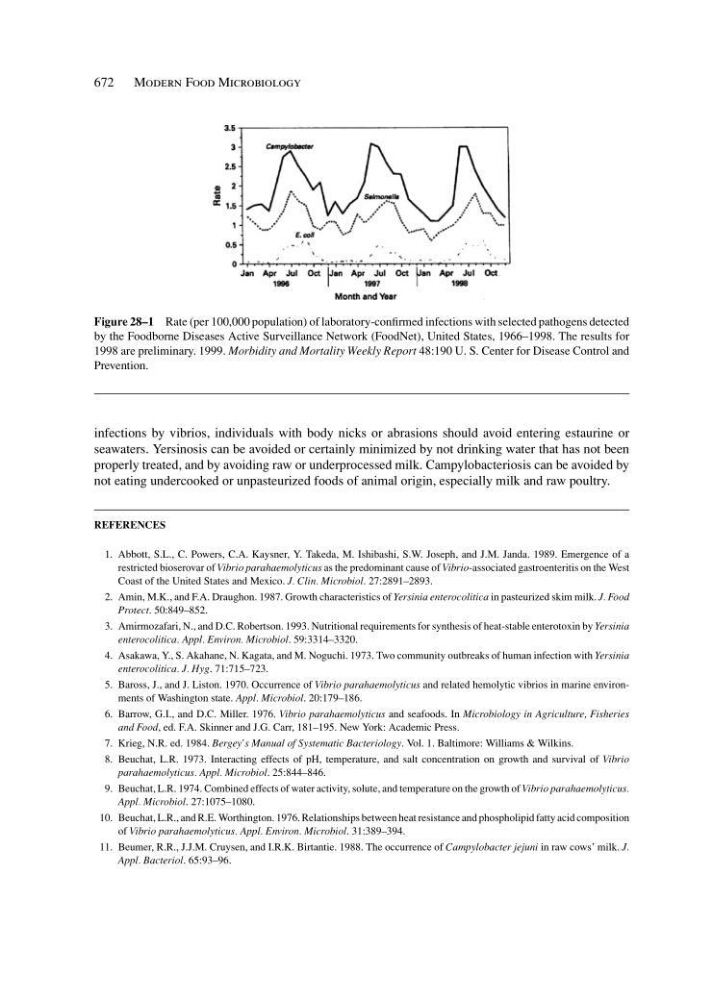
Figure 28–1 Rate (per 100,000 population) of laboratory-confirmed infections with selected pathogens detected
by the Foodborne Diseases Active Surveillance Network (FoodNet), United States, 1966–1998. The results for
1998 are preliminary. 1999. Morbidity and Mortality Weekly Report 48:190 U. S. Center for Disease Control and
Prevention.
infections by vibrios, individuals with body nicks or abrasions should avoid entering estaurine or
seawaters. Yersinosis can be avoided or certainly minimized by not drinking water that has not been
properly treated, and by avoiding raw or underprocessed milk. Campylobacteriosis can be avoided by
not eating undercooked or unpasteurized foods of animal origin, especially milk and raw poultry.
REFERENCES
1. Abbott, S.L., C. Powers, C.A. Kaysner, Y. Takeda, M. Ishibashi, S.W. Joseph, and J.M. Janda. 1989. Emergence of a
restricted bioserovar of Vibrio parahaemolyticus as the predominant cause of Vibrio-associated gastroenteritis on the West
Coast of the United States and Mexico. J. Clin. Microbiol. 27:2891–2893.
2. Amin, M.K., and F.A. Draughon. 1987. Growth characteristics of Yersinia enterocolitica in pasteurized skim milk. J. Food
Protect. 50:849–852.
3. Amirmozafari, N., and D.C. Robertson. 1993. Nutritional requirements for synthesis of heat-stable enterotoxin by Yersinia
enterocolitica. Appl. Environ. Microbiol. 59:3314–3320.
4. Asakawa, Y., S. Akahane, N. Kagata, and M. Noguchi. 1973. Two community outbreaks of human infection with Yersinia
enterocolitica. J. Hyg. 71:715–723.
5. Baross, J., and J. Liston. 1970. Occurrence of Vibrio parahaemolyticus and related hemolytic vibrios in marine environments of Washington state. Appl. Microbiol. 20:179–186.
6. Barrow, G.I., and D.C. Miller. 1976. Vibrio parahaemolyticus and seafoods. In Microbiology in Agriculture, Fisheries
and Food, ed. F.A. Skinner and J.G. Carr, 181–195. New York: Academic Press.
7. Krieg, N.R. ed. 1984. Bergey’s Manual of Systematic Bacteriology. Vol. 1. Baltimore: Williams & Wilkins.
8. Beuchat, L.R. 1973. Interacting effects of pH, temperature, and salt concentration on growth and survival of Vibrio
parahaemolyticus. Appl. Microbiol. 25:844–846.
9. Beuchat, L.R. 1974. Combined effects of water activity, solute, and temperature on the growth of Vibrio parahaemolyticus.
Appl. Microbiol. 27:1075–1080.
10. Beuchat, L.R., and R.E. Worthington. 1976. Relationships between heat resistance and phospholipid fatty acid composition
of Vibrio parahaemolyticus. Appl. Environ. Microbiol. 31:389–394.
11. Beumer, R.R., J.J.M. Cruysen, and I.R.K. Birtantie. 1988. The occurrence of Campylobacter jejuni in raw cows’ milk. J.
Appl. Bacteriol. 65:93–96.