

Foodborne Gastroenteritis Caused by Escherichia coli
647
Table 27–3 Some Cases of EC O157:H7 Gastroenteritis from Drinking
and Recreational Waters in the United States
Year
State
Vehicle
No. of Cases
1995
Minnesota
Spring water
33
1995
Illinois
Lake
12
1995
Minnesota
Lake
8
1995
Wisconsin
Lake
8
1996
Georgia
Pool
18
1996
Minnesota
Lake
6
Source: MMWR Morb Mort Wkly Rep 47, SS-5, 1998.
The numbers of cases of EC O157:H7 recorded by the U.S. Centers for Disease Control and
Prevention (CDC) for the years 1994–1997 are as follows: 1420, 2139, 2741, and 2555, respectively,
for 1994, 1995, 1996, and 1997.
12 In 1997, 1167 or 45.7% occurred in the months of July, August,
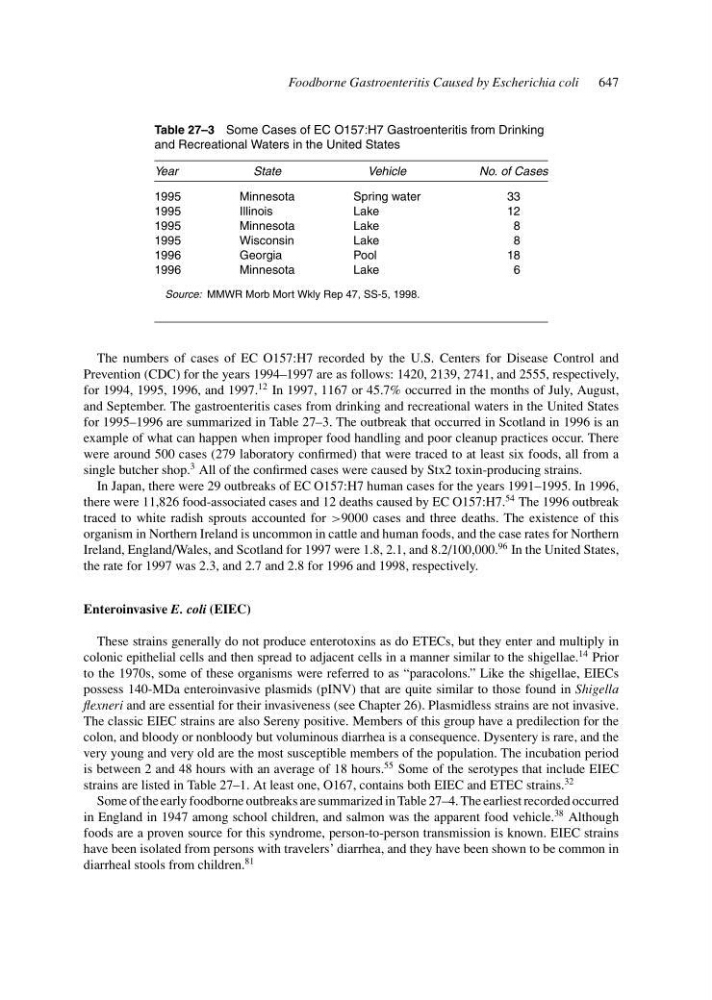
and September. The gastroenteritis cases from drinking and recreational waters in the United States
for 1995–1996 are summarized in Table 27–3. The outbreak that occurred in Scotland in 1996 is an
example of what can happen when improper food handling and poor cleanup practices occur. There
were around 500 cases (279 laboratory confirmed) that were traced to at least six foods, all from a
single butcher shop.
3 All of the confirmed cases were caused by Stx2 toxin-producing strains.
In Japan, there were 29 outbreaks of EC O157:H7 human cases for the years 1991–1995. In 1996,
there were 11,826 food-associated cases and 12 deaths caused by EC O157:H7.
54 The 1996 outbreak
traced to white radish sprouts accounted for >9000 cases and three deaths. The existence of this
organism in Northern Ireland is uncommon in cattle and human foods, and the case rates for Northern
Ireland, England/Wales, and Scotland for 1997 were 1.8, 2.1, and 8.2/100,000.
96 In the United States,
the rate for 1997 was 2.3, and 2.7 and 2.8 for 1996 and 1998, respectively.
Enteroinvasive E. coli (EIEC)
These strains generally do not produce enterotoxins as do ETECs, but they enter and multiply in
colonic epithelial cells and then spread to adjacent cells in a manner similar to the shigellae.
14 Prior
to the 1970s, some of these organisms were referred to as “paracolons.” Like the shigellae, EIECs
possess 140-MDa enteroinvasive plasmids (pINV) that are quite similar to those found in Shigella
flexneri and are essential for their invasiveness (see Chapter 26). Plasmidless strains are not invasive.
The classic EIEC strains are also Sereny positive. Members of this group have a predilection for the
colon, and bloody or nonbloody but voluminous diarrhea is a consequence. Dysentery is rare, and the
very young and very old are the most susceptible members of the population. The incubation period
is between 2 and 48 hours with an average of 18 hours.
55 Some of the serotypes that include EIEC
strains are listed in Table 27–1. At least one, O167, contains both EIEC and ETEC strains.
32
Some of the early foodborne outbreaks are summarized in Table 27–4. The earliest recorded occurred
in England in 1947 among school children, and salmon was the apparent food vehicle.
38 Although
foods are a proven source for this syndrome, person-to-person transmission is known. EIEC strains
have been isolated from persons with travelers’ diarrhea, and they have been shown to be common in
diarrheal stools from children.
81