

628 Modern Food Microbiology
S. Enteritidis was the most common serovar in eggs in Spain
44 and the most predominant cause of
foodborne salmonellosis in England and Wales in 1988, where it was found in both poultry meat and
eggs.
24 Unlike U.S. outbreaks, those in Europe are caused by phage type 4 strains, which are more
invasive for young chicks than phage types 7, 8, or 13a.
24
Why the increased incidence of S. Enteritidis outbreaks are associated with eggs and poultry products
is unclear. The organism has been found by some investigators inside the eggs and ovaries of laying
hens,
44 but others have failed to find it in unbroken eggs. It was recovered from the ovaries of only
1 of 42 layer flocks located primarily in the southeast United States.
2 The S. Enteritidis outbreaks
have occurred more in July and August than other months, suggesting growth of the organism in or
on eggs and other poultry products. The strains in question are not heat resistant, and many of the
outbreaks have occurred following the consumption of raw or undercooked eggs. In one study in which
S. Enteritidis was inoculated into the yolk of eggs from normal hens, no growth occurred at 7
◦ C in
94 days.
6 Growth in yolks at 37
◦ C was faster from normal hens than in those from hens that were
seropositive. The possible routes of S. Enteritidis to eggs are the following:
31
1. Transovarial
2. Translocation from peritoneum to yolk sac or oviduct
3. Penetration of shell by organisms as eggs pass through the cloaca
4. Egg washing
5. Food handlers
Except for the association of S. Enteritidis with poultry and egg products, it is difficult to predict
the association of most other salmonellae serovars with specific food products. The three outbreaks
traced to fresh tomatoes in the United States during the years 1990, 1993, and 1997–1998 were caused
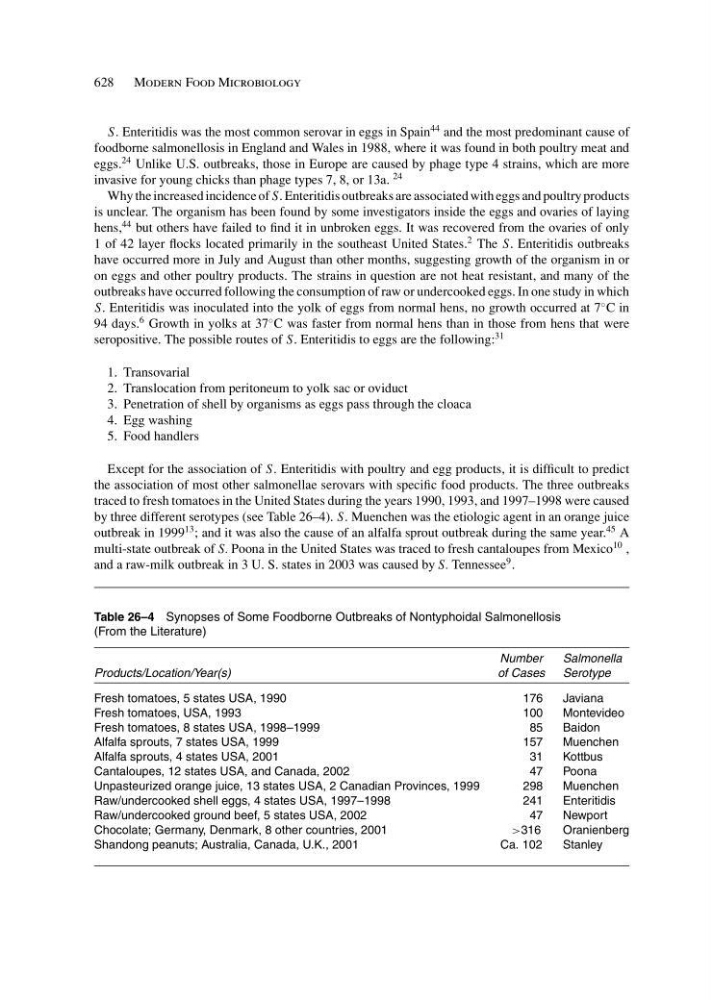
by three different serotypes (see Table 26–4). S. Muenchen was the etiologic agent in an orange juice
outbreak in 1999
13 ; and it was also the cause of an alfalfa sprout outbreak during the same year.
45 A
multi-state outbreak of S. Poona in the United States was traced to fresh cantaloupes from Mexico
10 ,
and a raw-milk outbreak in 3 U. S. states in 2003 was caused by S. Tennessee
9 .
Table 26–4 Synopses of Some Foodborne Outbreaks of Nontyphoidal Salmonellosis
(From the Literature)
Number
Salmonella
Products/Location/Year(s)
of Cases Serotype
Fresh tomatoes, 5 states USA, 1990
176
Javiana
Fresh tomatoes, USA, 1993
100
Montevideo
Fresh tomatoes, 8 states USA, 1998–1999
85
Baidon
Alfalfa sprouts, 7 states USA, 1999
157
Muenchen
Alfalfa sprouts, 4 states USA, 2001
31
Kottbus
Cantaloupes, 12 states USA, and Canada, 2002
47
Poona
Unpasteurized orange juice, 13 states USA, 2 Canadian Provinces, 1999
298
Muenchen
Raw/undercooked shell eggs, 4 states USA, 1997–1998
241
Enteritidis
Raw/undercooked ground beef, 5 states USA, 2002
47
Newport
Chocolate; Germany, Denmark, 8 other countries, 2001
>316
Oranienberg
Shandong peanuts; Australia, Canada, U.K., 2001
Ca. 102
Stanley