

Foodborne Gastroenteritis Caused by Salmonella and Shigella
627
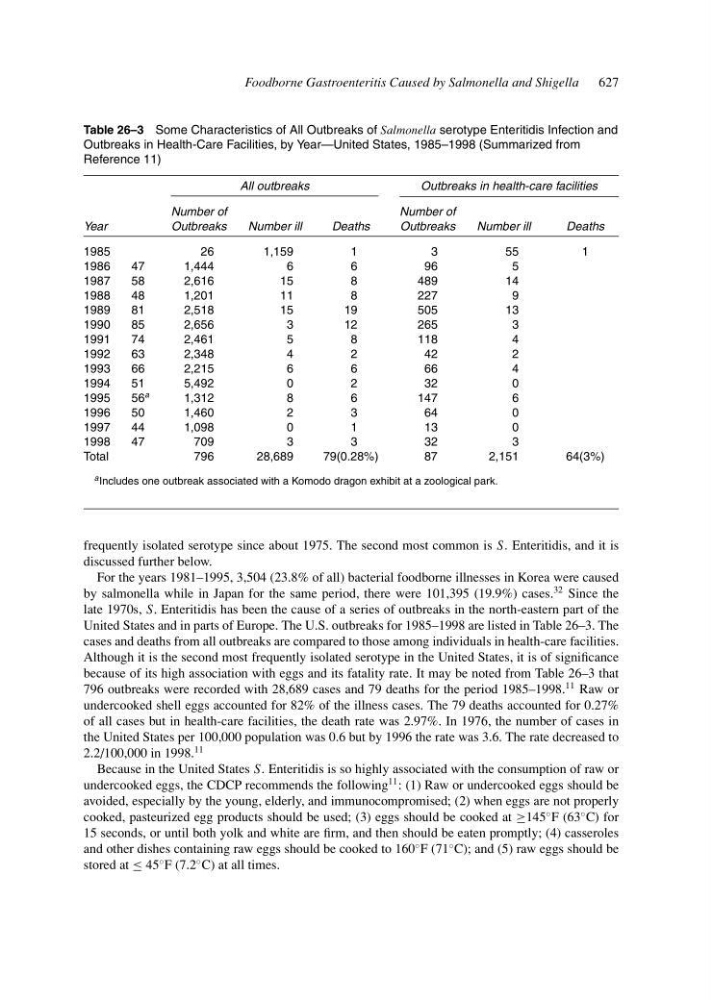
Table 26–3 Some Characteristics of All Outbreaks of Salmonella serotype Enteritidis Infection and
Outbreaks in Health-Care Facilities, by Year—United States, 1985–1998 (Summarized from
Reference 11)
All outbreaks
Outbreaks in health-care facilities
Number of
Number of
Year
Outbreaks
Number ill
Deaths
Outbreaks
Number ill
Deaths
1985
26
1,159
1
3
55
1
1986
47
1,444
6
6
96
5
1987
58
2,616
15
8
489
14
1988
48
1,201
11
8
227
9
1989
81
2,518
15
19
505
13
1990
85
2,656
3
12
265
3
1991
74
2,461
5
8
118
4
1992
63
2,348
4
2
42
2
1993
66
2,215
6
6
66
4
1994
51
5,492
0
2
32
0
1995
56
a
1,312
8
6
147
6
1996
50
1,460
2
3
64
0
1997
44
1,098
0
1
13
0
1998
47
709
3
3
32
3
Total
796
28,689
79(0.28%)
87
2,151
64(3%)
a Includes one outbreak associated with a Komodo dragon exhibit at a zoological park.
frequently isolated serotype since about 1975. The second most common is S. Enteritidis, and it is
discussed further below.
For the years 1981–1995, 3,504 (23.8% of all) bacterial foodborne illnesses in Korea were caused
by salmonella while in Japan for the same period, there were 101,395 (19.9%) cases.
32 Since the
late 1970s, S. Enteritidis has been the cause of a series of outbreaks in the north-eastern part of the
United States and in parts of Europe. The U.S. outbreaks for 1985–1998 are listed in Table 26–3. The
cases and deaths from all outbreaks are compared to those among individuals in health-care facilities.
Although it is the second most frequently isolated serotype in the United States, it is of significance
because of its high association with eggs and its fatality rate. It may be noted from Table 26–3 that
796 outbreaks were recorded with 28,689 cases and 79 deaths for the period 1985–1998.
11 Raw or
undercooked shell eggs accounted for 82% of the illness cases. The 79 deaths accounted for 0.27%
of all cases but in health-care facilities, the death rate was 2.97%. In 1976, the number of cases in
the United States per 100,000 population was 0.6 but by 1996 the rate was 3.6. The rate decreased to
2.2/100,000 in 1998.
11
Because in the United States S. Enteritidis is so highly associated with the consumption of raw or
undercooked eggs, the CDCP recommends the following
11 : (1) Raw or undercooked eggs should be
avoided, especially by the young, elderly, and immunocompromised; (2) when eggs are not properly
cooked, pasteurized egg products should be used; (3) eggs should be cooked at ≥145
◦ F (63
◦ C) for
15 seconds, or until both yolk and white are firm, and then should be eaten promptly; (4) casseroles
and other dishes containing raw eggs should be cooked to 160
◦ F (71
◦ C); and (5) raw eggs should be
stored at ≤ 45
◦ F (7.2
◦ C) at all times.