

Foodborne Listeriosis
601
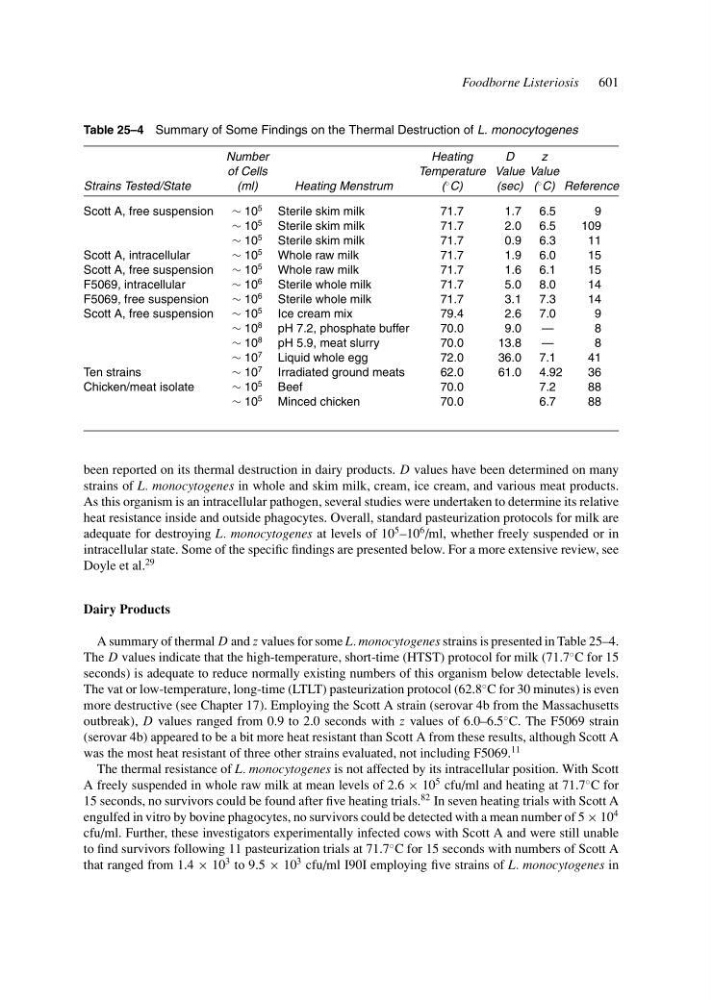
Table 25–4 Summary of Some Findings on the Thermal Destruction of L. monocytogenes
Number
Heating
D
z
of Cells
Temperature Value Value
Strains Tested/State
(ml)
Heating Menstrum
(
◦ C)
(sec) (
◦ C) Reference
Scott A, free suspension
∼ 10
5
Sterile skim milk
71.7
1.7 6.5
9
∼ 10
5
Sterile skim milk
71.7
2.0 6.5
109
∼ 10
5
Sterile skim milk
71.7
0.9 6.3
11
Scott A, intracellular
∼ 10
5
Whole raw milk
71.7
1.9 6.0
15
Scott A, free suspension
∼ 10
5
Whole raw milk
71.7
1.6 6.1
15
F5069, intracellular
∼ 10
6
Sterile whole milk
71.7
5.0 8.0
14
F5069, free suspension
∼ 10
6
Sterile whole milk
71.7
3.1 7.3
14
Scott A, free suspension
∼ 10
5
Ice cream mix
79.4
2.6 7.0
9
∼ 10
8
pH 7.2, phosphate buffer
70.0
9.0
—
8
∼ 10
8
pH 5.9, meat slurry
70.0
13.8
—
8
∼ 10
7
Liquid whole egg
72.0
36.0 7.1
41
Ten strains
∼ 10
7
Irradiated ground meats
62.0
61.0 4.92
36
Chicken/meat isolate
∼ 10
5
Beef
70.0
7.2
88
∼ 10
5
Minced chicken
70.0
6.7
88
been reported on its thermal destruction in dairy products. D values have been determined on many
strains of L. monocytogenes in whole and skim milk, cream, ice cream, and various meat products.
As this organism is an intracellular pathogen, several studies were undertaken to determine its relative
heat resistance inside and outside phagocytes. Overall, standard pasteurization protocols for milk are
adequate for destroying L. monocytogenes at levels of 10
5 –10
6 /ml, whether freely suspended or in
intracellular state. Some of the specific findings are presented below. For a more extensive review, see
Doyle et al.
29
Dairy Products
A summary of thermal D and z values for some L. monocytogenes strains is presented in Table 25–4.
The D values indicate that the high-temperature, short-time (HTST) protocol for milk (71.7
◦ C for 15
seconds) is adequate to reduce normally existing numbers of this organism below detectable levels.
The vat or low-temperature, long-time (LTLT) pasteurization protocol (62.8
◦ C for 30 minutes) is even
more destructive (see Chapter 17). Employing the Scott A strain (serovar 4b from the Massachusetts
outbreak), D values ranged from 0.9 to 2.0 seconds with z values of 6.0–6.5
◦ C. The F5069 strain
(serovar 4b) appeared to be a bit more heat resistant than Scott A from these results, although Scott A
was the most heat resistant of three other strains evaluated, not including F5069.
11
The thermal resistance of L. monocytogenes is not affected by its intracellular position. With Scott
A freely suspended in whole raw milk at mean levels of 2.6 × 10
5 cfu/ml and heating at 71.7
◦ C for
15 seconds, no survivors could be found after five heating trials.
82 In seven heating trials with Scott A
engulfed in vitro by bovine phagocytes, no survivors could be detected with a mean number of 5 × 10
4
cfu/ml. Further, these investigators experimentally infected cows with Scott A and were still unable
to find survivors following 11 pasteurization trials at 71.7
◦ C for 15 seconds with numbers of Scott A
that ranged from 1.4 × 10
3 to 9.5 × 10
3 cfu/ml I90I employing five strains of L. monocytogenes in