

Foodborne Listeriosis
599
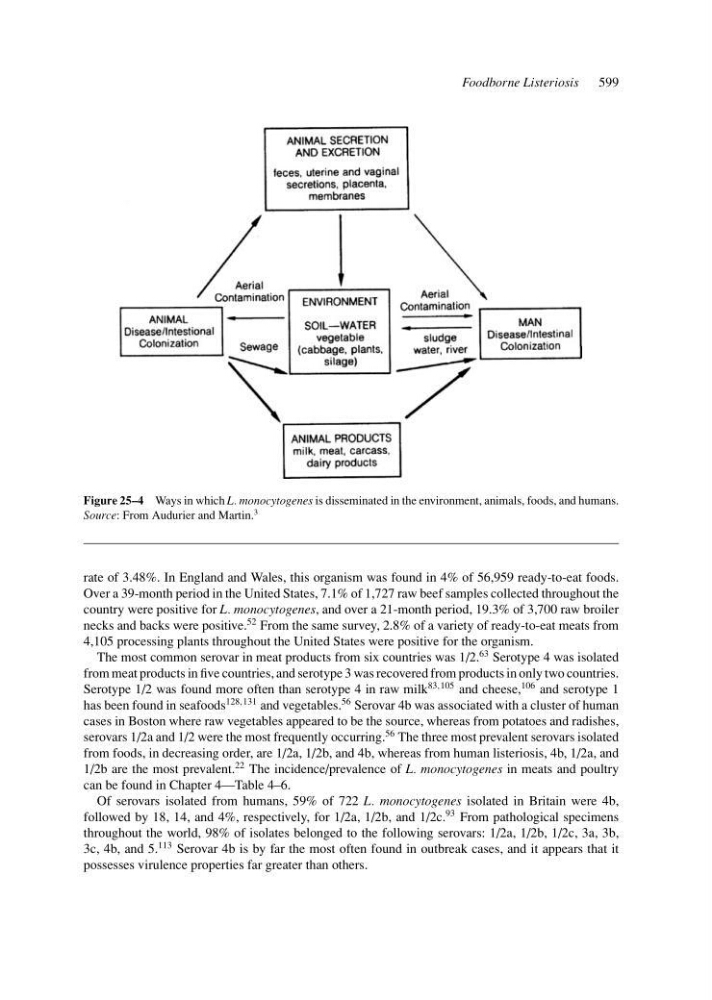
Figure 25–4 Ways in which L. monocytogenes is disseminated in the environment, animals, foods, and humans.
Source: From Audurier and Martin.
3
rate of 3.48%. In England and Wales, this organism was found in 4% of 56,959 ready-to-eat foods.
Over a 39-month period in the United States, 7.1% of 1,727 raw beef samples collected throughout the
country were positive for L. monocytogenes, and over a 21-month period, 19.3% of 3,700 raw broiler
necks and backs were positive.
52 From the same survey, 2.8% of a variety of ready-to-eat meats from
4,105 processing plants throughout the United States were positive for the organism.
The most common serovar in meat products from six countries was 1/2.
63 Serotype 4 was isolated
from meat products in five countries, and serotype 3 was recovered from products in only two countries.
Serotype 1/2 was found more often than serotype 4 in raw milk
83,105 and cheese,
106 and serotype 1
has been found in seafoods
128,131 and vegetables.
56 Serovar 4b was associated with a cluster of human
cases in Boston where raw vegetables appeared to be the source, whereas from potatoes and radishes,
serovars 1/2a and 1/2 were the most frequently occurring.
56 The three most prevalent serovars isolated
from foods, in decreasing order, are 1/2a, 1/2b, and 4b, whereas from human listeriosis, 4b, 1/2a, and
1/2b are the most prevalent.
22 The incidence/prevalence of L. monocytogenes in meats and poultry
can be found in Chapter 4—Table 4–6.
Of serovars isolated from humans, 59% of 722 L. monocytogenes isolated in Britain were 4b,
followed by 18, 14, and 4%, respectively, for 1/2a, 1/2b, and 1/2c.
93 From pathological specimens
throughout the world, 98% of isolates belonged to the following serovars: 1/2a, 1/2b, 1/2c, 3a, 3b,
3c, 4b, and 5.
113 Serovar 4b is by far the most often found in outbreak cases, and it appears that it
possesses virulence properties far greater than others.