

594 Modern Food Microbiology
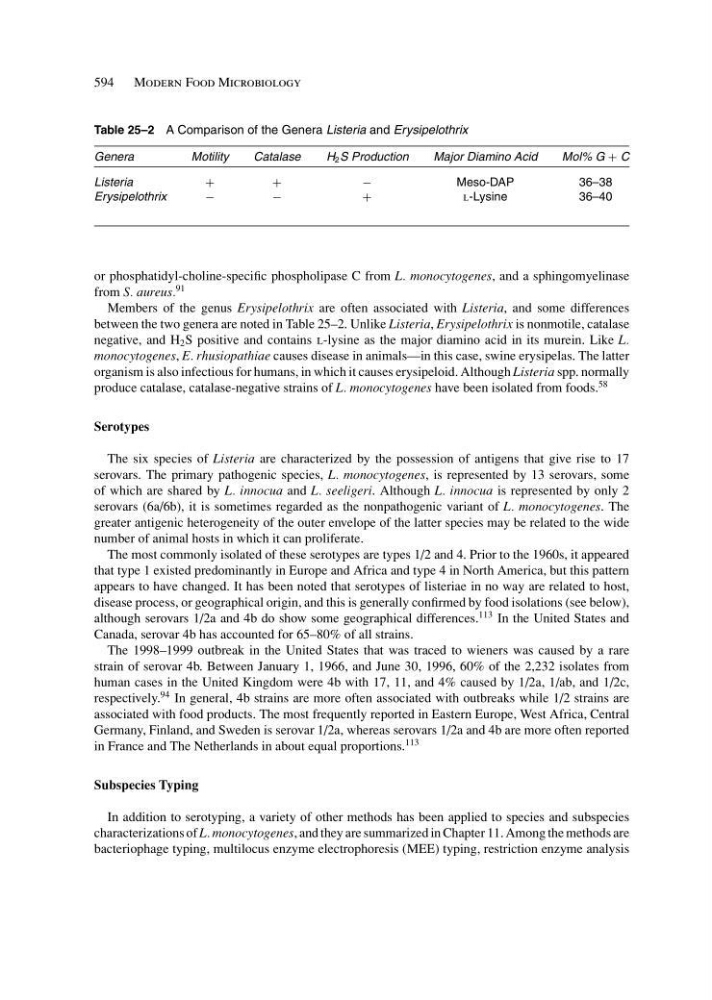
Table 25–2 A Comparison of the Genera Listeria and Erysipelothrix
Genera
Motility
Catalase
H 2 S Production
Major Diamino Acid
Mol% G + C
Listeria
+
+
−
Meso-DAP
36–38
Erysipelothrix
−
−
+
l-Lysine
36–40
or phosphatidyl-choline-specific phospholipase C from L. monocytogenes, and a sphingomyelinase
from S. aureus.
91
Members of the genus Erysipelothrix are often associated with Listeria, and some differences
between the two genera are noted in Table 25–2. Unlike Listeria, Erysipelothrix is nonmotile, catalase
negative, and H 2 S positive and contains l-lysine as the major diamino acid in its murein. Like L.
monocytogenes, E. rhusiopathiae causes disease in animals—in this case, swine erysipelas. The latter
organism is also infectious for humans, in which it causes erysipeloid. Although Listeria spp. normally
produce catalase, catalase-negative strains of L. monocytogenes have been isolated from foods.
58
Serotypes
The six species of Listeria are characterized by the possession of antigens that give rise to 17
serovars. The primary pathogenic species, L. monocytogenes, is represented by 13 serovars, some
of which are shared by L. innocua and L. seeligeri. Although L. innocua is represented by only 2
serovars (6a/6b), it is sometimes regarded as the nonpathogenic variant of L. monocytogenes. The
greater antigenic heterogeneity of the outer envelope of the latter species may be related to the wide
number of animal hosts in which it can proliferate.
The most commonly isolated of these serotypes are types 1/2 and 4. Prior to the 1960s, it appeared
that type 1 existed predominantly in Europe and Africa and type 4 in North America, but this pattern
appears to have changed. It has been noted that serotypes of listeriae in no way are related to host,
disease process, or geographical origin, and this is generally confirmed by food isolations (see below),
although serovars 1/2a and 4b do show some geographical differences.
113 In the United States and
Canada, serovar 4b has accounted for 65–80% of all strains.
The 1998–1999 outbreak in the United States that was traced to wieners was caused by a rare
strain of serovar 4b. Between January 1, 1966, and June 30, 1996, 60% of the 2,232 isolates from
human cases in the United Kingdom were 4b with 17, 11, and 4% caused by 1/2a, 1/ab, and 1/2c,
respectively.
94 In general, 4b strains are more often associated with outbreaks while 1/2 strains are
associated with food products. The most frequently reported in Eastern Europe, West Africa, Central
Germany, Finland, and Sweden is serovar 1/2a, whereas serovars 1/2a and 4b are more often reported
in France and The Netherlands in about equal proportions.
113
Subspecies Typing
In addition to serotyping, a variety of other methods has been applied to species and subspecies
characterizations of L. monocytogenes, and they are summarized in Chapter 11. Among the methods are
bacteriophage typing, multilocus enzyme electrophoresis (MEE) typing, restriction enzyme analysis