

Foodborne Listeriosis
593
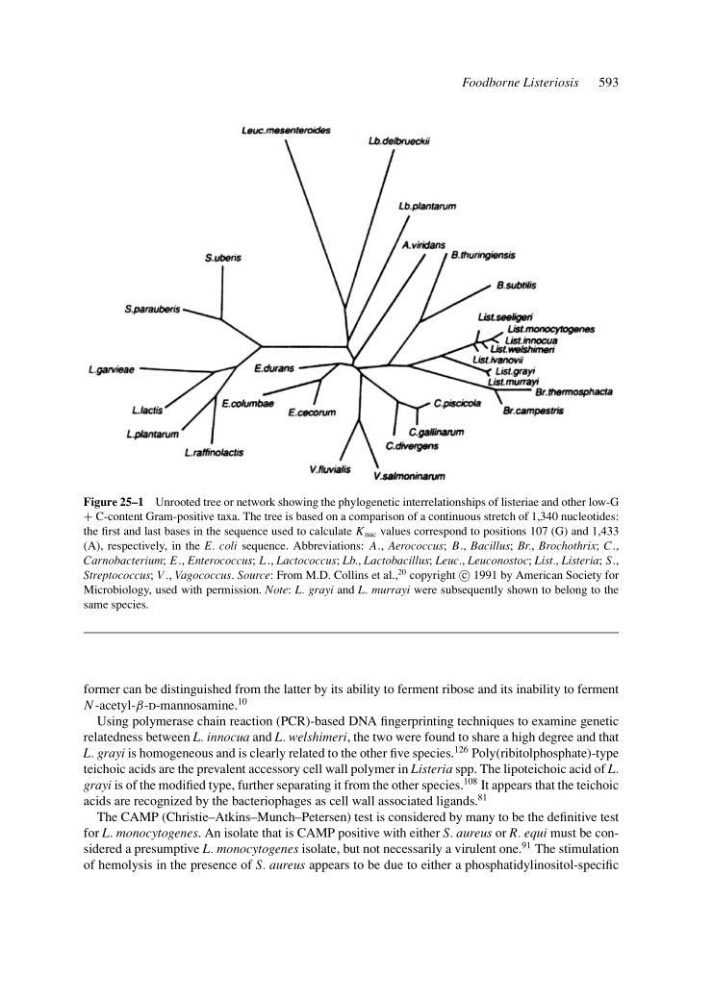
Figure 25–1 Unrooted tree or network showing the phylogenetic interrelationships of listeriae and other low-G
+ C-content Gram-positive taxa. The tree is based on a comparison of a continuous stretch of 1,340 nucleotides:
the first and last bases in the sequence used to calculate K nuc values correspond to positions 107 (G) and 1,433
(A), respectively, in the E. coli sequence. Abbreviations: A., Aerococcus; B., Bacillus; Br., Brochothrix; C.,
Carnobacterium; E., Enterococcus; L ., Lactococcus; Lb., Lactobacillus; Leuc., Leuconostoc; List., Listeria; S.,
Streptococcus; V., Vagococcus. Source: From M.D. Collins et al.,
20 copyright c
1991 by American Society for
Microbiology, used with permission. Note: L. grayi and L. murrayi were subsequently shown to belong to the
same species.
former can be distinguished from the latter by its ability to ferment ribose and its inability to ferment
N -acetyl-β-d-mannosamine.
10
Using polymerase chain reaction (PCR)-based DNA fingerprinting techniques to examine genetic
relatedness between L. innocua and L. welshimeri, the two were found to share a high degree and that
L. grayi is homogeneous and is clearly related to the other five species.
126 Poly(ribitolphosphate)-type
teichoic acids are the prevalent accessory cell wall polymer in Listeria spp. The lipoteichoic acid of L.
grayi is of the modified type, further separating it from the other species.
108 It appears that the teichoic
acids are recognized by the bacteriophages as cell wall associated ligands.
81
The CAMP (Christie–Atkins–Munch–Petersen) test is considered by many to be the definitive test
for L. monocytogenes. An isolate that is CAMP positive with either S. aureus or R. equi must be considered a presumptive L. monocytogenes isolate, but not necessarily a virulent one.
91 The stimulation
of hemolysis in the presence of S. aureus appears to be due to either a phosphatidylinositol-specific