

Food Poisoning Caused by Gram-Positive Sporeforming Bacteria
571
The enterotoxin may appear in a growth and sporulation medium about 3 hours after inoculation
with vegetative cells,
25 and from 1 to 100 µg/ml of enterotoxin production has been shown for three
strains of C. perfringens in Duncan–Strong (DS) medium after 24–36 hours.
33 It has been suggested
that preformed enterotoxin may exist in some foods and, in infrequent cases, contribute to the early
onset of symptoms. Purified enterotoxin has been shown to contain up to 3,500 mouse LD/mg of N.
The enterotoxin may be detected in the feces of victims. From one case, 13–16 µg/g of feces were
found, and from another victim with a milder case, 3–4 µg/g were detected.
102
Mode of Action
The C. perfringens enterotoxin (CPE) is not a superantigen
63 as are the staphylococcal enterotoxins
(see subsection Mode of Action in Chapter 23). The CPE protein contains 319 amino acids, and it
binds to either claudine and/or a 50 kDa eukaryotic membrane receptor that leads to the formation of
a 90-kDa CPE-containing complex in host cell membranes. A larger complex, >160-kDa, is formed
by the addition of host cell membrane proteins that ultimately leads to the induction of permeability
changes in cell membranes and death of host cells (see reference 60).
Vehicle Foods and Symptoms
Symptoms appear between 6 and 24 hours, especially between 8 and 12 hours, after the ingestion of
contaminated foods. The symptoms are characterized by acute abdominal pain and diarrhea; nausea,
fever, and vomiting are rare. Except in the elderly or in debilitated persons, the illness is of short
duration—a day or less. The fatality rate is quite low, and no immunity seems to occur, although
circulating antibodies to the enterotoxin may be found in some persons with a history of the syndrome.
The true incidence of C. perfringens food poisoning is unknown. Because of the relative mildness
of the disease, it is quite likely that only those outbreaks and cases that affect groups of people are
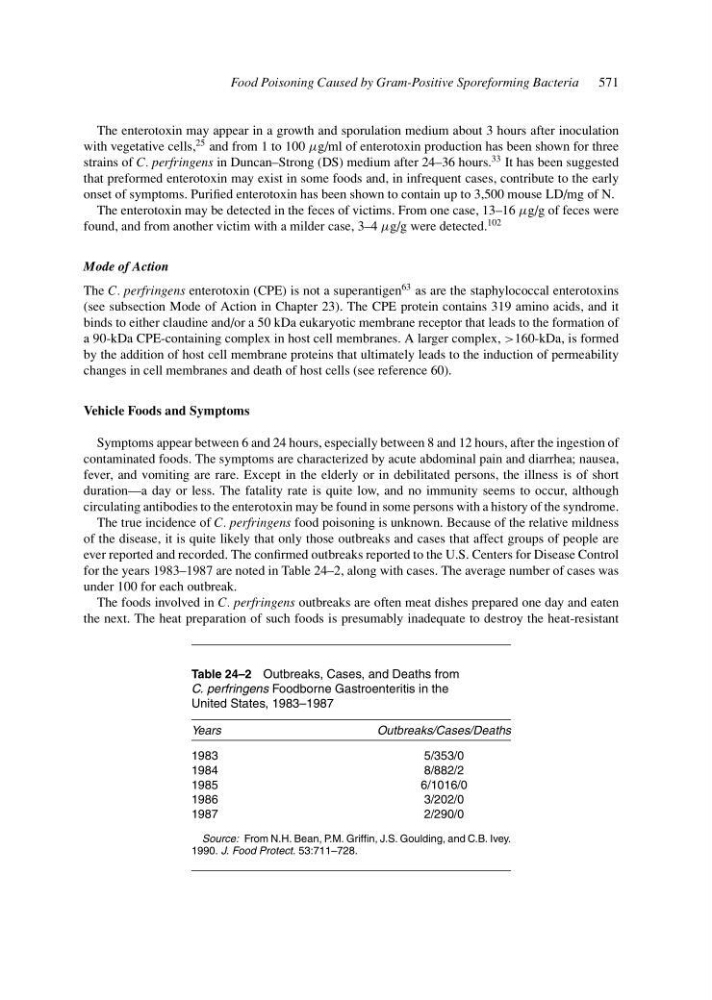
ever reported and recorded. The confirmed outbreaks reported to the U.S. Centers for Disease Control
for the years 1983–1987 are noted in Table 24–2, along with cases. The average number of cases was
under 100 for each outbreak.
The foods involved in C. perfringens outbreaks are often meat dishes prepared one day and eaten
the next. The heat preparation of such foods is presumably inadequate to destroy the heat-resistant
Table 24–2 Outbreaks, Cases, and Deaths from
C. perfringens Foodborne Gastroenteritis in the
United States, 1983–1987
Years
Outbreaks/Cases/Deaths
1983
5/353/0
1984
8/882/2
1985
6/1016/0
1986
3/202/0
1987
2/290/0
Source: From N.H. Bean, P.M. Griffin, J.S. Goulding, and C.B. Ivey.
1990. J. Food Protect. 53:711–728.