

570 Modern Food Microbiology
The Enterotoxin
The causative factor of C. perfringens food poisoning is an enterotoxin. It is unusual in that it
is a spore-specific protein; its production occurs together with that of sporulation. All known foodpoisoning cases by this organism are caused by type A strains. An unrelated disease, necrotic enteritis,
is caused by beta toxin produced by type C strains and is rarely reported outside New Guinea. Although
necrotic enteritis due to type C has been associated with a mortality rate of 35–40%, food poisoning
due to type A strains has been fatal only in elderly or otherwise debilitated persons. Some type C
strains have been shown to produce enterotoxin, but its role in disease is unclear.
The enterotoxin of type A strains was demonstrated by Duncan and Strong.
28 The purified enterotoxin has a molecular weight of 35,000 daltons and an isoelectric point of 4.3.
47 It is heat sensitive
(biological activity destroyed at 60
◦ C for 10 minutes) and pronase sensitive but resistant to trypsin,
chymotrypsin, and papain.
112 L-forms of C. perfringens produce the toxin, and in one study they were
shown to produce as much enterotoxin as classic forms.
77
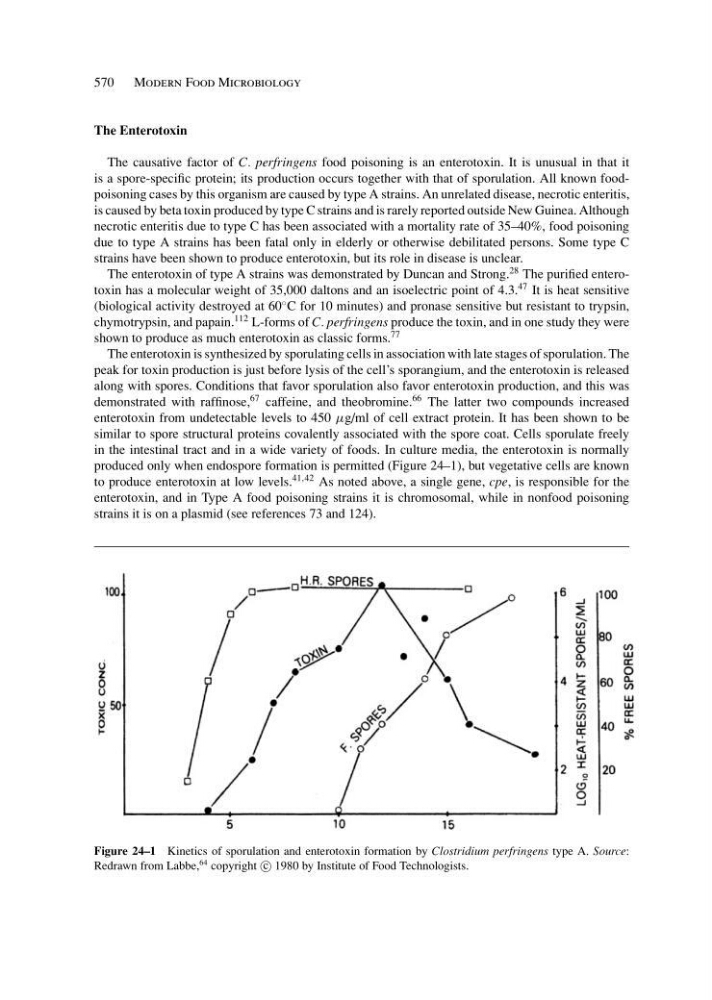
The enterotoxin is synthesized by sporulating cells in association with late stages of sporulation. The
peak for toxin production is just before lysis of the cell’s sporangium, and the enterotoxin is released
along with spores. Conditions that favor sporulation also favor enterotoxin production, and this was
demonstrated with raffinose,
67 caffeine, and theobromine.
66 The latter two compounds increased
enterotoxin from undetectable levels to 450 µg/ml of cell extract protein. It has been shown to be
similar to spore structural proteins covalently associated with the spore coat. Cells sporulate freely
in the intestinal tract and in a wide variety of foods. In culture media, the enterotoxin is normally
produced only when endospore formation is permitted (Figure 24–1), but vegetative cells are known
to produce enterotoxin at low levels.
41,42 As noted above, a single gene, cpe, is responsible for the
enterotoxin, and in Type A food poisoning strains it is chromosomal, while in nonfood poisoning
strains it is on a plasmid (see references 73 and 124).
Figure 24–1 Kinetics of sporulation and enterotoxin formation by Clostridium perfringens type A. Source:
Redrawn from Labbe,
64 copyright c
1980 by Institute of Food Technologists.