

Staphylococcal Gastroenteritis 559
Table 23–7 Staphylococcal Foodborne Gastroenteritis Outbreaks and Cases in the
United States, 1973–1987
Years
Outbreaks
Cases
Percentage of All Cases
1973–1987
367
17,248
14.0
1983
14
1,257
15.9
1984
11
1,153
14.1
1985
14
421
1.8
1986
7
250
4.3
1987
1
100
1.0
Source: Data from Bean and Griffin. 10
INCIDENCE AND VEHICLE FOODS
The incidence/prevalence of staphylococci in meats and seafoods are presented in Chapter 4 (Table
4–3) and Chapter 5 (Table 5–6). These organisms may be expected to occur in a wide variety of foods
not given heat treatments for their destruction.
With regard to vehicle foods for staphylococcal enteritis, a large number has been incriminated in
outbreaks, usually products made by hand and improperly refrigerated after being prepared. Outbreaks
and cases of foodborne gastroenteritis reported to the Centers for Disease Control for the years 1973–
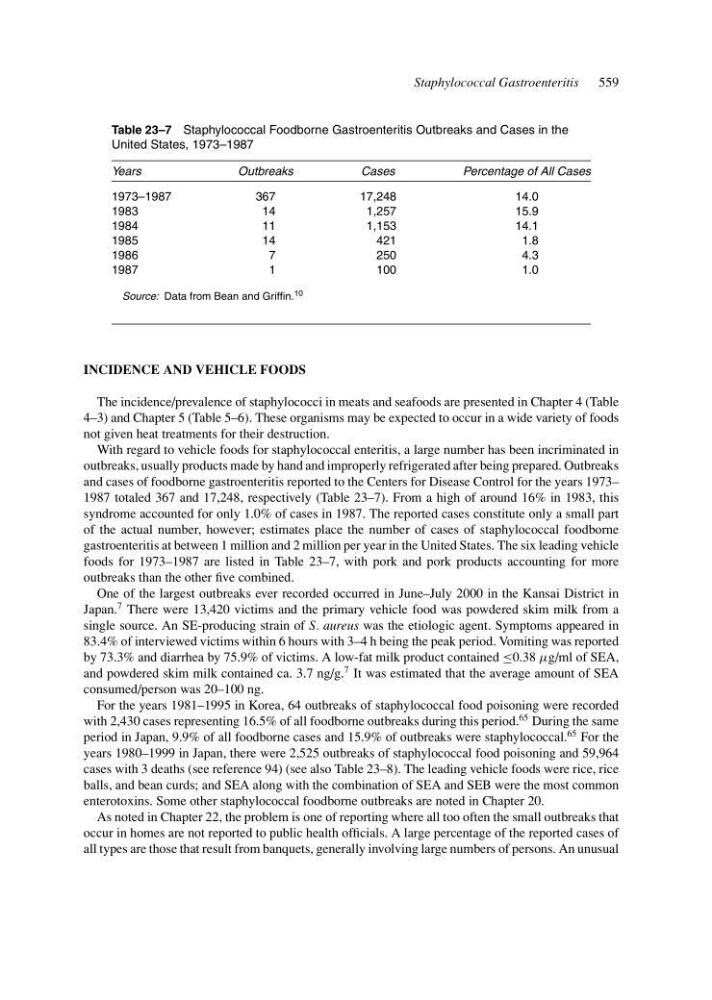
1987 totaled 367 and 17,248, respectively (Table 23–7). From a high of around 16% in 1983, this
syndrome accounted for only 1.0% of cases in 1987. The reported cases constitute only a small part
of the actual number, however; estimates place the number of cases of staphylococcal foodborne
gastroenteritis at between 1 million and 2 million per year in the United States. The six leading vehicle
foods for 1973–1987 are listed in Table 23–7, with pork and pork products accounting for more
outbreaks than the other five combined.
One of the largest outbreaks ever recorded occurred in June–July 2000 in the Kansai District in
Japan.
7 There were 13,420 victims and the primary vehicle food was powdered skim milk from a
single source. An SE-producing strain of S. aureus was the etiologic agent. Symptoms appeared in
83.4% of interviewed victims within 6 hours with 3–4 h being the peak period. Vomiting was reported
by 73.3% and diarrhea by 75.9% of victims. A low-fat milk product contained ≤0.38 µg/ml of SEA,
and powdered skim milk contained ca. 3.7 ng/g.
7 It was estimated that the average amount of SEA
consumed/person was 20–100 ng.
For the years 1981–1995 in Korea, 64 outbreaks of staphylococcal food poisoning were recorded
with 2,430 cases representing 16.5% of all foodborne outbreaks during this period.
65 During the same
period in Japan, 9.9% of all foodborne cases and 15.9% of outbreaks were staphylococcal.
65 For the
years 1980–1999 in Japan, there were 2,525 outbreaks of staphylococcal food poisoning and 59,964
cases with 3 deaths (see reference 94) (see also Table 23–8). The leading vehicle foods were rice, rice
balls, and bean curds; and SEA along with the combination of SEA and SEB were the most common
enterotoxins. Some other staphylococcal foodborne outbreaks are noted in Chapter 20.
As noted in Chapter 22, the problem is one of reporting where all too often the small outbreaks that
occur in homes are not reported to public health officials. A large percentage of the reported cases of
all types are those that result from banquets, generally involving large numbers of persons. An unusual