

40
Modern Food Microbiology
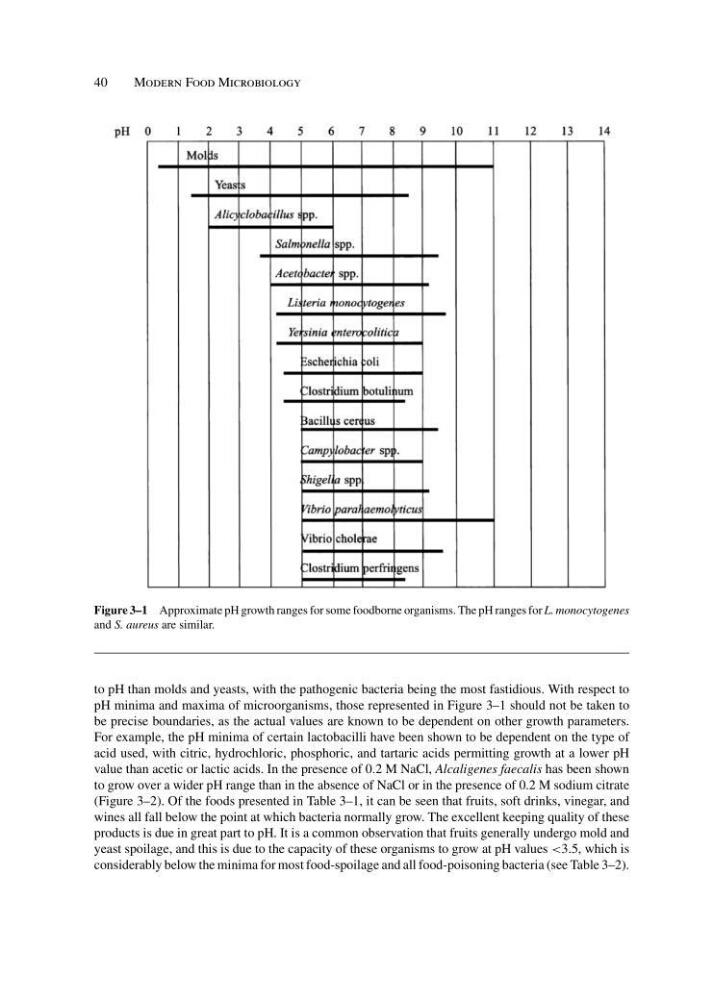
Figure 3–1 Approximate pH growth ranges for some foodborne organisms. The pH ranges for L. monocytogenes
and S. aureus are similar.
to pH than molds and yeasts, with the pathogenic bacteria being the most fastidious. With respect to
pH minima and maxima of microorganisms, those represented in Figure 3–1 should not be taken to
be precise boundaries, as the actual values are known to be dependent on other growth parameters.
For example, the pH minima of certain lactobacilli have been shown to be dependent on the type of
acid used, with citric, hydrochloric, phosphoric, and tartaric acids permitting growth at a lower pH
value than acetic or lactic acids. In the presence of 0.2 M NaCl, Alcaligenes faecalis has been shown
to grow over a wider pH range than in the absence of NaCl or in the presence of 0.2 M sodium citrate
(Figure 3–2). Of the foods presented in Table 3–1, it can be seen that fruits, soft drinks, vinegar, and
wines all fall below the point at which bacteria normally grow. The excellent keeping quality of these
products is due in great part to pH. It is a common observation that fruits generally undergo mold and
yeast spoilage, and this is due to the capacity of these organisms to grow at pH values <3.5, which is
considerably below the minima for most food-spoilage and all food-poisoning bacteria (see Table 3–2).
Modern Food Microbiology
Figure 3–1 Approximate pH growth ranges for some foodborne organisms. The pH ranges for L. monocytogenes
and S. aureus are similar.
to pH than molds and yeasts, with the pathogenic bacteria being the most fastidious. With respect to
pH minima and maxima of microorganisms, those represented in Figure 3–1 should not be taken to
be precise boundaries, as the actual values are known to be dependent on other growth parameters.
For example, the pH minima of certain lactobacilli have been shown to be dependent on the type of
acid used, with citric, hydrochloric, phosphoric, and tartaric acids permitting growth at a lower pH
value than acetic or lactic acids. In the presence of 0.2 M NaCl, Alcaligenes faecalis has been shown
to grow over a wider pH range than in the absence of NaCl or in the presence of 0.2 M sodium citrate
(Figure 3–2). Of the foods presented in Table 3–1, it can be seen that fruits, soft drinks, vinegar, and
wines all fall below the point at which bacteria normally grow. The excellent keeping quality of these
products is due in great part to pH. It is a common observation that fruits generally undergo mold and
yeast spoilage, and this is due to the capacity of these organisms to grow at pH values <3.5, which is
considerably below the minima for most food-spoilage and all food-poisoning bacteria (see Table 3–2).