

554 Modern Food Microbiology
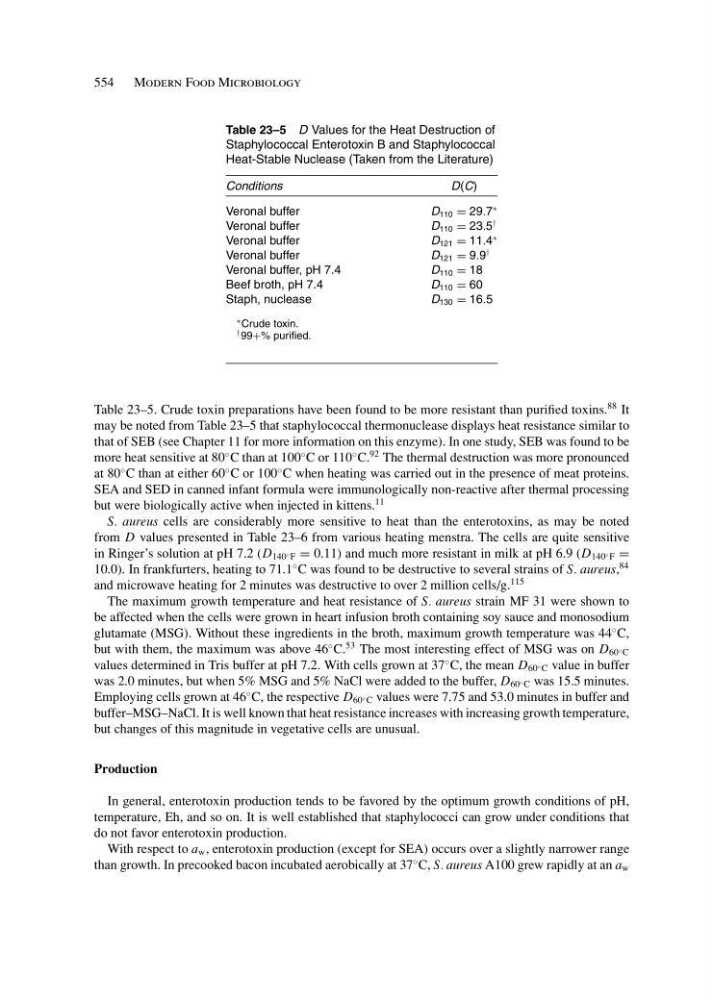
Table 23–5 D Values for the Heat Destruction of
Staphylococcal Enterotoxin B and Staphylococcal
Heat-Stable Nuclease (Taken from the Literature)
Conditions
D(C)
Veronal buffer
D 110 = 29.7
∗
Veronal buffer
D 110 = 23.5
†
Veronal buffer
D 121 = 11.4
∗
Veronal buffer
D 121 = 9.9
†
Veronal buffer, pH 7.4
D 110 = 18
Beef broth, pH 7.4
D 110 = 60
Staph, nuclease
D 130 = 16.5
∗ Crude toxin.
† 99+% purified.
Table 23–5. Crude toxin preparations have been found to be more resistant than purified toxins.
88 It
may be noted from Table 23–5 that staphylococcal thermonuclease displays heat resistance similar to
that of SEB (see Chapter 11 for more information on this enzyme). In one study, SEB was found to be
more heat sensitive at 80
◦ C than at 100
◦ C or 110
◦ C.
92 The thermal destruction was more pronounced
at 80
◦ C than at either 60
◦ C or 100
◦ C when heating was carried out in the presence of meat proteins.
SEA and SED in canned infant formula were immunologically non-reactive after thermal processing
but were biologically active when injected in kittens.
11
S. aureus cells are considerably more sensitive to heat than the enterotoxins, as may be noted
from D values presented in Table 23–6 from various heating menstra. The cells are quite sensitive
in Ringer’s solution at pH 7.2 (D 140 ◦ F = 0.11) and much more resistant in milk at pH 6.9 (D 140 ◦ F =
10.0). In frankfurters, heating to 71.1
◦ C was found to be destructive to several strains of S. aureus,
84
and microwave heating for 2 minutes was destructive to over 2 million cells/g.
115
The maximum growth temperature and heat resistance of S. aureus strain MF 31 were shown to
be affected when the cells were grown in heart infusion broth containing soy sauce and monosodium
glutamate (MSG). Without these ingredients in the broth, maximum growth temperature was 44
◦ C,
but with them, the maximum was above 46
◦ C.
53 The most interesting effect of MSG was on D 60 ◦ C
values determined in Tris buffer at pH 7.2. With cells grown at 37
◦ C, the mean D 60 ◦ C value in buffer
was 2.0 minutes, but when 5% MSG and 5% NaCl were added to the buffer, D 60 ◦ C was 15.5 minutes.
Employing cells grown at 46
◦ C, the respective D 60 ◦ C values were 7.75 and 53.0 minutes in buffer and
buffer–MSG–NaCl. It is well known that heat resistance increases with increasing growth temperature,
but changes of this magnitude in vegetative cells are unusual.
Production
In general, enterotoxin production tends to be favored by the optimum growth conditions of pH,
temperature, Eh, and so on. It is well established that staphylococci can grow under conditions that
do not favor enterotoxin production.
With respect to a w , enterotoxin production (except for SEA) occurs over a slightly narrower range
than growth. In precooked bacon incubated aerobically at 37
◦ C, S. aureus A100 grew rapidly at an a w