

Staphylococcal Gastroenteritis 553
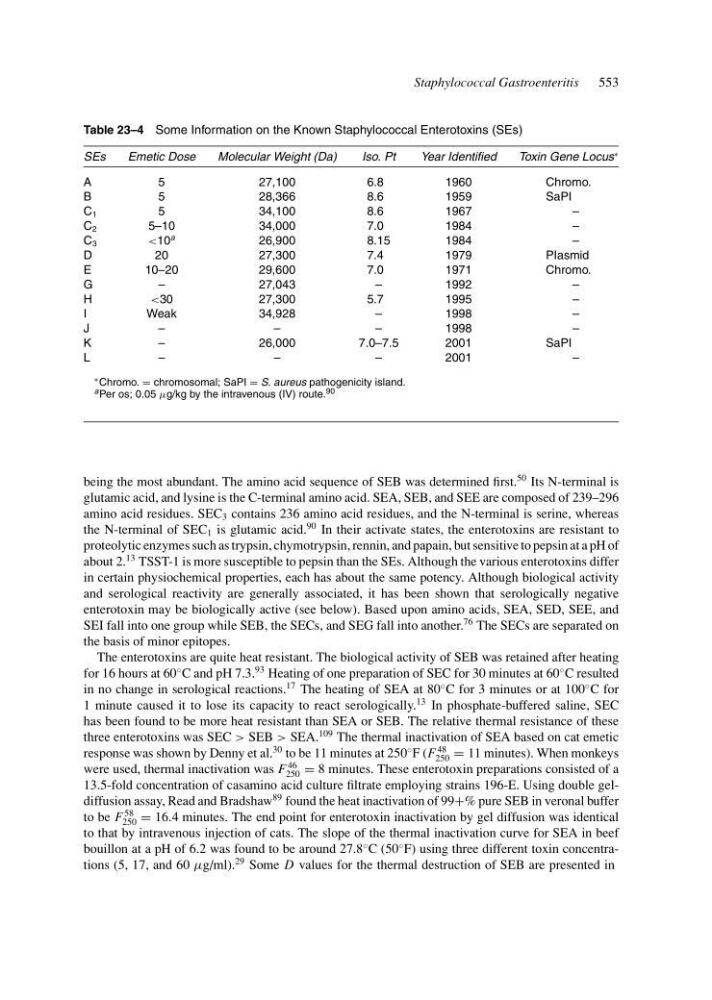
Table 23–4 Some Information on the Known Staphylococcal Enterotoxins (SEs)
SEs
Emetic Dose
Molecular Weight (Da)
Iso. Pt
Year Identified
Toxin Gene Locus
∗
A
5
27,100
6.8
1960
Chromo.
B
5
28,366
8.6
1959
SaPI
C 1
5
34,100
8.6
1967
–
C 2
5–10
34,000
7.0
1984
–
C 3
<10
a
26,900
8.15
1984
–
D
20
27,300
7.4
1979
PIasmid
E
10–20
29,600
7.0
1971
Chromo.
G
–
27,043
–
1992
–
H
<30
27,300
5.7
1995
–
I
Weak
34,928
–
1998
–
J
–
–
–
1998
–
K
–
26,000
7.0–7.5
2001
SaPI
L
–
–
–
2001
–
∗ Chromo. = chromosomal; SaPI = S. aureus pathogenicity island.
a Per os; 0.05 µg/kg by the intravenous (IV) route. 90
being the most abundant. The amino acid sequence of SEB was determined first.
50 Its N-terminal is
glutamic acid, and lysine is the C-terminal amino acid. SEA, SEB, and SEE are composed of 239–296
amino acid residues. SEC 3 contains 236 amino acid residues, and the N-terminal is serine, whereas
the N-terminal of SEC 1 is glutamic acid.
90 In their activate states, the enterotoxins are resistant to
proteolytic enzymes such as trypsin, chymotrypsin, rennin, and papain, but sensitive to pepsin at a pH of
about 2.
13 TSST-1 is more susceptible to pepsin than the SEs. Although the various enterotoxins differ
in certain physiochemical properties, each has about the same potency. Although biological activity
and serological reactivity are generally associated, it has been shown that serologically negative
enterotoxin may be biologically active (see below). Based upon amino acids, SEA, SED, SEE, and
SEI fall into one group while SEB, the SECs, and SEG fall into another.
76 The SECs are separated on
the basis of minor epitopes.
The enterotoxins are quite heat resistant. The biological activity of SEB was retained after heating
for 16 hours at 60
◦ C and pH 7.3.
93 Heating of one preparation of SEC for 30 minutes at 60
◦ C resulted
in no change in serological reactions.
17 The heating of SEA at 80
◦ C for 3 minutes or at 100
◦ C for
1 minute caused it to lose its capacity to react serologically.
13 In phosphate-buffered saline, SEC
has been found to be more heat resistant than SEA or SEB. The relative thermal resistance of these
three enterotoxins was SEC > SEB > SEA.
109 The thermal inactivation of SEA based on cat emetic
response was shown by Denny et al.
30 to be 11 minutes at 250
◦ F (F
48
250 = 11 minutes). When monkeys
were used, thermal inactivation was F
46
250 = 8 minutes. These enterotoxin preparations consisted of a
13.5-fold concentration of casamino acid culture filtrate employing strains 196-E. Using double geldiffusion assay, Read and Bradshaw
89 found the heat inactivation of 99+% pure SEB in veronal buffer
to be F
58
250 = 16.4 minutes. The end point for enterotoxin inactivation by gel diffusion was identical
to that by intravenous injection of cats. The slope of the thermal inactivation curve for SEA in beef
bouillon at a pH of 6.2 was found to be around 27.8
◦ C (50
◦ F) using three different toxin concentrations (5, 17, and 60 µg/ml).
29 Some D values for the thermal destruction of SEB are presented in