

Staphylococcal Gastroenteritis 551
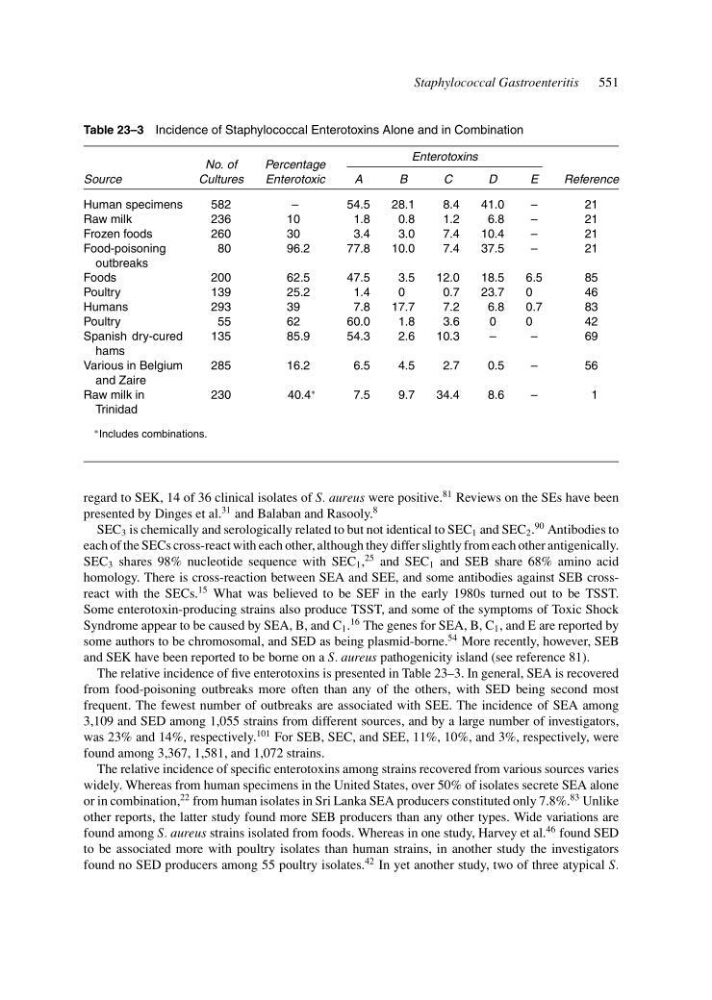
Table 23–3 Incidence of Staphylococcal Enterotoxins Alone and in Combination
Enterotoxins
No. of
Percentage
Source
Cultures
Enterotoxic
A
B
C
D
E
Reference
Human specimens
582
–
54.5
28.1
8.4
41.0
–
21
Raw milk
236
10
1.8
0.8
1.2
6.8
–
21
Frozen foods
260
30
3.4
3.0
7.4
10.4
–
21
Food-poisoning
outbreaks
80
96.2
77.8
10.0
7.4
37.5
–
21
Foods
200
62.5
47.5
3.5
12.0
18.5
6.5
85
Poultry
139
25.2
1.4
0
0.7
23.7
0
46
Humans
293
39
7.8
17.7
7.2
6.8
0.7
83
Poultry
55
62
60.0
1.8
3.6
0
0
42
Spanish dry-cured
hams
135
85.9
54.3
2.6
10.3
–
–
69
Various in Belgium
and Zaire
285
16.2
6.5
4.5
2.7
0.5
–
56
Raw milk in
Trinidad
230
40.4
∗
7.5
9.7
34.4
8.6
–
1
∗ Includes combinations.
regard to SEK, 14 of 36 clinical isolates of S. aureus were positive.
81 Reviews on the SEs have been
presented by Dinges et al.
31 and Balaban and Rasooly.
8
SEC 3 is chemically and serologically related to but not identical to SEC 1 and SEC 2 .
90 Antibodies to
each of the SECs cross-react with each other, although they differ slightly from each other antigenically.
SEC 3 shares 98% nucleotide sequence with SEC 1 ,
25 and SEC 1 and SEB share 68% amino acid
homology. There is cross-reaction between SEA and SEE, and some antibodies against SEB crossreact with the SECs.
15 What was believed to be SEF in the early 1980s turned out to be TSST.
Some enterotoxin-producing strains also produce TSST, and some of the symptoms of Toxic Shock
Syndrome appear to be caused by SEA, B, and C 1 .
16 The genes for SEA, B, C 1 , and E are reported by
some authors to be chromosomal, and SED as being plasmid-borne.
54 More recently, however, SEB
and SEK have been reported to be borne on a S. aureus pathogenicity island (see reference 81).
The relative incidence of five enterotoxins is presented in Table 23–3. In general, SEA is recovered
from food-poisoning outbreaks more often than any of the others, with SED being second most
frequent. The fewest number of outbreaks are associated with SEE. The incidence of SEA among
3,109 and SED among 1,055 strains from different sources, and by a large number of investigators,
was 23% and 14%, respectively.
101 For SEB, SEC, and SEE, 11%, 10%, and 3%, respectively, were
found among 3,367, 1,581, and 1,072 strains.
The relative incidence of specific enterotoxins among strains recovered from various sources varies
widely. Whereas from human specimens in the United States, over 50% of isolates secrete SEA alone
or in combination,
22 from human isolates in Sri Lanka SEA producers constituted only 7.8%.
83 Unlike
other reports, the latter study found more SEB producers than any other types. Wide variations are
found among S. aureus strains isolated from foods. Whereas in one study, Harvey et al.
46 found SED
to be associated more with poultry isolates than human strains, in another study the investigators
found no SED producers among 55 poultry isolates.
42 In yet another study, two of three atypical S.