

Staphylococcal Gastroenteritis 549
EFFECT OF p pH, WATER ACTIVITY, AND OTHER PARAMETERS
Regarding pH, S. aureus can grow over the range 4.0–9.8, but its optimum is in the range 6–7. As
is the case with the other growth parameters, the precise minimum growth pH is dependent on the
degree to which all other parameters are at optimal levels. In homemade mayonnaise, enterotoxins
were produced when the initial pH was as low as 5.15 and when the final growth pH was not below
4.7.
44 SEB was produced at a level of 158 ng/100 g with an inoculum of approximately 10
5 /g. In
general, SEA production is less sensitive to pH than SEB. The buffering of a culture medium at pH
7.0 leads to more SEB than when the medium is unbuffered or buffered in the acid range.
71 A similar
result was noted at a controlled pH of 6.5 rather than 7.0.
58
With respect to a w , the staphylococci are unique in being able to grow at values lower than any
other nonhalophilic bacteria. Growth has been demonstrated as low as 0.83 under otherwise ideal
conditions, although 0.86 is the generally recognized minimum a w .
NaCl and pH
Using a protein hydrolysate medium incubated at 37
◦ C for 8 days, growth and enterotoxin C
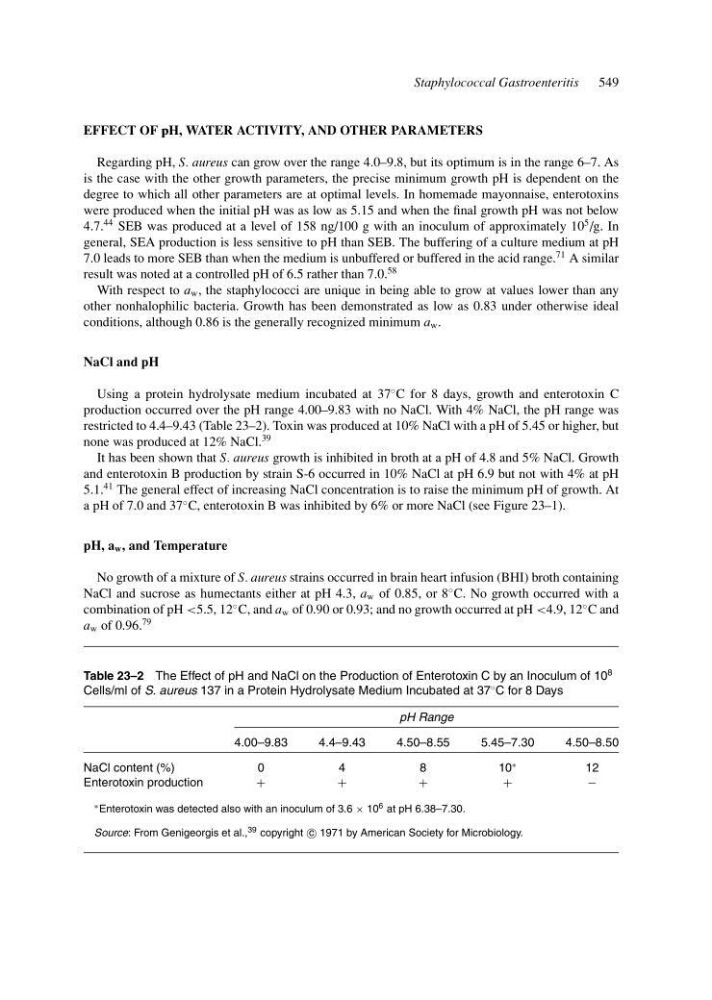
production occurred over the pH range 4.00–9.83 with no NaCl. With 4% NaCl, the pH range was
restricted to 4.4–9.43 (Table 23–2). Toxin was produced at 10% NaCl with a pH of 5.45 or higher, but
none was produced at 12% NaCl.
39
It has been shown that S. aureus growth is inhibited in broth at a pH of 4.8 and 5% NaCl. Growth
and enterotoxin B production by strain S-6 occurred in 10% NaCl at pH 6.9 but not with 4% at pH
5.1.
41 The general effect of increasing NaCl concentration is to raise the minimum pH of growth. At
a pH of 7.0 and 37
◦ C, enterotoxin B was inhibited by 6% or more NaCl (see Figure 23–1).
pH, a w , and Temperature
No growth of a mixture of S. aureus strains occurred in brain heart infusion (BHI) broth containing
NaCl and sucrose as humectants either at pH 4.3, a w of 0.85, or 8
◦ C. No growth occurred with a
combination of pH <5.5, 12
◦ C, and a w of 0.90 or 0.93; and no growth occurred at pH <4.9, 12
◦ C and
a w of 0.96.
79
Table 23–2 The Effect of pH and NaCl on the Production of Enterotoxin C by an Inoculum of 10
8
Cells/ml of S. aureus 137 in a Protein Hydrolysate Medium Incubated at 37
◦ C for 8 Days
pH Range
4.00–9.83
4.4–9.43
4.50–8.55
5.45–7.30
4.50–8.50
NaCl content (%)
0
4
8
10
∗
12
Enterotoxin production
+
+
+
+
−
∗ Enterotoxin was detected also with an inoculum of 3.6 × 10 6 at pH 6.38–7.30.
Source: From Genigeorgis et al., 39 copyright c
1971 by American Society for Microbiology.