

Introduction to Foodborne Pathogens
527
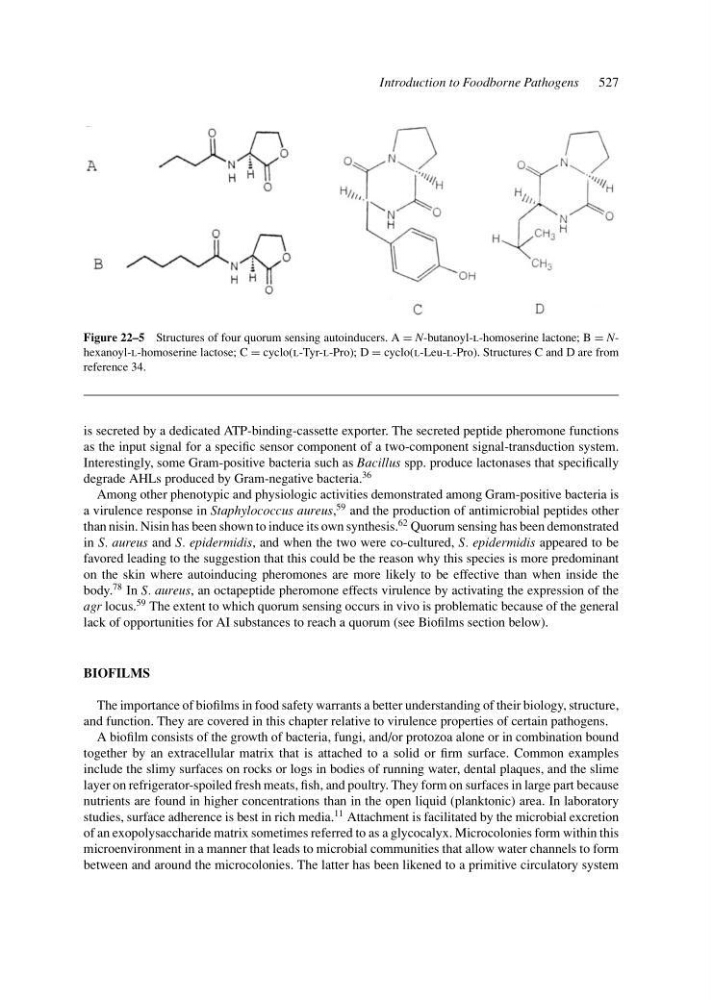
Figure 22–5 Structures of four quorum sensing autoinducers. A = N-butanoyl-l-homoserine lactone; B = Nhexanoyl-l-homoserine lactose; C = cyclo(l-Tyr-l-Pro); D = cyclo(l-Leu-l-Pro). Structures C and D are from
reference 34.
is secreted by a dedicated ATP-binding-cassette exporter. The secreted peptide pheromone functions
as the input signal for a specific sensor component of a two-component signal-transduction system.
Interestingly, some Gram-positive bacteria such as Bacillus spp. produce lactonases that specifically
degrade AHLs produced by Gram-negative bacteria.
36
Among other phenotypic and physiologic activities demonstrated among Gram-positive bacteria is
a virulence response in Staphylococcus aureus,
59 and the production of antimicrobial peptides other
than nisin. Nisin has been shown to induce its own synthesis.
62 Quorum sensing has been demonstrated
in S. aureus and S. epidermidis, and when the two were co-cultured, S. epidermidis appeared to be
favored leading to the suggestion that this could be the reason why this species is more predominant
on the skin where autoinducing pheromones are more likely to be effective than when inside the
body.
78 In S. aureus, an octapeptide pheromone effects virulence by activating the expression of the
agr locus.
59 The extent to which quorum sensing occurs in vivo is problematic because of the general
lack of opportunities for AI substances to reach a quorum (see Biofilms section below).
BIOFILMS
The importance of biofilms in food safety warrants a better understanding of their biology, structure,
and function. They are covered in this chapter relative to virulence properties of certain pathogens.
A biofilm consists of the growth of bacteria, fungi, and/or protozoa alone or in combination bound
together by an extracellular matrix that is attached to a solid or firm surface. Common examples
include the slimy surfaces on rocks or logs in bodies of running water, dental plaques, and the slime
layer on refrigerator-spoiled fresh meats, fish, and poultry. They form on surfaces in large part because
nutrients are found in higher concentrations than in the open liquid (planktonic) area. In laboratory
studies, surface adherence is best in rich media.
11 Attachment is facilitated by the microbial excretion
of an exopolysaccharide matrix sometimes referred to as a glycocalyx. Microcolonies form within this
microenvironment in a manner that leads to microbial communities that allow water channels to form
between and around the microcolonies. The latter has been likened to a primitive circulatory system
527
Figure 22–5 Structures of four quorum sensing autoinducers. A = N-butanoyl-l-homoserine lactone; B = Nhexanoyl-l-homoserine lactose; C = cyclo(l-Tyr-l-Pro); D = cyclo(l-Leu-l-Pro). Structures C and D are from
reference 34.
is secreted by a dedicated ATP-binding-cassette exporter. The secreted peptide pheromone functions
as the input signal for a specific sensor component of a two-component signal-transduction system.
Interestingly, some Gram-positive bacteria such as Bacillus spp. produce lactonases that specifically
degrade AHLs produced by Gram-negative bacteria.
36
Among other phenotypic and physiologic activities demonstrated among Gram-positive bacteria is
a virulence response in Staphylococcus aureus,
59 and the production of antimicrobial peptides other
than nisin. Nisin has been shown to induce its own synthesis.
62 Quorum sensing has been demonstrated
in S. aureus and S. epidermidis, and when the two were co-cultured, S. epidermidis appeared to be
favored leading to the suggestion that this could be the reason why this species is more predominant
on the skin where autoinducing pheromones are more likely to be effective than when inside the
body.
78 In S. aureus, an octapeptide pheromone effects virulence by activating the expression of the
agr locus.
59 The extent to which quorum sensing occurs in vivo is problematic because of the general
lack of opportunities for AI substances to reach a quorum (see Biofilms section below).
BIOFILMS
The importance of biofilms in food safety warrants a better understanding of their biology, structure,
and function. They are covered in this chapter relative to virulence properties of certain pathogens.
A biofilm consists of the growth of bacteria, fungi, and/or protozoa alone or in combination bound
together by an extracellular matrix that is attached to a solid or firm surface. Common examples
include the slimy surfaces on rocks or logs in bodies of running water, dental plaques, and the slime
layer on refrigerator-spoiled fresh meats, fish, and poultry. They form on surfaces in large part because
nutrients are found in higher concentrations than in the open liquid (planktonic) area. In laboratory
studies, surface adherence is best in rich media.
11 Attachment is facilitated by the microbial excretion
of an exopolysaccharide matrix sometimes referred to as a glycocalyx. Microcolonies form within this
microenvironment in a manner that leads to microbial communities that allow water channels to form
between and around the microcolonies. The latter has been likened to a primitive circulatory system