

Introduction to Foodborne Pathogens
525
Exhibit 22–2 Sites of Pathogenesis of Foodborne and Related Organisms in Humans
Skeletal muscles
Trichinella spiralis
Stomach
Helicobacter pylori
Liver
Clonorchis—liver flukes
Listeria monocytogenes
Hepatitis A and E
Small intestine
Astroviruses
Bacillus cereus
Campylobacter jejuni (distal ileum; ileum is
lowest part of small intestine)
Clostridium perfringens
Cryptosporidium parvum
Cyclospora cayetanensis
Escherichia coli—EPEC and ETEC strains
Giardia lamblia
Hepatitis A (also the liver)
Listeria monocytogenes
Rotaviruses
Salmonellae (nontyphoid)—terminal ileum
S. Typhi (distal small intestine)
Shigellae (terminal ileum and jejunum when
watery diarrhea is produced)
Toxoplasma gondii
Tapeworms
Vibrio cholerae
V. parahaemolyticus
Yersiniae
Large intestine/colon
Campylobacter (small intestine/colon)
Escherichia coli (enterohemorrhagic [EHEC]
and enteropathogenic [EPEC] strains,
especially the ascending and transverse colon)
Entamoeba histolytica
Plesiomonas shigelloides (apparently)
Salmonella Enteritidis
Shigella, especially S. dysenteriae
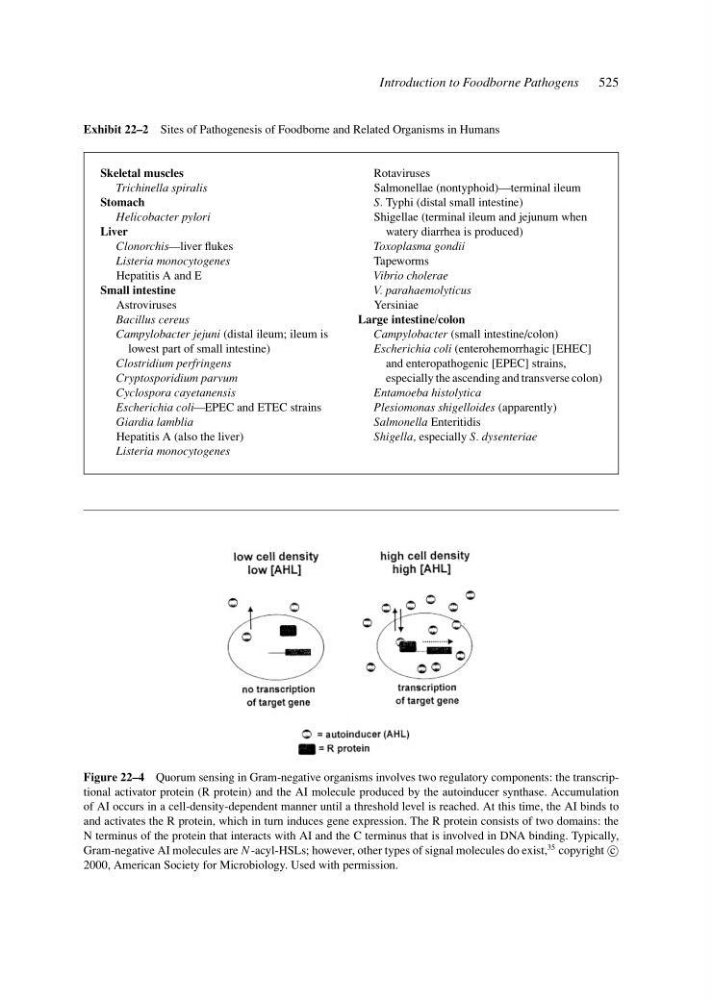
Figure 22–4 Quorum sensing in Gram-negative organisms involves two regulatory components: the transcriptional activator protein (R protein) and the AI molecule produced by the autoinducer synthase. Accumulation
of AI occurs in a cell-density-dependent manner until a threshold level is reached. At this time, the AI binds to
and activates the R protein, which in turn induces gene expression. The R protein consists of two domains: the
N terminus of the protein that interacts with AI and the C terminus that is involved in DNA binding. Typically,
Gram-negative AI molecules are N -acyl-HSLs; however, other types of signal molecules do exist,
35 copyright c
2000, American Society for Microbiology. Used with permission.
525
Exhibit 22–2 Sites of Pathogenesis of Foodborne and Related Organisms in Humans
Skeletal muscles
Trichinella spiralis
Stomach
Helicobacter pylori
Liver
Clonorchis—liver flukes
Listeria monocytogenes
Hepatitis A and E
Small intestine
Astroviruses
Bacillus cereus
Campylobacter jejuni (distal ileum; ileum is
lowest part of small intestine)
Clostridium perfringens
Cryptosporidium parvum
Cyclospora cayetanensis
Escherichia coli—EPEC and ETEC strains
Giardia lamblia
Hepatitis A (also the liver)
Listeria monocytogenes
Rotaviruses
Salmonellae (nontyphoid)—terminal ileum
S. Typhi (distal small intestine)
Shigellae (terminal ileum and jejunum when
watery diarrhea is produced)
Toxoplasma gondii
Tapeworms
Vibrio cholerae
V. parahaemolyticus
Yersiniae
Large intestine/colon
Campylobacter (small intestine/colon)
Escherichia coli (enterohemorrhagic [EHEC]
and enteropathogenic [EPEC] strains,
especially the ascending and transverse colon)
Entamoeba histolytica
Plesiomonas shigelloides (apparently)
Salmonella Enteritidis
Shigella, especially S. dysenteriae
Figure 22–4 Quorum sensing in Gram-negative organisms involves two regulatory components: the transcriptional activator protein (R protein) and the AI molecule produced by the autoinducer synthase. Accumulation
of AI occurs in a cell-density-dependent manner until a threshold level is reached. At this time, the AI binds to
and activates the R protein, which in turn induces gene expression. The R protein consists of two domains: the
N terminus of the protein that interacts with AI and the C terminus that is involved in DNA binding. Typically,
Gram-negative AI molecules are N -acyl-HSLs; however, other types of signal molecules do exist,
35 copyright c
2000, American Society for Microbiology. Used with permission.