

478 Modern Food Microbiology
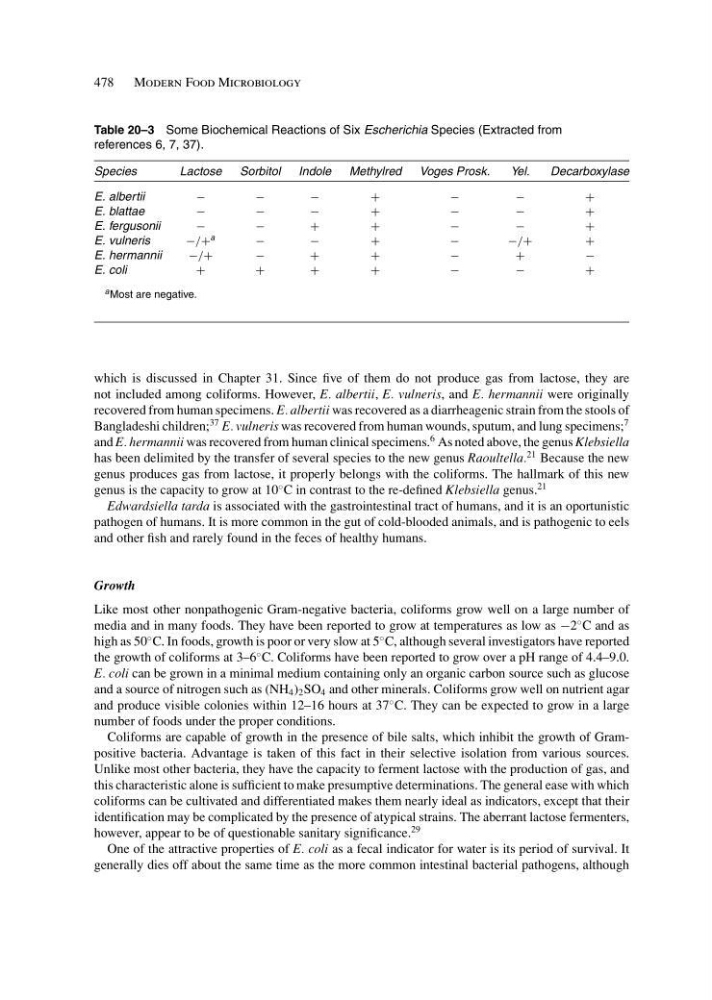
Table 20–3 Some Biochemical Reactions of Six Escherichia Species (Extracted from
references 6, 7, 37).
Species
Lactose
Sorbitol
Indole
Methylred
Voges Prosk.
Yel.
Decarboxylase
E. albertii
−
−
−
+
−
−
+
E. blattae
−
−
−
+
−
−
+
E. fergusonii
−
−
+
+
−
−
+
E. vulneris
−/+
a
−
−
+
−
− /+
+
E. hermannii
−/+
−
+
+
−
+
−
E. coli
+
+
+
+
−
−
+
a Most are negative.
which is discussed in Chapter 31. Since five of them do not produce gas from lactose, they are
not included among coliforms. However, E. albertii, E. vulneris, and E. hermannii were originally
recovered from human specimens. E. albertii was recovered as a diarrheagenic strain from the stools of
Bangladeshi children;
37 E. vulneris was recovered from human wounds, sputum, and lung specimens;
7
and E. hermannii was recovered from human clinical specimens.
6 As noted above, the genus Klebsiella
has been delimited by the transfer of several species to the new genus Raoultella.
21 Because the new
genus produces gas from lactose, it properly belongs with the coliforms. The hallmark of this new
genus is the capacity to grow at 10
◦ C in contrast to the re-defined Klebsiella genus.
21
Edwardsiella tarda is associated with the gastrointestinal tract of humans, and it is an oportunistic
pathogen of humans. It is more common in the gut of cold-blooded animals, and is pathogenic to eels
and other fish and rarely found in the feces of healthy humans.
Growth
Like most other nonpathogenic Gram-negative bacteria, coliforms grow well on a large number of
media and in many foods. They have been reported to grow at temperatures as low as −2
◦ C and as
high as 50
◦ C. In foods, growth is poor or very slow at 5
◦ C, although several investigators have reported
the growth of coliforms at 3–6
◦ C. Coliforms have been reported to grow over a pH range of 4.4–9.0.
E. coli can be grown in a minimal medium containing only an organic carbon source such as glucose
and a source of nitrogen such as (NH 4 ) 2 SO 4 and other minerals. Coliforms grow well on nutrient agar
and produce visible colonies within 12–16 hours at 37
◦ C. They can be expected to grow in a large
number of foods under the proper conditions.
Coliforms are capable of growth in the presence of bile salts, which inhibit the growth of Grampositive bacteria. Advantage is taken of this fact in their selective isolation from various sources.
Unlike most other bacteria, they have the capacity to ferment lactose with the production of gas, and
this characteristic alone is sufficient to make presumptive determinations. The general ease with which
coliforms can be cultivated and differentiated makes them nearly ideal as indicators, except that their
identification may be complicated by the presence of atypical strains. The aberrant lactose fermenters,
however, appear to be of questionable sanitary significance.
29
One of the attractive properties of E. coli as a fecal indicator for water is its period of survival. It
generally dies off about the same time as the more common intestinal bacterial pathogens, although
Table 20–3 Some Biochemical Reactions of Six Escherichia Species (Extracted from
references 6, 7, 37).
Species
Lactose
Sorbitol
Indole
Methylred
Voges Prosk.
Yel.
Decarboxylase
E. albertii
−
−
−
+
−
−
+
E. blattae
−
−
−
+
−
−
+
E. fergusonii
−
−
+
+
−
−
+
E. vulneris
−/+
a
−
−
+
−
− /+
+
E. hermannii
−/+
−
+
+
−
+
−
E. coli
+
+
+
+
−
−
+
a Most are negative.
which is discussed in Chapter 31. Since five of them do not produce gas from lactose, they are
not included among coliforms. However, E. albertii, E. vulneris, and E. hermannii were originally
recovered from human specimens. E. albertii was recovered as a diarrheagenic strain from the stools of
Bangladeshi children;
37 E. vulneris was recovered from human wounds, sputum, and lung specimens;
7
and E. hermannii was recovered from human clinical specimens.
6 As noted above, the genus Klebsiella
has been delimited by the transfer of several species to the new genus Raoultella.
21 Because the new
genus produces gas from lactose, it properly belongs with the coliforms. The hallmark of this new
genus is the capacity to grow at 10
◦ C in contrast to the re-defined Klebsiella genus.
21
Edwardsiella tarda is associated with the gastrointestinal tract of humans, and it is an oportunistic
pathogen of humans. It is more common in the gut of cold-blooded animals, and is pathogenic to eels
and other fish and rarely found in the feces of healthy humans.
Growth
Like most other nonpathogenic Gram-negative bacteria, coliforms grow well on a large number of
media and in many foods. They have been reported to grow at temperatures as low as −2
◦ C and as
high as 50
◦ C. In foods, growth is poor or very slow at 5
◦ C, although several investigators have reported
the growth of coliforms at 3–6
◦ C. Coliforms have been reported to grow over a pH range of 4.4–9.0.
E. coli can be grown in a minimal medium containing only an organic carbon source such as glucose
and a source of nitrogen such as (NH 4 ) 2 SO 4 and other minerals. Coliforms grow well on nutrient agar
and produce visible colonies within 12–16 hours at 37
◦ C. They can be expected to grow in a large
number of foods under the proper conditions.
Coliforms are capable of growth in the presence of bile salts, which inhibit the growth of Grampositive bacteria. Advantage is taken of this fact in their selective isolation from various sources.
Unlike most other bacteria, they have the capacity to ferment lactose with the production of gas, and
this characteristic alone is sufficient to make presumptive determinations. The general ease with which
coliforms can be cultivated and differentiated makes them nearly ideal as indicators, except that their
identification may be complicated by the presence of atypical strains. The aberrant lactose fermenters,
however, appear to be of questionable sanitary significance.
29
One of the attractive properties of E. coli as a fecal indicator for water is its period of survival. It
generally dies off about the same time as the more common intestinal bacterial pathogens, although