

Indicators of Food Microbial Quality and Safety 477
V = Voges–Proskauer reaction (production of acetoin), and C = citrate utilization. By this method,
the two organisms noted have the following formulas:
I
M
V
C
E. coli
+
+
−
−
E. aerogenes
−
−
+
+
The IMViC reaction + + −− designates E. coli type I; E. coli type II strains are − + −−. The
MR reaction is the most consistent for E. coli. Citrobacter spp. have been referred to as intermediate
coliforms, and delayed lactose fermentation by some strains is known. All are MR+ and VP−. Most
are citrate +, whereas indole production varies. Klebsiella isolates are highly variable with respect
to IMViC reactions, although K. pneumoniae is generally MR−, VP+, and C+, but variations are
known to occur in the MR and I reactions. Fluorogenic substrate methods for differentiating between
E. coli and other coliforms are discussed in Chapter 11.
Fecal coliforms are defined by the production of acid and gas in EC broth between 44
◦ C and 46
◦ C,
usually 44.5
◦ C or 45.5
◦ C. (EC broth, for E. coli, was developed in 1942 by Perry and Hajna.)
68 A test
for fecal coliforms is essentially a test for E. coli type 1, although some Citrobacter and Klebsiella
strains fit the definition. Notable exceptions are the EHEC strains that do not grow at 44.5
◦ C in
the standard EC medium formulation but will grow when the bile salts content in the medium is
reduced from 0.15% to 0.112%.
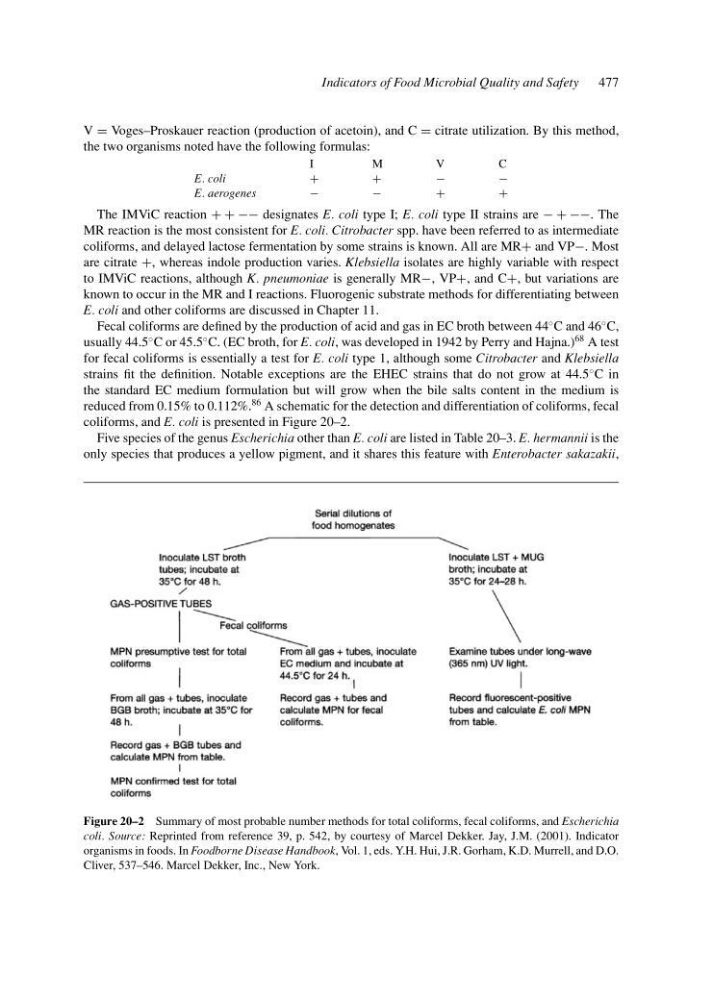
86 A schematic for the detection and differentiation of coliforms, fecal
coliforms, and E. coli is presented in Figure 20–2.
Five species of the genus Escherichia other than E. coli are listed in Table 20–3. E. hermannii is the
only species that produces a yellow pigment, and it shares this feature with Enterobacter sakazakii,
Figure 20–2 Summary of most probable number methods for total coliforms, fecal coliforms, and Escherichia
coli. Source: Reprinted from reference 39, p. 542, by courtesy of Marcel Dekker. Jay, J.M. (2001). Indicator
organisms in foods. In Foodborne Disease Handbook, Vol. 1, eds. Y.H. Hui, J.R. Gorham, K.D. Murrell, and D.O.
Cliver, 537–546. Marcel Dekker, Inc., New York.
V = Voges–Proskauer reaction (production of acetoin), and C = citrate utilization. By this method,
the two organisms noted have the following formulas:
I
M
V
C
E. coli
+
+
−
−
E. aerogenes
−
−
+
+
The IMViC reaction + + −− designates E. coli type I; E. coli type II strains are − + −−. The
MR reaction is the most consistent for E. coli. Citrobacter spp. have been referred to as intermediate
coliforms, and delayed lactose fermentation by some strains is known. All are MR+ and VP−. Most
are citrate +, whereas indole production varies. Klebsiella isolates are highly variable with respect
to IMViC reactions, although K. pneumoniae is generally MR−, VP+, and C+, but variations are
known to occur in the MR and I reactions. Fluorogenic substrate methods for differentiating between
E. coli and other coliforms are discussed in Chapter 11.
Fecal coliforms are defined by the production of acid and gas in EC broth between 44
◦ C and 46
◦ C,
usually 44.5
◦ C or 45.5
◦ C. (EC broth, for E. coli, was developed in 1942 by Perry and Hajna.)
68 A test
for fecal coliforms is essentially a test for E. coli type 1, although some Citrobacter and Klebsiella
strains fit the definition. Notable exceptions are the EHEC strains that do not grow at 44.5
◦ C in
the standard EC medium formulation but will grow when the bile salts content in the medium is
reduced from 0.15% to 0.112%.
86 A schematic for the detection and differentiation of coliforms, fecal
coliforms, and E. coli is presented in Figure 20–2.
Five species of the genus Escherichia other than E. coli are listed in Table 20–3. E. hermannii is the
only species that produces a yellow pigment, and it shares this feature with Enterobacter sakazakii,
Figure 20–2 Summary of most probable number methods for total coliforms, fecal coliforms, and Escherichia
coli. Source: Reprinted from reference 39, p. 542, by courtesy of Marcel Dekker. Jay, J.M. (2001). Indicator
organisms in foods. In Foodborne Disease Handbook, Vol. 1, eds. Y.H. Hui, J.R. Gorham, K.D. Murrell, and D.O.
Cliver, 537–546. Marcel Dekker, Inc., New York.