

Other Food Protection Methods
459
7. Cell morphology is altered, and ribosomes are destroyed.
8. Changes occur in the lipid–protein complex of cell membranes, and increased membrane fluidity
is one consequence. The leakage of nucleic acids from cells exposed to 200–400 MPa has been
demonstrated.
9. Adenosinetriphosphatase (ATPase) is inactivated, leading to shortage of cellular ATP, but oxidative enzymes of fruits are baroresistant.
10. Although HHP is generally ineffective against the walls of bacteria, there is synergism between
HHP treatments and bacteriocins with both Gram-positive and Gram-negative bacteria, and with
heat, low pH, CO 2 , and lysozyme. Thus, HHP can be used as a hurdle in multiplex systems.
11. Since HHP inflicts cell injury, injured cells have been shown to resuscitate in the food product
and grow over time, and this phenomenon should be anticipated.
31
12. Bacterial endospores display high resistance, but when inactivated, it appears to be the result
of induced germination with subsequent destruction of the vegetative cells.
13. G. stearothermophilus spores may be reduced by use of a rapid decompression method that
involves the use of 200 MPa at 75
◦ C for 60 minutes.
15
14. From a study of the effect of HHP on spore germination, an 100 MPa induced spore germination
in B. subtilis by activating germinant receptors, and 550 MPa opened the channels for release
of dipicolinic acid leading to the later steps in spore germination.
36
Effects of HHP on Specific Foodborne Organisms
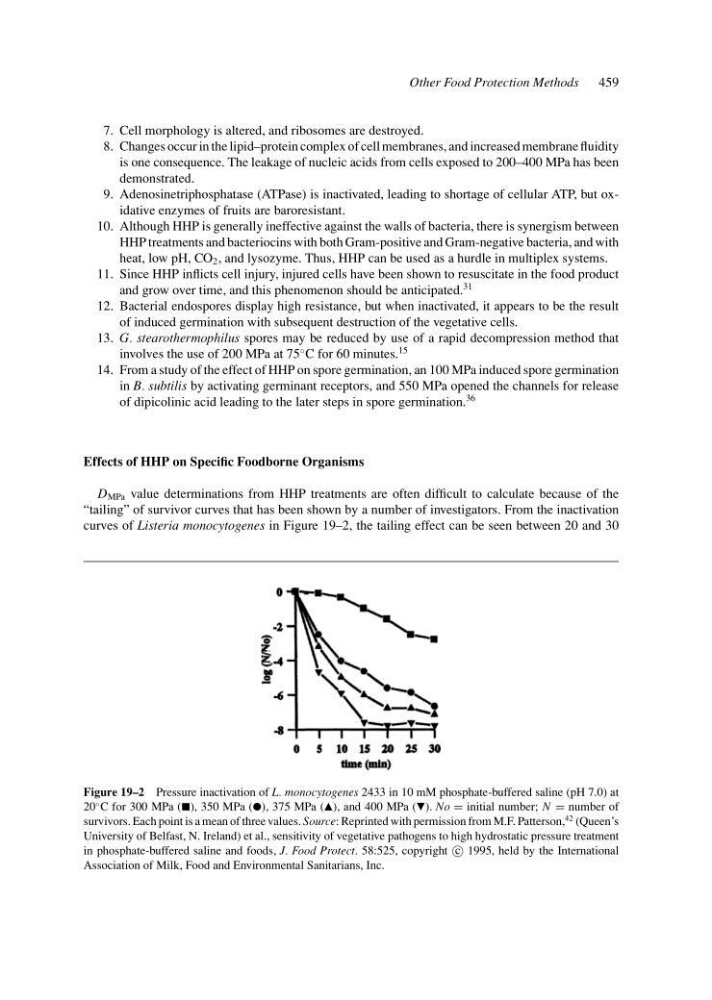
D MPa value determinations from HHP treatments are often difficult to calculate because of the
“tailing” of survivor curves that has been shown by a number of investigators. From the inactivation
curves of Listeria monocytogenes in Figure 19–2, the tailing effect can be seen between 20 and 30
Figure 19–2 Pressure inactivation of L. monocytogenes 2433 in 10 mM phosphate-buffered saline (pH 7.0) at
20
◦ C for 300 MPa (), 350 MPa (᭹), 375 MPa (᭡), and 400 MPa (᭢). No = initial number; N = number of
survivors. Each point is a mean of three values. Source: Reprinted with permission from M.F. Patterson,
42 (Queen’s
University of Belfast, N. Ireland) et al., sensitivity of vegetative pathogens to high hydrostatic pressure treatment
in phosphate-buffered saline and foods, J. Food Protect. 58:525, copyright c
1995, held by the International
Association of Milk, Food and Environmental Sanitarians, Inc.
459
7. Cell morphology is altered, and ribosomes are destroyed.
8. Changes occur in the lipid–protein complex of cell membranes, and increased membrane fluidity
is one consequence. The leakage of nucleic acids from cells exposed to 200–400 MPa has been
demonstrated.
9. Adenosinetriphosphatase (ATPase) is inactivated, leading to shortage of cellular ATP, but oxidative enzymes of fruits are baroresistant.
10. Although HHP is generally ineffective against the walls of bacteria, there is synergism between
HHP treatments and bacteriocins with both Gram-positive and Gram-negative bacteria, and with
heat, low pH, CO 2 , and lysozyme. Thus, HHP can be used as a hurdle in multiplex systems.
11. Since HHP inflicts cell injury, injured cells have been shown to resuscitate in the food product
and grow over time, and this phenomenon should be anticipated.
31
12. Bacterial endospores display high resistance, but when inactivated, it appears to be the result
of induced germination with subsequent destruction of the vegetative cells.
13. G. stearothermophilus spores may be reduced by use of a rapid decompression method that
involves the use of 200 MPa at 75
◦ C for 60 minutes.
15
14. From a study of the effect of HHP on spore germination, an 100 MPa induced spore germination
in B. subtilis by activating germinant receptors, and 550 MPa opened the channels for release
of dipicolinic acid leading to the later steps in spore germination.
36
Effects of HHP on Specific Foodborne Organisms
D MPa value determinations from HHP treatments are often difficult to calculate because of the
“tailing” of survivor curves that has been shown by a number of investigators. From the inactivation
curves of Listeria monocytogenes in Figure 19–2, the tailing effect can be seen between 20 and 30
Figure 19–2 Pressure inactivation of L. monocytogenes 2433 in 10 mM phosphate-buffered saline (pH 7.0) at
20
◦ C for 300 MPa (), 350 MPa (᭹), 375 MPa (᭡), and 400 MPa (᭢). No = initial number; N = number of
survivors. Each point is a mean of three values. Source: Reprinted with permission from M.F. Patterson,
42 (Queen’s
University of Belfast, N. Ireland) et al., sensitivity of vegetative pathogens to high hydrostatic pressure treatment
in phosphate-buffered saline and foods, J. Food Protect. 58:525, copyright c
1995, held by the International
Association of Milk, Food and Environmental Sanitarians, Inc.