

458 Modern Food Microbiology
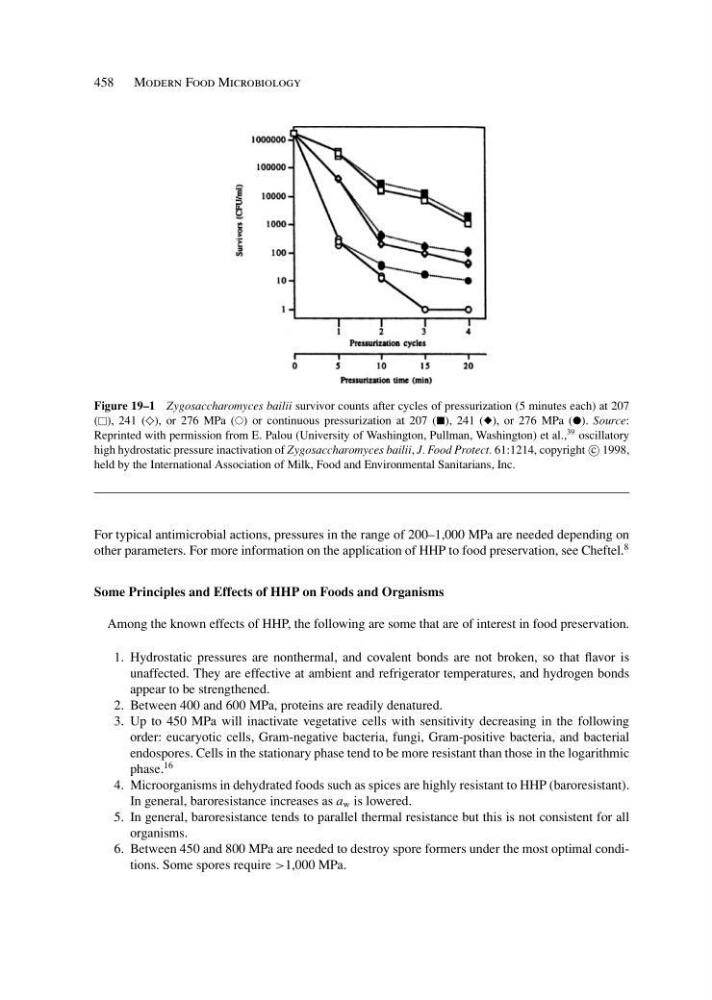
Figure 19–1 Zygosaccharomyces bailii survivor counts after cycles of pressurization (5 minutes each) at 207
(ٗ), 241 (♦), or 276 MPa (᭺) or continuous pressurization at 207 (), 241 (᭜), or 276 MPa (᭹). Source:
Reprinted with permission from E. Palou (University of Washington, Pullman, Washington) et al.,
39 oscillatory
high hydrostatic pressure inactivation of Zygosaccharomyces bailii, J. Food Protect. 61:1214, copyright c
1998,
held by the International Association of Milk, Food and Environmental Sanitarians, Inc.
For typical antimicrobial actions, pressures in the range of 200–1,000 MPa are needed depending on
other parameters. For more information on the application of HHP to food preservation, see Cheftel.
8
Some Principles and Effects of HHP on Foods and Organisms
Among the known effects of HHP, the following are some that are of interest in food preservation.
1. Hydrostatic pressures are nonthermal, and covalent bonds are not broken, so that flavor is
unaffected. They are effective at ambient and refrigerator temperatures, and hydrogen bonds
appear to be strengthened.
2. Between 400 and 600 MPa, proteins are readily denatured.
3. Up to 450 MPa will inactivate vegetative cells with sensitivity decreasing in the following
order: eucaryotic cells, Gram-negative bacteria, fungi, Gram-positive bacteria, and bacterial
endospores. Cells in the stationary phase tend to be more resistant than those in the logarithmic
phase.
16
4. Microorganisms in dehydrated foods such as spices are highly resistant to HHP (baroresistant).
In general, baroresistance increases as a w is lowered.
5. In general, baroresistance tends to parallel thermal resistance but this is not consistent for all
organisms.
6. Between 450 and 800 MPa are needed to destroy spore formers under the most optimal conditions. Some spores require >1,000 MPa.
Figure 19–1 Zygosaccharomyces bailii survivor counts after cycles of pressurization (5 minutes each) at 207
(ٗ), 241 (♦), or 276 MPa (᭺) or continuous pressurization at 207 (), 241 (᭜), or 276 MPa (᭹). Source:
Reprinted with permission from E. Palou (University of Washington, Pullman, Washington) et al.,
39 oscillatory
high hydrostatic pressure inactivation of Zygosaccharomyces bailii, J. Food Protect. 61:1214, copyright c
1998,
held by the International Association of Milk, Food and Environmental Sanitarians, Inc.
For typical antimicrobial actions, pressures in the range of 200–1,000 MPa are needed depending on
other parameters. For more information on the application of HHP to food preservation, see Cheftel.
8
Some Principles and Effects of HHP on Foods and Organisms
Among the known effects of HHP, the following are some that are of interest in food preservation.
1. Hydrostatic pressures are nonthermal, and covalent bonds are not broken, so that flavor is
unaffected. They are effective at ambient and refrigerator temperatures, and hydrogen bonds
appear to be strengthened.
2. Between 400 and 600 MPa, proteins are readily denatured.
3. Up to 450 MPa will inactivate vegetative cells with sensitivity decreasing in the following
order: eucaryotic cells, Gram-negative bacteria, fungi, Gram-positive bacteria, and bacterial
endospores. Cells in the stationary phase tend to be more resistant than those in the logarithmic
phase.
16
4. Microorganisms in dehydrated foods such as spices are highly resistant to HHP (baroresistant).
In general, baroresistance increases as a w is lowered.
5. In general, baroresistance tends to parallel thermal resistance but this is not consistent for all
organisms.
6. Between 450 and 800 MPa are needed to destroy spore formers under the most optimal conditions. Some spores require >1,000 MPa.