

452 Modern Food Microbiology
meat and berries. Hennican is the name given to the chicken-based IMF. Both moisture content and
a w of this system can be altered by adjustment of ingredient mix.
The humectants commonly used in pet food formulations are propylene glycol, polyhydric alcohols (sorbitol, for example), polyethylene glycols, glycerol, sugars (sucrose, fructose, glucose, and
corn syrup), and salts (NaCl, KCl, and so on). The commonly used mycostats are propylene glycol,
potassium sorbate, sodium benzoate, and others. The pH of these products may be as low as 5.4 and
as high as 7.0.
Microbial Aspects of IMF
The general a w range of IMF products make it unlikely that Gram-negative bacteria will proliferate.
This is true also for most Gram-positive bacteria with the exception of cocci, some spore formers, and
lactobacilli. In addition to the inhibitory effect of lowered a w , antimicrobial activity results from an
interaction of pH, oxidation–reduction (Eh), added preservatives (including some of the humectants),
the competitive microflora, generally low storage temperatures, and the pasteurization or other heat
processes applied during processing.
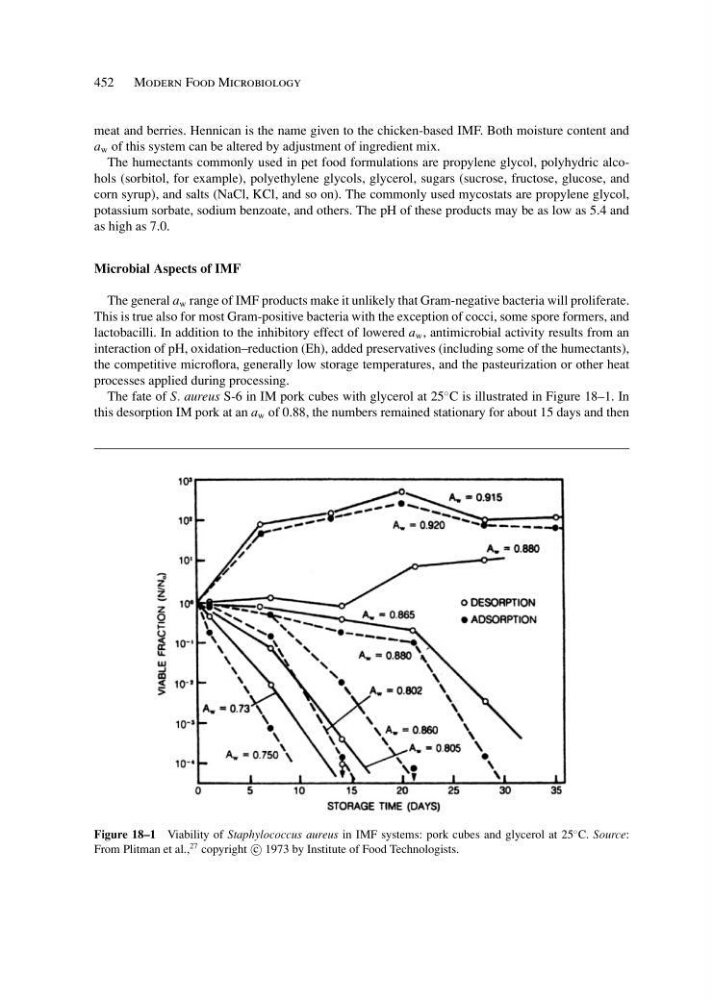
The fate of S. aureus S-6 in IM pork cubes with glycerol at 25
◦ C is illustrated in Figure 18–1. In
this desorption IM pork at an a w of 0.88, the numbers remained stationary for about 15 days and then
Figure 18–1 Viability of Staphylococcus aureus in IMF systems: pork cubes and glycerol at 25
◦ C. Source:
From Plitman et al.,
27 copyright c
1973 by Institute of Food Technologists.
meat and berries. Hennican is the name given to the chicken-based IMF. Both moisture content and
a w of this system can be altered by adjustment of ingredient mix.
The humectants commonly used in pet food formulations are propylene glycol, polyhydric alcohols (sorbitol, for example), polyethylene glycols, glycerol, sugars (sucrose, fructose, glucose, and
corn syrup), and salts (NaCl, KCl, and so on). The commonly used mycostats are propylene glycol,
potassium sorbate, sodium benzoate, and others. The pH of these products may be as low as 5.4 and
as high as 7.0.
Microbial Aspects of IMF
The general a w range of IMF products make it unlikely that Gram-negative bacteria will proliferate.
This is true also for most Gram-positive bacteria with the exception of cocci, some spore formers, and
lactobacilli. In addition to the inhibitory effect of lowered a w , antimicrobial activity results from an
interaction of pH, oxidation–reduction (Eh), added preservatives (including some of the humectants),
the competitive microflora, generally low storage temperatures, and the pasteurization or other heat
processes applied during processing.
The fate of S. aureus S-6 in IM pork cubes with glycerol at 25
◦ C is illustrated in Figure 18–1. In
this desorption IM pork at an a w of 0.88, the numbers remained stationary for about 15 days and then
Figure 18–1 Viability of Staphylococcus aureus in IMF systems: pork cubes and glycerol at 25
◦ C. Source:
From Plitman et al.,
27 copyright c
1973 by Institute of Food Technologists.