

Protection of Foods by Drying
451
Table 18–5 Typical Composition of Soft Moist
or Intermediate-Moisture Dog Food
Ingredient
%
Meat byproducts
32.0
Soy flakes
33.0
Sugar
22.0
Skimmed milk, dry
2.5
Calcium and phosphorus
3.3
Propylene glycol
2.0
Sorbitol
2.0
Animal fat
1.0
Emulsifier
1.0
Salt
0.6
Potassium sorbate
0.3
Minerals, vitamins, and color
0.3
Source: From Kaplow, 19 copyright c
1970 by Institute
of Food Technologists.
catfish, with raw samples of about 2 grams each, has been prepared by the moist infusion method.
9 Pet
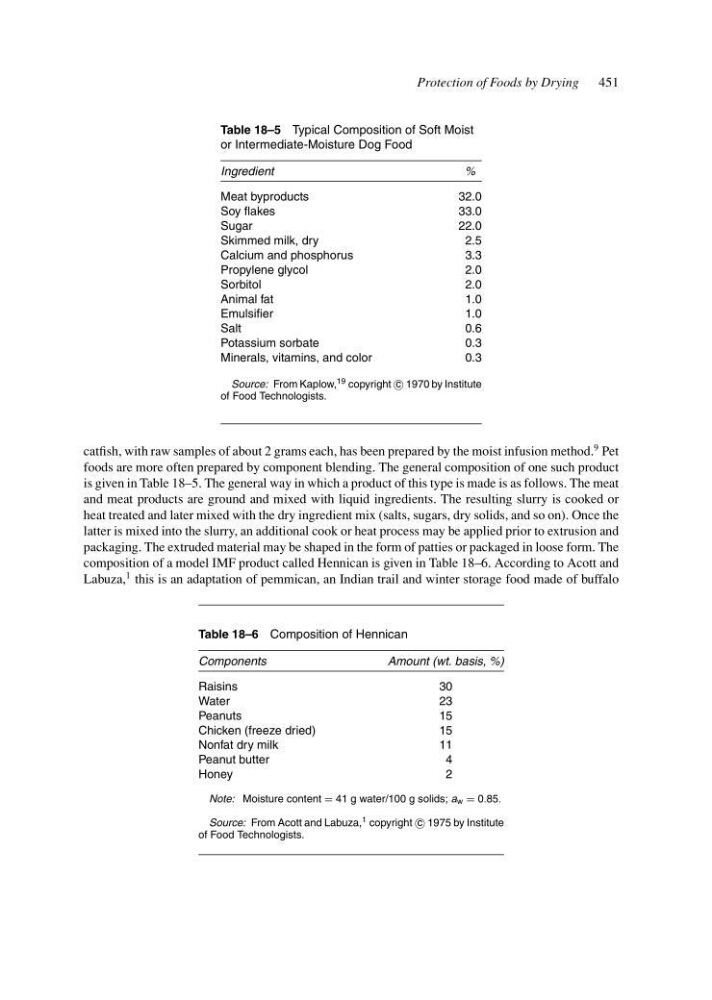
foods are more often prepared by component blending. The general composition of one such product
is given in Table 18–5. The general way in which a product of this type is made is as follows. The meat
and meat products are ground and mixed with liquid ingredients. The resulting slurry is cooked or
heat treated and later mixed with the dry ingredient mix (salts, sugars, dry solids, and so on). Once the
latter is mixed into the slurry, an additional cook or heat process may be applied prior to extrusion and
packaging. The extruded material may be shaped in the form of patties or packaged in loose form. The
composition of a model IMF product called Hennican is given in Table 18–6. According to Acott and
Labuza,
1 this is an adaptation of pemmican, an Indian trail and winter storage food made of buffalo
Table 18–6 Composition of Hennican
Components
Amount (wt. basis, %)
Raisins
30
Water
23
Peanuts
15
Chicken (freeze dried)
15
Nonfat dry milk
11
Peanut butter
4
Honey
2
Note: Moisture content = 41 g water/100 g solids; a w = 0.85.
Source: From Acott and Labuza, 1 copyright c
1975 by Institute
of Food Technologists.
451
Table 18–5 Typical Composition of Soft Moist
or Intermediate-Moisture Dog Food
Ingredient
%
Meat byproducts
32.0
Soy flakes
33.0
Sugar
22.0
Skimmed milk, dry
2.5
Calcium and phosphorus
3.3
Propylene glycol
2.0
Sorbitol
2.0
Animal fat
1.0
Emulsifier
1.0
Salt
0.6
Potassium sorbate
0.3
Minerals, vitamins, and color
0.3
Source: From Kaplow, 19 copyright c
1970 by Institute
of Food Technologists.
catfish, with raw samples of about 2 grams each, has been prepared by the moist infusion method.
9 Pet
foods are more often prepared by component blending. The general composition of one such product
is given in Table 18–5. The general way in which a product of this type is made is as follows. The meat
and meat products are ground and mixed with liquid ingredients. The resulting slurry is cooked or
heat treated and later mixed with the dry ingredient mix (salts, sugars, dry solids, and so on). Once the
latter is mixed into the slurry, an additional cook or heat process may be applied prior to extrusion and
packaging. The extruded material may be shaped in the form of patties or packaged in loose form. The
composition of a model IMF product called Hennican is given in Table 18–6. According to Acott and
Labuza,
1 this is an adaptation of pemmican, an Indian trail and winter storage food made of buffalo
Table 18–6 Composition of Hennican
Components
Amount (wt. basis, %)
Raisins
30
Water
23
Peanuts
15
Chicken (freeze dried)
15
Nonfat dry milk
11
Peanut butter
4
Honey
2
Note: Moisture content = 41 g water/100 g solids; a w = 0.85.
Source: From Acott and Labuza, 1 copyright c
1975 by Institute
of Food Technologists.